
Do AirPods Lose Volume Over Time? Apple’s Answer and Ours
Do AirPods lose volume over time? Apple documents a setting that turns your volume down on purpose, and it states that you can turn the volume back up.
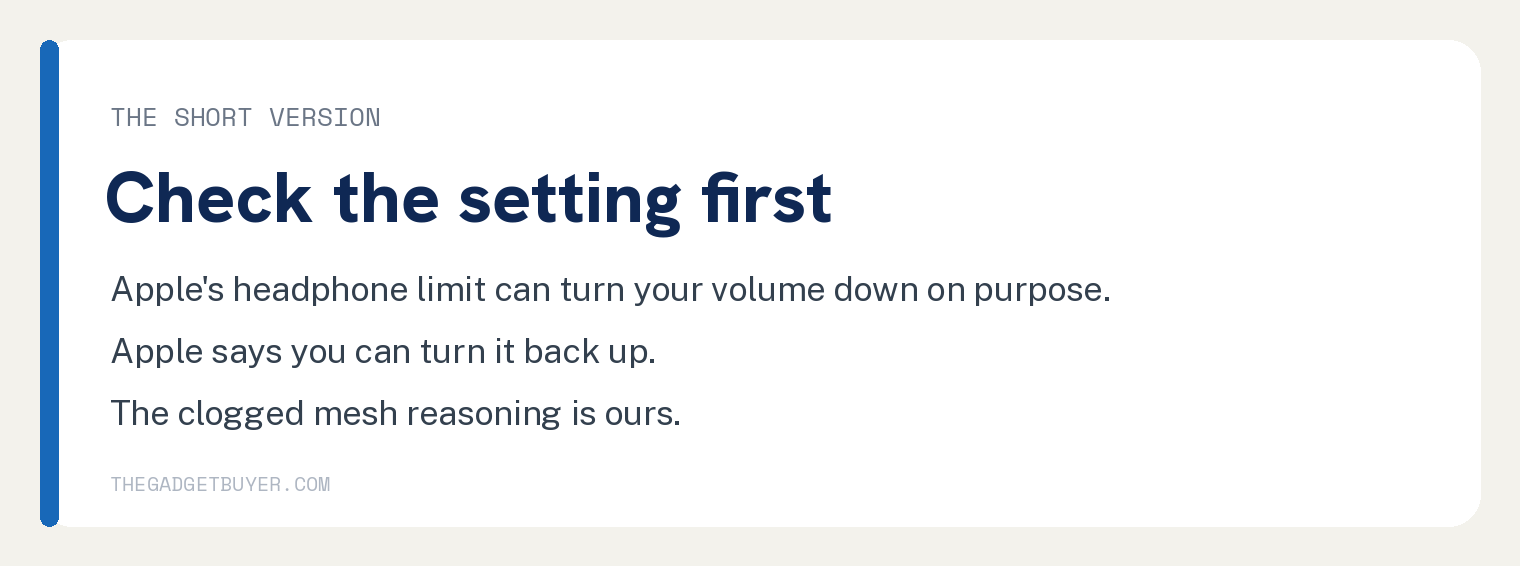
Apple publishes no wear figure for the drivers themselves on any of the five Apple pages we searched, all five named further down. The second thing to check is a clogged mesh, and the reasoning that links a clogged mesh to quieter sound is ours rather than Apple’s.
The setting Apple documents, and it is the first thing to rule out
Your iPhone keeps a running total of how loud your headphones have been, and past a threshold it lowers them for you.
Apple states the alert condition as a share of the limit, writing that your “iPhone, iPad, or Apple Watch can now alert you when you’ve exceeded 100% of the 7-day exposure limit while wearing headphones.”
Apple prints a decibel figure as an illustration of that much exposure, and the words for example are Apple’s own: “for example, over 80 decibels (dB) for 40 hours total within the last 7 days”.
Apple then states exactly what happens and that you can undo it: “After receiving a notification, the next time you plug in your headphones or connect them via Bluetooth, your volume will be automatically set to a lower level. You can still turn your volume back up if you choose.”
So the drop is real, the drop is deliberate, and the volume slider still works.
Apple does not say the lower level persists after you raise it, and neither do we.
One scope line matters here, and Apple prints it: “The 7-day exposure limit applies only to media audio. Phone calls do not count towards your headphone audio exposure.”
Change the limit yourself, in Apple’s own steps
Apple’s path on an iPhone runs in three steps, and the middle one is where Apple tells you to scroll down.
- Apple writes: “Go to the Settings app on your iPhone.”
- Apple writes: “Tap Sounds & Haptics, scroll down, then tap Headphone Safety.”
- Apple writes: “Turn on Reduce Loud Audio, then drag the slider.”
What that slider does, in Apple’s words: “iPhone analyzes your headphone audio and reduces any sound above the level you set.”
That is the second of two controls Apple documents on these pages that lower your headphone volume for you. Apple names it alongside the notification: “You can also turn on Reduce Loud Audio to automatically lower your headphone volume when it exceeds your set decibel level.”
Apple attaches a qualifier to turning notifications off, and it prints it on this page: “Depending on your country or region, Headphone Notifications may be turned on by default, and in some countries or regions, you may not be able to turn it off.”
On the accuracy of the measurement itself: “Headphone audio measurements are most accurate when using Apple or Beats headphones.”
There is a lock, and Apple attaches a condition to it: “If you set up Screen Time for family members, you can prevent them from changing the Reduce Loud Sounds level.”
Apple’s path for that is “Go to Settings > Screen Time > Content & Privacy Restrictions > Reduce Loud Sounds, then select Don’t Allow.”
What Apple does not publish about the drivers
We searched Apple’s headphone notification page, both AirPods cleaning pages, its general product cleaning page and its AirPods service page for the word driver and found no occurrence on any of the five.
So on those five pages Apple carries no driver wear figure and no volume loss curve by age. That is a statement about those pages and not about what AirPods hardware does over five years, and we are not going to pretend otherwise.

The clogged mesh, and this reasoning is ours
Earwax and skin oil collect on the speaker mesh of an earbud that lives in an ear. Sound has to get through that mesh to reach you.
We searched both of Apple’s AirPods cleaning pages for the word volume and found no occurrence on either. Apple frames the procedure as maintenance, writing: “After workouts with AirPods 3, AirPods 4, or AirPods 5, or after your device is exposed to liquids such as sweat, soap, shampoo, makeup, sunscreen, and lotions that can potentially cause skin irritations, clean and dry your device.”
So the link between a clogged mesh and quieter sound is our reasoning. Apple publishes the cleaning procedure and never connects it to volume, and we are telling you which part of this page is Apple and which part is us.
These two Apple pages publish a mesh procedure for five models
Check your model before you start, because this is the step that sends the wrong reader down the wrong procedure.
Apple’s AirPods page opens its procedure this way: “To clean your AirPods 3, AirPods 4, and AirPods 5 meshes, you need a Belkin AirPods Cleaning Kit or:”. Its separate Pro page is headed “Clean your AirPods Pro 2 and AirPods Pro 3 meshes”.
Those five are the scope of these two pages. AirPods 1, AirPods 2, AirPods Pro 1 and AirPods Max have no mesh procedure on either page, and a two year old pair of AirPods 2 is exactly the pair that prompts this question.
What Apple says you need, if you are not buying the Belkin kit, is five things, and here is Apple’s list whole: “Micellar water that includes PEG-6 Caprylic/Capric Glycerides, such as from Bioderma or Neutrogena”, “Distilled water”, “A soft-bristled children’s toothbrush”, “Two small cups” and “A paper towel”. Read that first ingredient as one entry on a label, which Apple spells with a hyphen after PEG.
Apple restricts where the brush goes before it gives a single step, writing: “You can clean the encircled meshes on your AirPods 4 and your AirPods 5. Avoid cleaning any other areas.”
Apple’s list runs to eight steps and its own step 6 refers back to steps 2 to 5, so here it is whole, in Apple’s words.
- “Add a small amount of micellar water to a cup.”
- “Dip the toothbrush in the cup of micellar water until the bristles are fully saturated.”
- “Hold your AirPod with the mesh facing up.”
- “Brush the mesh in circles for about 15 seconds.”
- “Turn over your AirPod and blot it on a paper towel. Ensure the paper towel contacts the mesh.”
- “Repeat steps 2-5 two more times (three times total) for each mesh that you would like to clean.”
- “To rinse off the micellar water, rinse the brush with distilled water, then repeat steps 1-5 with distilled water for each mesh that you cleaned.”
- “Allow your AirPods to dry completely — for at least two hours — before you place them in the charging case or use them.”
On a Pro pair there is an extra first move, and Apple states it for both models: “Before you clean your AirPods Pro 2, remove the ear tips.” and “Before you clean your AirPods Pro 3, remove the ear tips.”
On the newer pair Apple adds one area: “You can clean the encircled meshes on your AirPods Pro 3, including the bottom mic.”
Apple also publishes an optional water rinse for the Pro 3 alone, it runs to five steps, and the last two are the ones that keep a wet earbud out of the charging case.
- “Place your thumb or index finger over the ear tip hole of each AirPod to seal it.”
- “Rinse each AirPod by immersing it in a bowl of water for 10 seconds while shaking the AirPod lightly to wash away debris.”
- “Hold the AirPod stem and dab the ear tip onto a dry, lint-free cloth for 10 seconds to remove excess water.”
- “Dry your AirPods Pro 3 with the lint-free cloth.”
- “Allow your AirPods Pro 3 to dry completely — for at least two hours — before you place them in the charging case or attempt to use them.”
What this page used to tell you to do, and why we were wrong
An older version of this article told readers to pick at the mesh with a toothpick, to wipe the AirPods themselves with a rubbing alcohol wipe, and to suck on the earbud to draw out wax. We are taking all three back.
Apple’s own prohibitions rule out the first: “Don’t run your AirPods under water, and don’t use sharp objects or abrasive materials to clean your AirPods.”
On the alcohol wipe, two Apple pages pull against each other and the retraction is only safe if you see both. Apple’s general product cleaning page permits it broadly: “Using a 70 percent isopropyl alcohol wipe, 75 percent ethyl alcohol wipe, or Clorox Disinfecting Wipes, you may gently wipe the hard, nonporous surfaces of your Apple product, such as the display, keyboard, or other exterior surfaces.”
That same answer attaches four limits, and the third one is the reason it never clears an earbud mesh: “Do not use these cleaning products on Apple Vision Pro as they may damage the device.” “Don’t use products containing bleach or hydrogen peroxide.” “Avoid getting moisture in any opening, and don’t submerge your Apple product in any cleaning agents.” “Don’t use on fabric or leather surfaces.”
Apple’s AirPods page is narrower, and the narrower page is the one to follow on AirPods. It allows alcohol on the case and not on the earbuds: “Clean the charging case with a soft, dry, lint-free cloth. If necessary, you can dampen the cloth slightly with isopropyl alcohol.”
The general page also prints a line that rules out the third thing we told you: “Don’t get moisture into any openings.” We searched both AirPods cleaning pages for the word moisture and found no occurrence on either, so that line comes from the page Apple applies to all its products rather than from the AirPods pages themselves.
Two more prohibitions belong with any cleaning you do. On the ports: “To avoid damaging the metal contacts, don’t put anything in the charging ports.” And on liquid: “Don’t get any liquid in the charging ports, and don’t use abrasive materials to clean the charging case.”

If one side is quieter than the other, check the balance slider
A single quiet side can read as general volume loss, and one iPhone setting produces it with no wax and no wear involved.
Apple’s path to it, on the page Apple calls adjust audio settings on iPhone, runs in three moves.
- Apple writes: “Go to the Settings app on your iPhone.”
- Apple writes: “Tap Accessibility, then tap Audio & Visual.”
- Apple writes: “Stereo Audio Balance: Drag the Balance slider left or right.”
If the slider is centred and one side is still quiet, our own writeup on one AirPod being louder than the other goes through the rest.
When it is the hardware after all
If the setting is clear, the mesh is clean and the balance is centred, the next step is Apple’s.
Apple’s AirPods service page offers a model selector and an estimate rather than a price, and says: “We’ll need to inspect your product to provide a personalized estimate.”
Apple’s own label for what that page shows is “Estimated service cost”, and Apple adds lower down: “We’ll inspect your device to determine the final service fee.” So we are not quoting you a repair figure.
Questions people ask
Will cleaning the mesh bring my volume back?
Our answer is that it can, and we are labelling that as ours. Apple publishes the cleaning procedure and never mentions volume on either cleaning page, so no Apple page endorses this.
Do AirPods 2 have a mesh cleaning procedure?
Not on either of these Apple pages. The published scope is AirPods 3, AirPods 4 and AirPods 5 on one page and AirPods Pro 2 and AirPods Pro 3 on the other.
Can I turn headphone notifications off completely?
That depends on where you are. Apple writes “Depending on your country or region, Headphone Notifications may be turned on by default, and in some countries or regions, you may not be able to turn it off.”
On its support page Apple gives the reason: “Due to regulations and safety standards, headphone notifications can’t be turned off in certain countries or regions.”
Does talking on the phone count towards the limit?
No. Apple writes: “The 7-day exposure limit applies only to media audio. Phone calls do not count towards your headphone audio exposure.”
Related reading on this site
- How long AirPods last, for the battery side of ageing.
- An AirPods microphone that sounds muffled on calls, which is the same debris in a different opening.
- AirPods that keep pausing, if the sound cuts rather than drops.