
Transfer Contacts From iPhone to PC: vCard or Outlook
To transfer contacts from iPhone to PC, export them in the iPhone Contacts app and mail them to yourself, or download a vCard from iCloud.com on the PC. Apple’s iPhone guide says “You can export some or all of your contacts to another device or app.”
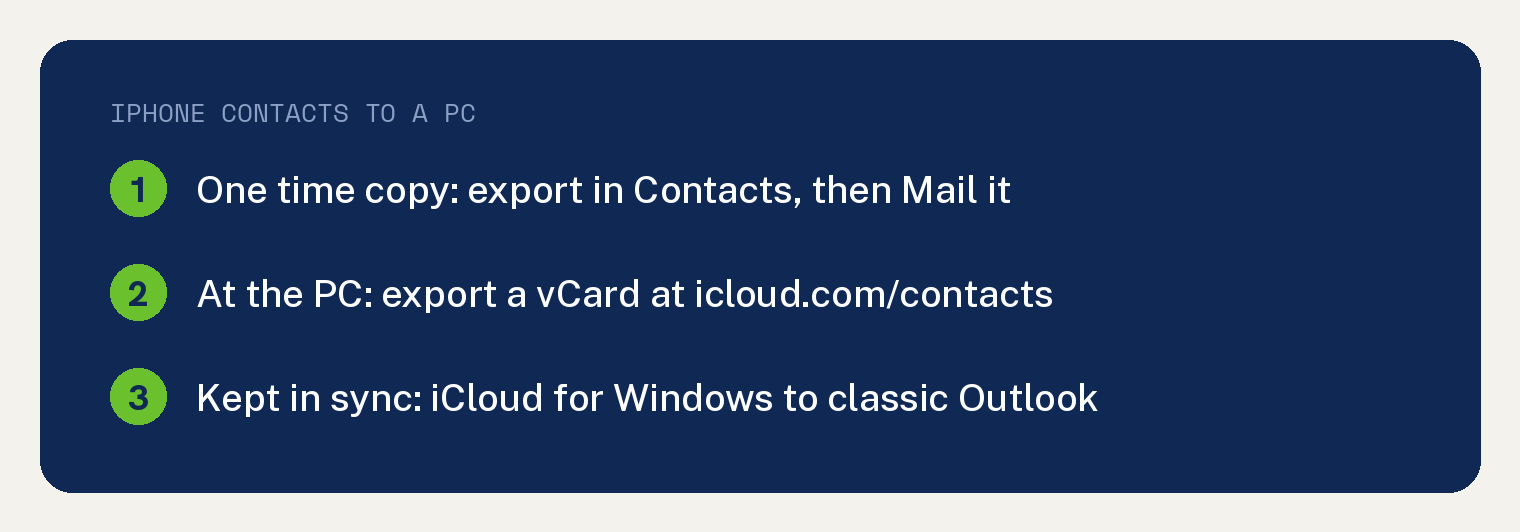
If you want the contacts to stay up to date on the PC, iCloud for Windows can sync them to the classic version of Outlook. Apple says “You can view your iCloud calendars and contacts in the classic version of Microsoft Outlook.”
Export contacts from the iPhone Contacts app
This route runs on the iPhone. Apple’s iPhone User Guide for iOS 27 lists these steps:
- Go to the Contacts app on your iPhone.
- Tap the Lists button (or the Show Sidebar button).
- Touch and hold an existing list (or create a new list by tapping Add List).
- Tap Export, select the fields you want to include, then tap Done.
- Choose a method to send or save the exported contact cards, such as Messages or Mail.
On iOS 18, Apple’s guide gives step 2 as “Tap Lists at the top left.”
Pick Mail and send the cards to an email address you can open on your PC. Apple’s last step reads “Choose a method to send or save the exported contact cards, such as Messages or Mail.”
Step 3 is where you choose who goes. Apple’s step reads “Touch and hold an existing list (or create a new list by tapping Add List).”
Download a vCard from iCloud.com on your PC
This route starts in a web browser on the PC, and it reads the contacts stored in iCloud. Apple’s iCloud guide says that after you turn on Contacts in iCloud on your iPhone, “All the contacts that you see in the Contacts app are now stored in iCloud.”
Turn on Contacts in iCloud on your iPhone
- On your iPhone, go to Settings, tap your name, then tap iCloud.
- Tap See All (or Show All), then turn on Contacts.
Use one account on both ends. Apple’s note says “Make sure you’re signed in to the same Apple Account on each device.”
The same note explains what happens otherwise: “If you’re not signed in to your Apple Account on a device, or the device has the Contacts feature turned off, you won’t be able to see your iCloud contacts on the device.”
If sign in keeps failing on the iPhone, our guide to an iPhone that keeps asking for the Apple ID password walks through the fixes.
Export the vCard at iCloud.com
A vCard is the contact file iCloud.com exports. Apple’s page says “You can import or export a virtual card, called a vCard.” It adds “vCards contain contact information for one or more contacts.”
Apple’s Export a vCard steps on iCloud.com:
- Go to icloud.com/contacts, then sign in to your Apple Account (if necessary).
- Pick the contacts. Select one contact, or hold Control on a Windows device and click each contact you want, or select the Select Menu button on a computer, then choose Select All Contacts.
- Select the Actions button, then choose Export vCard.
The Control click step works on a computer only. Apple’s wording is “On a computer only, press and hold Command (on a Mac computer) or Control (on a Windows device), then click each contact you want to export.”
Picking more than one contact still gives you one file. Apple says “If you select multiple contacts, Contacts exports a single vCard containing all of them.”

Keep contacts synced in classic Outlook with iCloud for Windows
This route puts your iCloud contacts inside the classic version of Microsoft Outlook on the PC. Apple says “You can view your iCloud calendars and contacts in the classic version of Microsoft Outlook.”
So turn on Contacts in iCloud on the iPhone first, as in the section above. Apple’s iCloud guide says that after you turn it on, “All the contacts that you see in the Contacts app are now stored in iCloud.”
Apple’s page names one more thing to have ready: “Before getting started, make sure you’ve set up an @icloud.com email address.” Apple adds “See Create a primary email address for iCloud Mail in the iCloud User Guide.”
If you do not have an Apple Account yet, our guide to making an iCloud account without a phone number covers the sign up.
Apple’s iCloud for Windows steps:
- On your Windows computer, open iCloud for Windows.
- To the right of Calendars and Contacts, click the Arrow button, then turn on “Automatically sync your iCloud calendars and contacts to Microsoft Outlook.”
- Click Done, then follow the onscreen instructions to set up Outlook.
Which route to pick
Our order: for a one time copy, export on the iPhone and mail it to yourself. If you are at the PC and Contacts is already on in iCloud, use iCloud.com.
For contacts that keep updating in classic Outlook, use iCloud for Windows. If two iPhones share one Apple Account and their contacts got mixed, our guide to unsyncing two iPhones covers separating them.