
Drop Your iPhone in the Toilet? Apple’s Steps, 5 Hour Wait
If you drop your iPhone in the toilet, Apple’s water resistance page says this under “What should I do if my iPhone gets wet?”: “To dry your iPhone, tap it gently against your hand with the Lightning or USB-C connector facing down to remove excess liquid. Leave your iPhone in a dry area with some airflow.” Apple’s charging rule follows: “Allow at least 5 hours before charging with a Lightning or USB-C cable or connecting an accessory.”
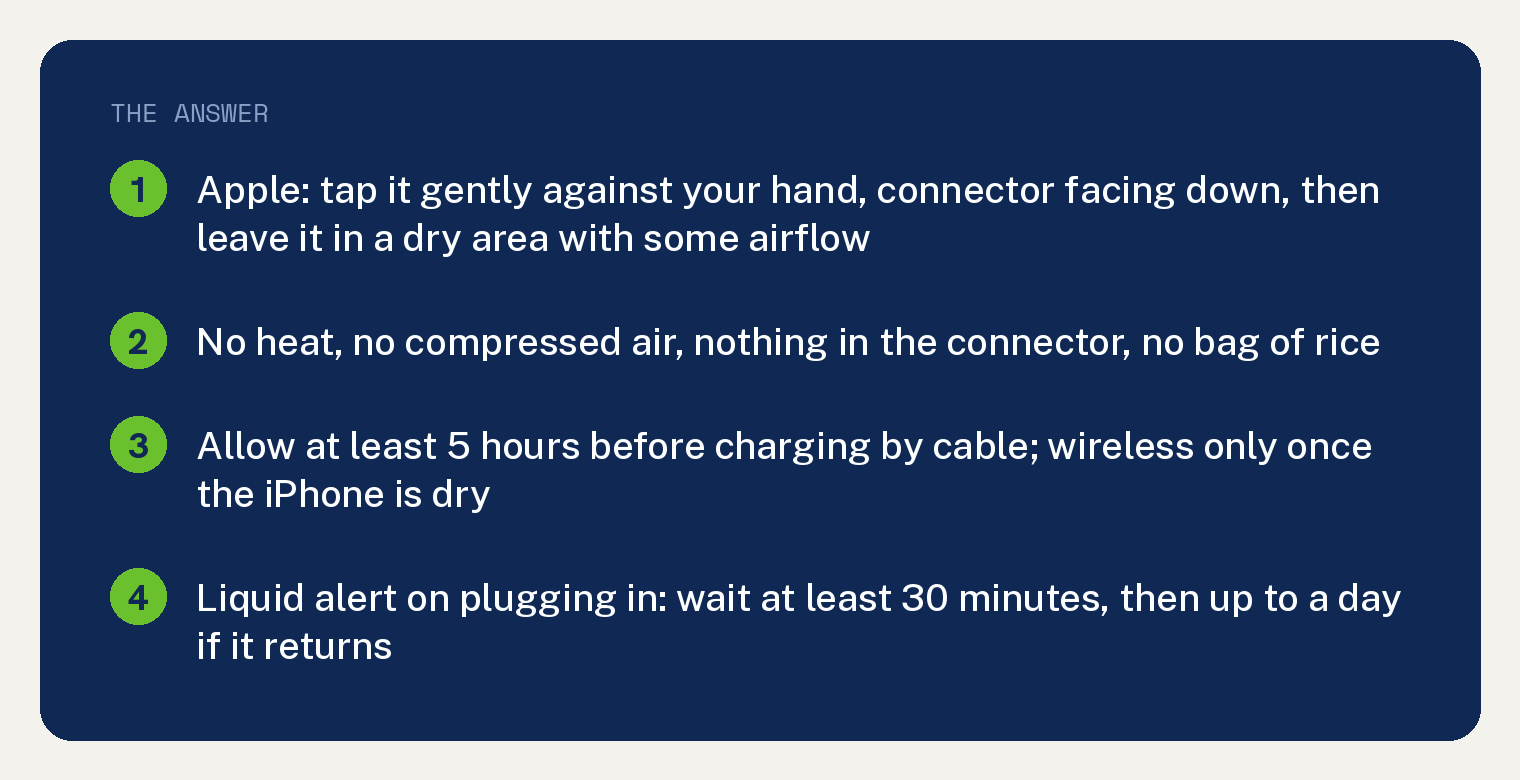
Every quotation below is Apple’s, from the two pages in the Sources section: Apple’s water resistance article and its liquid detection alert article. The order is ours, from the moment the phone comes out of the water.
Step 1: rinse if it was not water, then wipe
Under “What should I do if my iPhone gets wet?”, Apple’s first line reads: “If a liquid other than water splashes on your iPhone, rinse the affected area with tap water.”
Apple’s next line: “Wipe your iPhone off with a soft, lint-free cloth” and then: “Make sure that your iPhone is dry before opening the SIM tray.”
Step 2: tap it out and give it airflow
Apple’s drying step under the same heading: “To dry your iPhone, tap it gently against your hand with the Lightning or USB-C connector facing down to remove excess liquid. Leave your iPhone in a dry area with some airflow.”
Apple adds: “Placing your iPhone in front of a fan blowing cool air directly into the Lightning or USB-C connector might help the drying process.”
Step 3: do not do these four things
Apple’s water resistance page says: “Don’t dry your iPhone using an external heat source or insert a foreign object, such as a cotton swab or a paper towel, into the Lightning or USB-C connector.”
Apple’s liquid alert page prints a list headed “Here are a few things not to do:” with three items: “Don’t dry your iPhone using an external heat source or compressed air.” “Don’t insert a foreign object, such as a cotton swab or a paper towel, into the connector.” “Don’t put your iPhone in a bag of rice. Doing so could allow small particles of rice to damage your iPhone.”
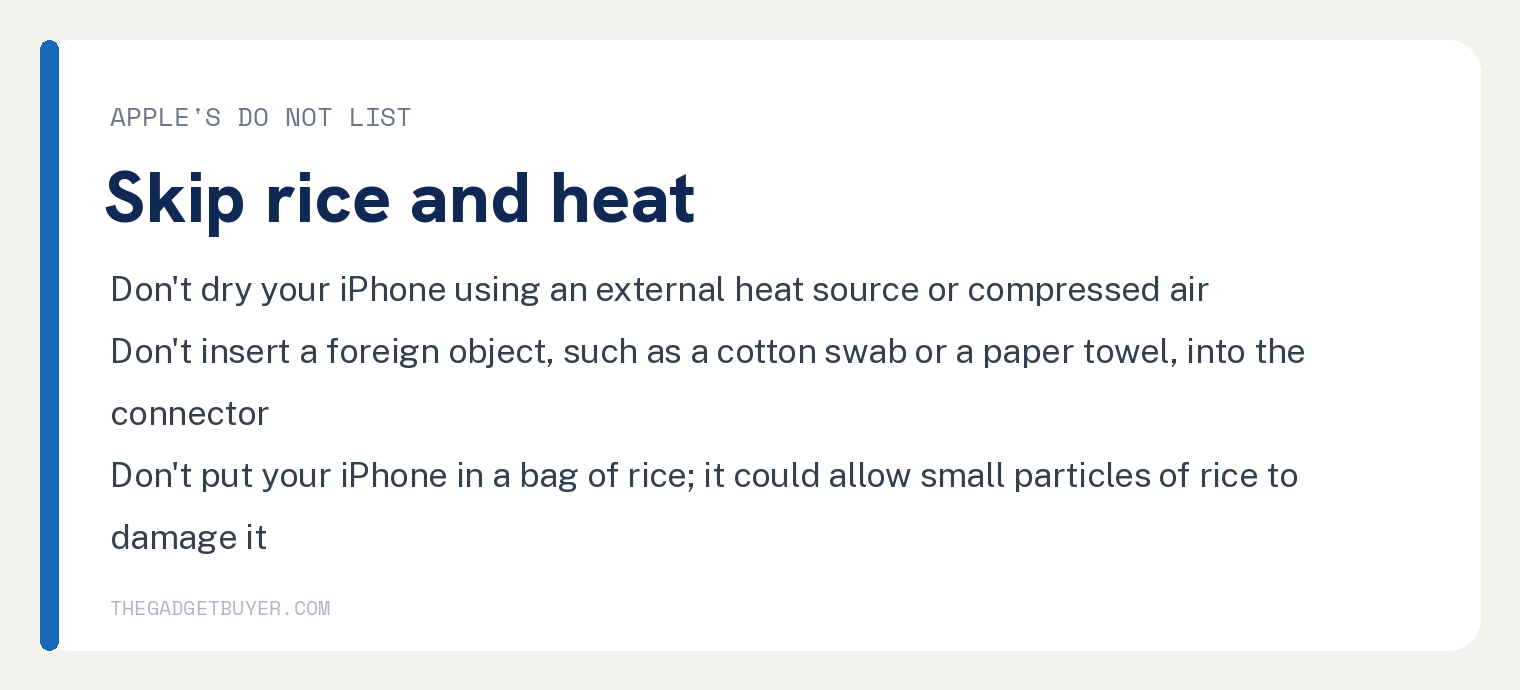
The 2022 version of this article told readers to use rice. Apple’s page says the opposite, in the sentence above, and this article follows Apple.
Step 4: wait before you charge
Under “If my iPhone gets wet, can I charge it?”, Apple says: “If your iPhone has been exposed to liquid, unplug all cables and do not charge your device until it’s completely dry. Using accessories or charging when wet might damage your iPhone. Allow at least 5 hours before charging with a Lightning or USB-C cable or connecting an accessory.”
On wireless charging, the same section says: “Make sure that your iPhone is dry before you place it on a compatible wireless charging mat.”
If you see a liquid alert when you plug in
Apple’s water resistance page says which models warn you: “Your iPhone can warn you if there’s liquid in the Lightning or USB-C connector when you connect a cable or an accessory to your iPhone XS, iPhone XS Max, iPhone XR, or later.”
Apple’s alert page explains what the alert means: “If you see one of these alerts, your iPhone has detected liquid in the Lightning or USB-C connector or on the cable or accessory. To protect your iPhone and the accessory, charging and accessory connection are unavailable until the connector, cable ends, and the accessory are dry.”
That page prints a longer timeline under “If your iPhone or accessory is wet”. Its steps: “Unplug the cable from your iPhone and unplug the other end of the cable from the power adapter or accessory.” then “Don’t plug the cable in again until your iPhone and the cable are completely dry.” then, under “Dry your iPhone:”, the tap and airflow step and this: “After at least 30 minutes, try charging with a Lightning or USB-C cable or connecting an accessory.”
If the alert comes back, Apple says: “If you see the alert again, there is still liquid in the connector or under the pins of your cable. Leave your iPhone in a dry area with some airflow for up to a day.”
Apple adds: “You can try again to charge or connect an accessory throughout this period. It might take up to 24 hours to fully dry.”
Apple’s last step under “If your iPhone or accessory is wet”: “If your phone has dried out but still isn’t charging, unplug the cable from the adapter and unplug the adapter from the wall (if possible) and then connect them again.”
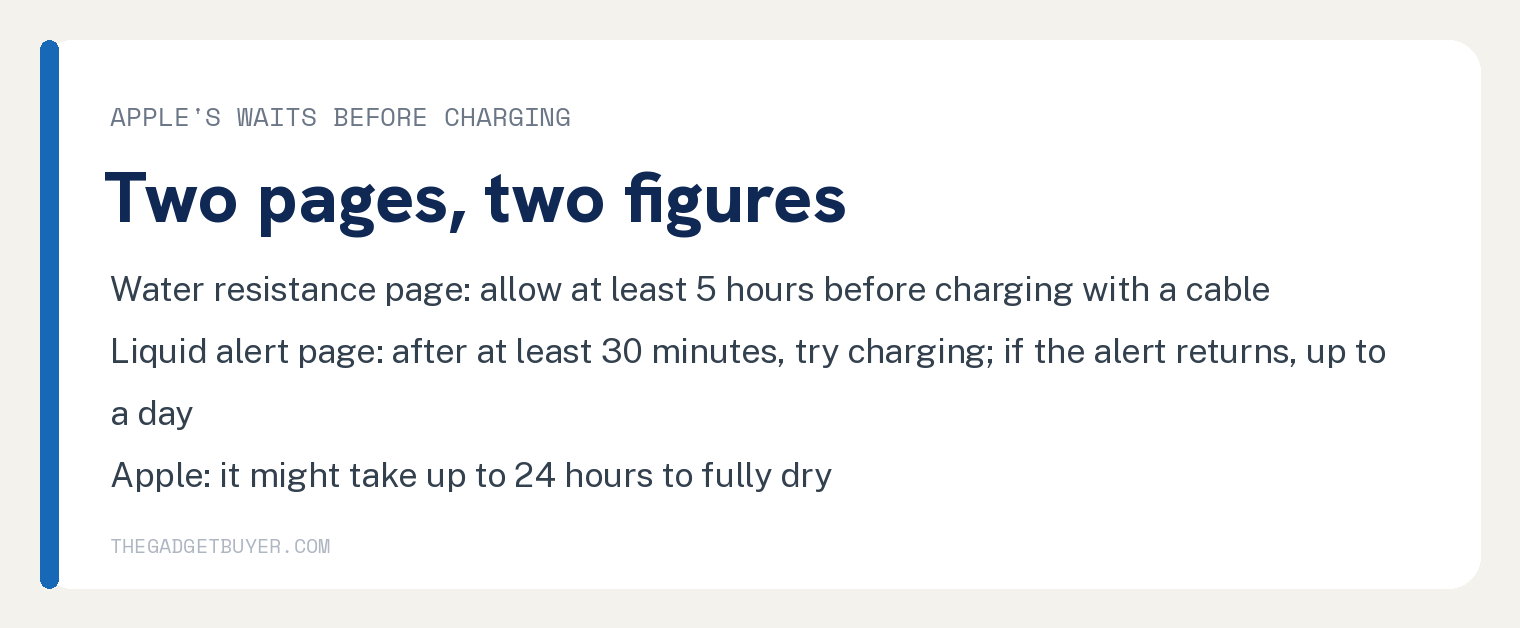
| Apple page | Apple’s wait before charging by cable |
|---|---|
| Water resistance article, “If my iPhone gets wet, can I charge it?” | “Allow at least 5 hours before charging with a Lightning or USB-C cable or connecting an accessory.” |
| Liquid alert article, “Dry your iPhone:” | “After at least 30 minutes, try charging with a Lightning or USB-C cable or connecting an accessory.” and, if the alert returns, “It might take up to 24 hours to fully dry.” |
The two pages print two different first waits. This article keeps each under its own page and heading rather than merging them into one figure.
Apple’s alert page also covers the emergency: “Although you shouldn’t charge your iPhone when it’s wet, you might need to in an emergency. If you reconnect your iPhone to the cable or accessory, you have the option in an emergency to override the liquid detection and charge your iPhone.”
And the corrosion reason: “If you charge your iPhone while the Lightning or USB-C connector is wet, the pins on the connector or cable can corrode and cause permanent damage or stop functioning, causing connectivity issues for your iPhone or accessory.”
What Apple’s two pages do not say
The 2022 version of this article told readers to turn the phone off, remove the SIM tray to drain water, shake it and bury it in rice. Apple’s two pages cited below print no power off step and no shake step: the strings turn off your iPhone, power off, remove the SIM and shake appear on neither page. Apple’s one line on the SIM tray is the one quoted in Step 1: “Make sure that your iPhone is dry before opening the SIM tray.”
Neither page names a toilet or a sink; the words toilet and sink print on neither. Apple’s water resistance page does list “Swimming or bathing with your iPhone” under “To prevent liquid damage, avoid:”. Apple’s steps are for an iPhone that “gets wet”, whatever it fell into.
Frequently asked questions
Is water damage covered by Apple’s warranty?
Apple’s water resistance page says: “Splash, water, and dust resistance are not permanent conditions and resistance might decrease as a result of normal wear. Liquid damage is not covered under warranty, but you might have rights under consumer law”.
My iPhone is water resistant. Does the toilet count?
Neither Apple page names a toilet; the word prints on neither page.
Apple’s water resistance page lists its models by rating, from “IP68 under IEC standard 60529 (maximum depth of 6 meters up to 30 minutes)” down to “IP67 under IEC standard 60529 (maximum depth of 1 meter up to 30 minutes)”, and its avoid list includes “Intentionally submerging your iPhone in water”. The model lists are on that page and are not reproduced here. This site also covers whether AppleCare covers water damage.
The speaker sounds muffled now. Is that water?
Apple’s water resistance page says, under “What should I do if my iPhone got wet, and now its speaker sounds muffled?”: “Check to see if water is in the microphone or speaker: Place your iPhone, speaker side down, on a lint-free cloth and see if water drips out. Water in the port might degrade speaker or microphone performance until it completely evaporates. Dry your iPhone using the previous instructions.”
The liquid alert shows every time I plug in, and the phone is dry
Apple’s alert page, under “If your iPhone and accessory aren’t wet”, says: “If you see this alert every time you connect a certain cable or accessory, that cable or accessory might be damaged. Contact the manufacturer.” And: “If you see this alert every time you connect an Apple Lightning or USB-C cable or accessory, you might need service.”
If the screen misbehaves afterward, this site covers an iPhone blinking on and off. For the repair route, this site covers whether the Apple Store fixes a water damaged iPhone, and this site also covers an iPhone charging port that is loose.
Thank you so Much!!!