
Two iPhones Have the Same Apple ID and Your Data Gets Mixed
When two iPhones have the same Apple ID, Apple’s own page says what to expect: “You might experience issues if you share an Apple Account with another family member. Your data will get mixed together because certain services will treat you and your family member as the same person.”
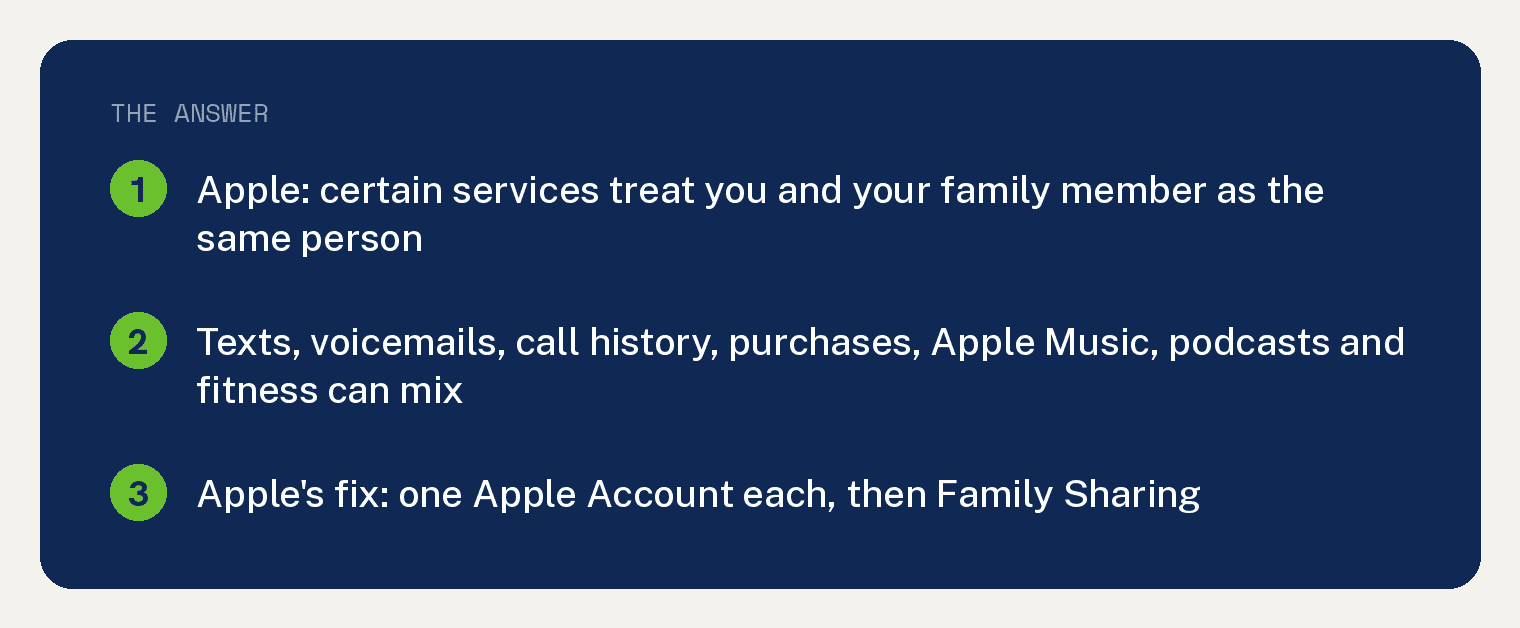
Apple lists seven items that get mixed, and its fix is a separate Apple Account for each person joined by Family Sharing. Every quotation below is Apple’s, from the two pages in the Sources section, and the order is ours.
What Apple says gets mixed, starting with what you notice first
Apple’s page “Make sure that each family member has their own Apple Account” prints a seven item list under “Avoid sharing an Apple Account”. We have ordered it with the everyday items first (messages, calls), then purchases, then media and fitness, with Apple’s first list item last; the quoted words are Apple’s.
| Item | What Apple says happens |
|---|---|
| Messages and voicemails | “You might receive text messages and voicemails that are intended for your family member.” |
| Call history | “Your recent call history will include any calls made and received by your family member.” |
| App Store, Apple Books, and iTunes purchases | “If Family Sharing is ever stopped, the owner of the shared Apple Account will keep all purchases. You might lose access to everything in the account, including purchases you initiated.” |
| Apple Music family subscription | “Instead of receiving your own membership with your own library, you’ll share a library and recommendations with the other family member.” |
| Apple Podcasts and Apple Books | “Podcast episodes and books might sync according to the other family member’s preferences or be accidentally deleted.” |
| Fitness | “You might see Health details, Workouts, and Fitness+ recommendations intended for your family member.” |
| Apple’s first list item, which carries no label | “Some of your personal data could be accessible to other family members.” |
Apple writes “might” or “could” into five of the seven items. This article keeps each word where Apple puts it.
What Apple’s two pages do not say
The 2021 version of this article claimed that Find My would show both phones’ locations, that the phones would mirror each other, and that a separate iCloud account could hold your mail, photos and backups while one Apple Account handled purchases.
None of that is on either Apple page cited below. The words Find My, mirror, iCloud account, contacts, photos and backup print nowhere on Apple’s shared account page or its Family Sharing setup page, so this article makes none of those claims.
If you want the two phones to stop sharing, this site covers how to unsync two iPhones.
Apple’s fix: one Apple Account each, then Family Sharing
Apple’s rule is in the first sentence of its page: “To share purchases and subscriptions with your family, you need to have Family Sharing set up, and each family member needs to use their own Apple Account.”
Apple’s next sentence: “This way, your family can share purchases, subscriptions, and more without sharing personal information like emails, text messages, or passwords.”
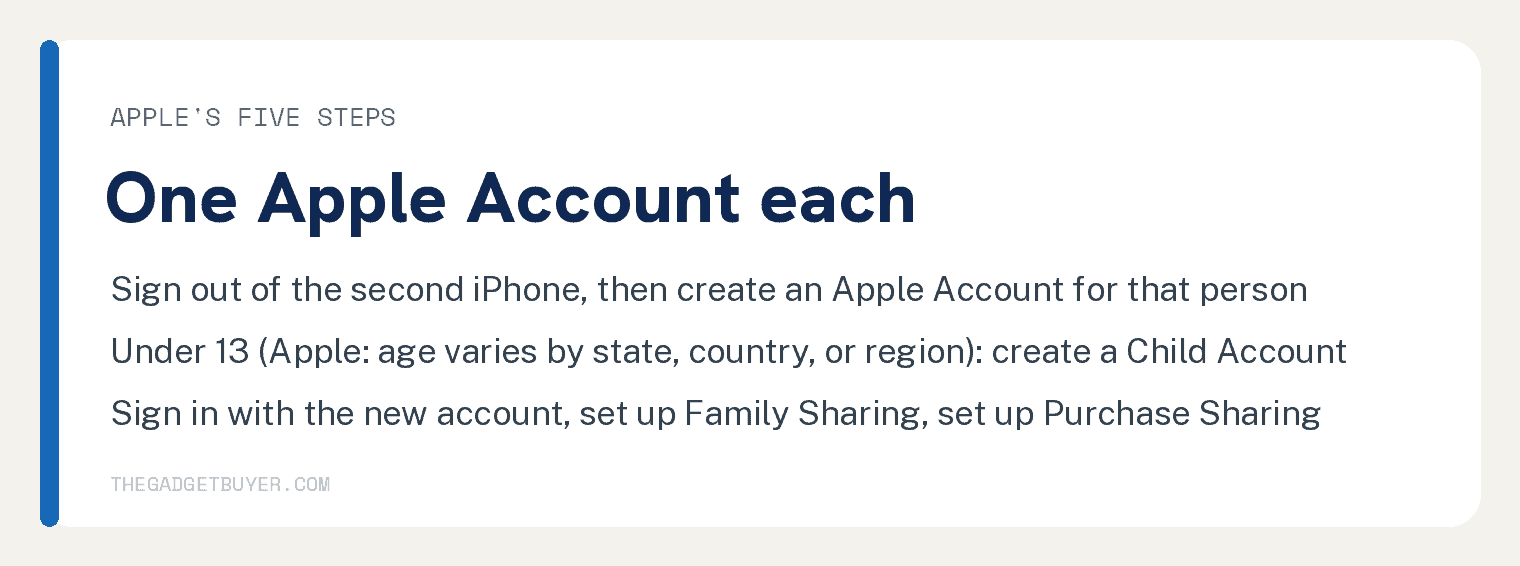
Under “Create an Apple Account for a family member, then set up Family Sharing”, Apple prints five steps. They are quoted here in Apple’s order.
- “On the family member’s device, sign out of their device”
- “Ask your family member to create an Apple Account”. Apple adds: “If the family member is under 13”, “create a Child Account for the child”, and marks the age with this note: “Age varies by state, country, or region.”
- “Ask your family member to sign in with their new Apple Account on their device.”
- “Set up Family Sharing and invite the family member to your group”
- “Set up Purchase Sharing”. Apple adds: “If you have children in your family, you can also set up Ask to Buy” and “parental controls to manage their device”.
Step 1 links to a separate Apple page on signing out, which this article does not quote. If you cannot sign out on the second iPhone, this site covers why you can’t sign out of an Apple ID on iPhone.
For step 2, this site covers an Apple ID without a phone number and whether your Apple ID has to be an email address.
Step 4: setting up Family Sharing
Apple’s Family Sharing page opens with: “With Family Sharing, you and up to five family members can share access to Apple services like iCloud+, Apple Music, Apple TV, and more” “without sharing an Apple Account.”
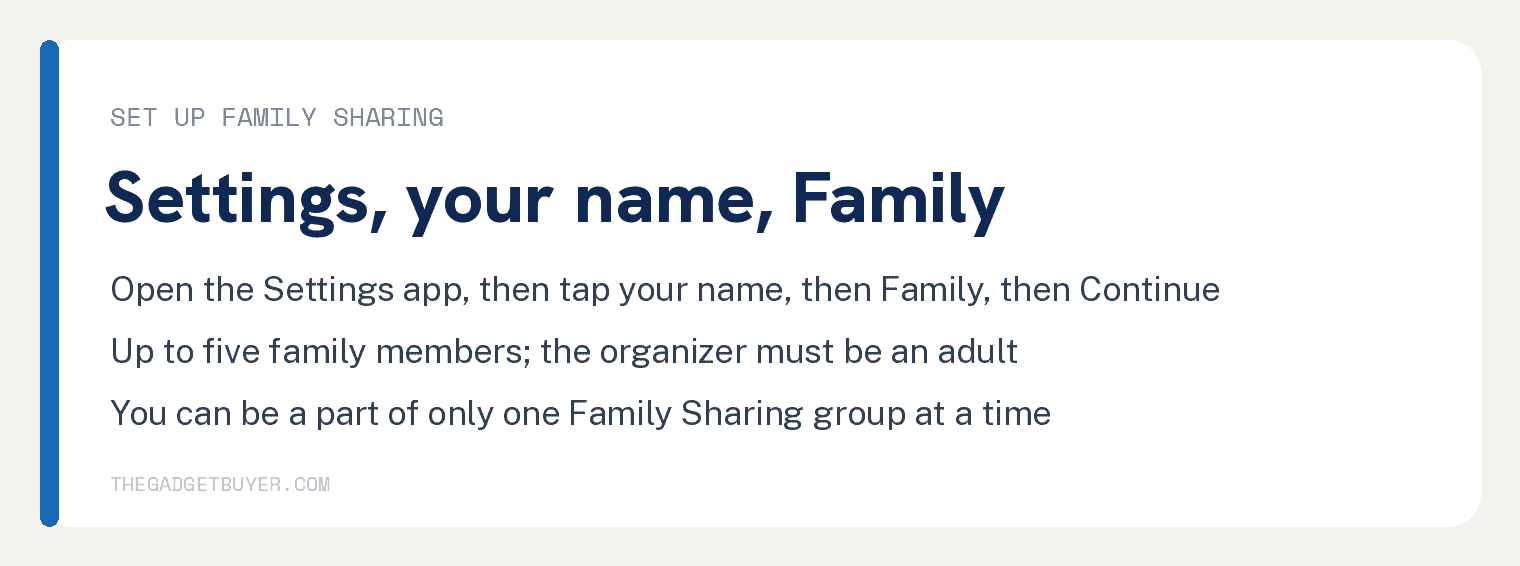
Under “Set up a Family Sharing group”, Apple says: “The Family Sharing organizer, which must be an adult, can set up a Family Sharing group from their device. When you set up a Family Sharing group, you might be asked to confirm that you’re an adult.”
The steps under that heading read: “Open the Settings app, then tap your name.”, “Tap Family, then tap Continue.” and “Follow the onscreen instructions to set up your Family Sharing group and invite your family members.”
Under “Invite people to join your Family Sharing group”, the steps read: “Open the Settings app, then tap Family.”, “Tap the Add Member button” and “Tap Invite Others to add an adult or a child that already has a Child Account.” Apple adds: “If your child doesn’t have a Child Account, tap Create Child Account, then follow the onscreen instructions.”
For the person you invite, Apple says under “Join a Family Sharing group”: “You’ll get an invitation to join a Family Sharing group by email or in a text message, and you can respond right from the invitation.” The steps there read “Open the Settings app, then tap your name.” then “Tap Invitations.”
Two more limits Apple prints on the Family Sharing page
Apple says: “You can be a part of only one Family Sharing group at a time.” Under “If you can’t accept the invitation”, Apple adds: “Remember, you can only join one Family Sharing group at a time, and you can only switch to a different Family Sharing group once per year.”
The same section opens with: “If you can’t accept the invitation, check if someone else joined a Family Sharing group with your Apple Account.”
Frequently asked questions
Will the other iPhone see my texts?
Apple’s page says: “You might experience issues if you share an Apple Account with another family member.” Under that, Apple prints: “You might receive text messages and voicemails that are intended for your family member.”
If Family Sharing is stopped later, who keeps the apps?
Apple says: “If Family Sharing is ever stopped, the owner of the shared Apple Account will keep all purchases. You might lose access to everything in the account, including purchases you initiated.”
Is there an age rule for the second account?
Apple says “If the family member is under 13” to “create a Child Account for the child”, with this note: “Age varies by state, country, or region. Where legally required, an Apple Account created for a child under 18 needs to be part of a Family Sharing group.”
Can both phones still back up to iCloud?
Neither Apple page cited below mentions iCloud backup; the word backup prints on neither. This site covers whether two iPhones can back up to the same iCloud account.