
To Switch Phones on Metro, Move a SIM or Use Switch Device
To switch phones on Metro, you have three routes: move your SIM card into the new phone, use Switch Device in MyAccount for a phone that takes an eSIM, or let a Metro store or Customer CARE do it. Metro’s own line on the card: “SIM cards come in different sizes and can be moved from phone to phone.”
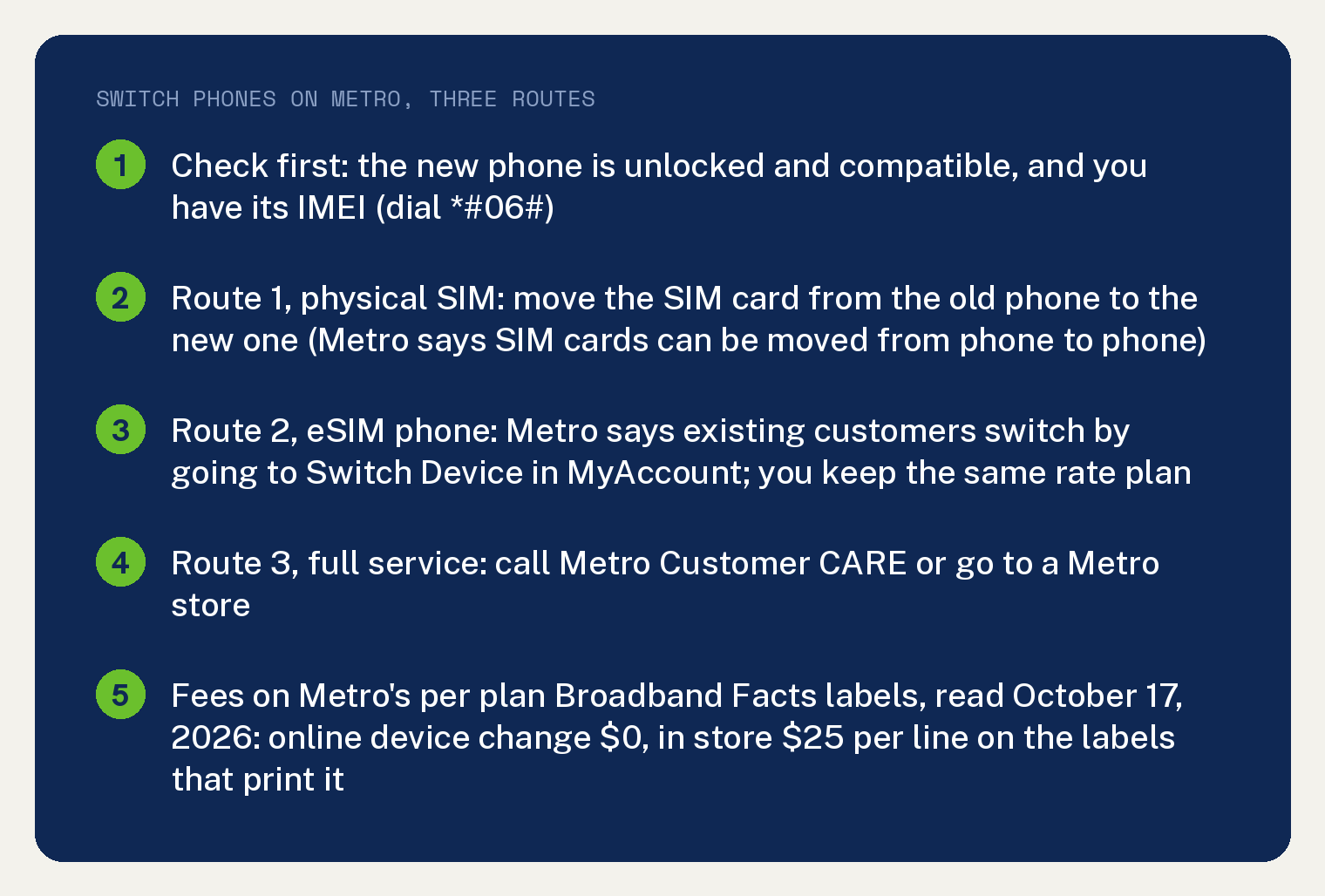
Before any of those, the new phone has to be unlocked and compatible with Metro, and you will want its IMEI handy. Those checks are below, in Metro’s words.
Which way should you switch phones on Metro?
The bare minimum is moving the SIM card. Metro: “SIM cards come in different sizes and can be moved from phone to phone.”
The route this site recommends is Switch Device in MyAccount, because Metro’s labels list the online device change fee at $0. The full service version is a store, where three of Metro’s four labels list a $25 per line change fee.
That ranking is this site’s reading of Metro’s two pages cited below.
Is the new phone unlocked and compatible with Metro?
Unlocked means the phone will work on another carrier’s network. Metro’s definition, this whole sentence in its words: “Unlocked” means your phone isn’t “locked” to a specific carrier or network and can work with multiple service providers.
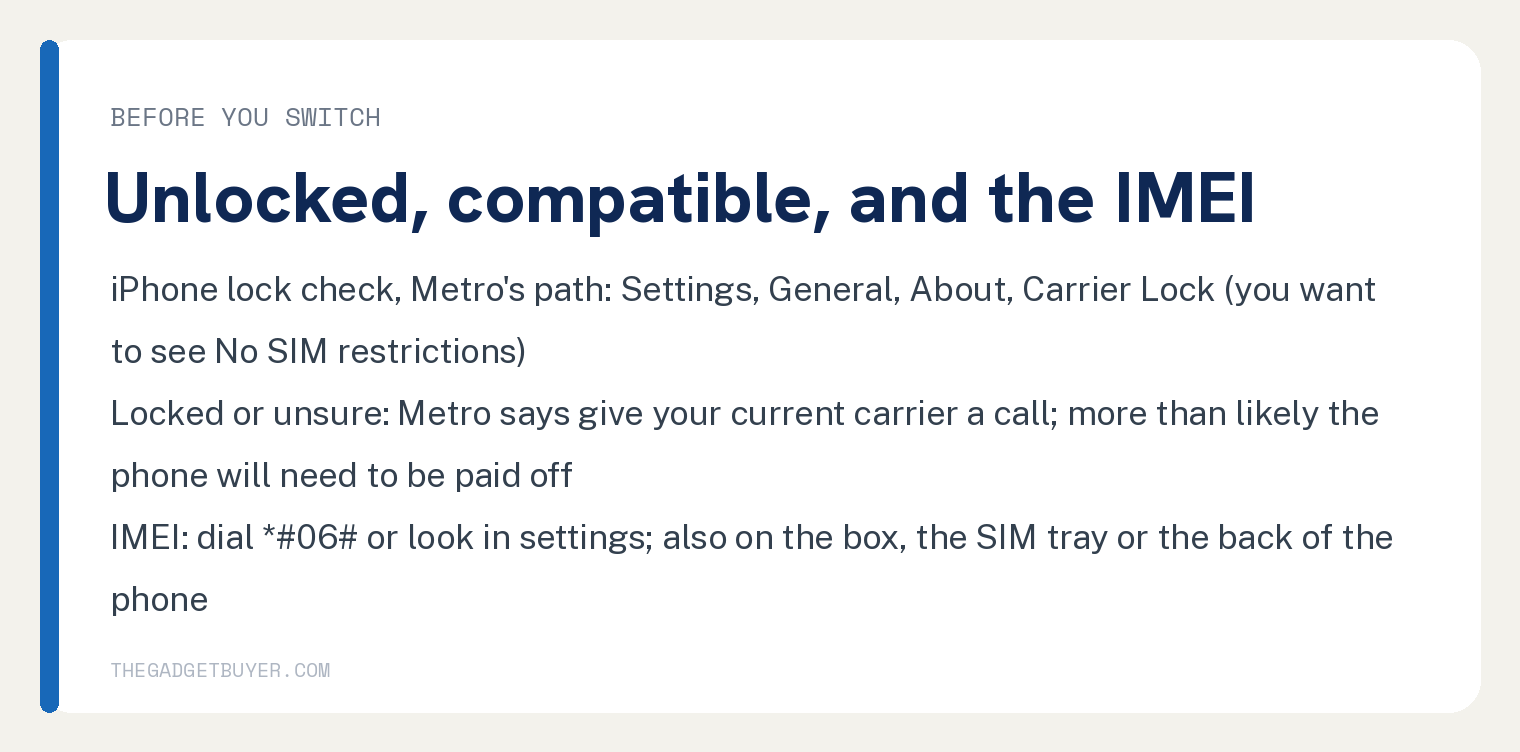
A phone bought through a carrier may still be locked, and Metro keeps that as a likelihood: “there’s a good chance it is locked”. Its settings may show the status, and Metro lists the paths for three brands.
On an iPhone the path is “Settings → General → About → Carrier Lock”. On a Samsung it is Settings, Connections, More Connections Settings, then Network Unlock; on a Motorola it is Motorola, About Phone, then Device Unlock, both as Metro prints them.
On an iPhone, Metro’s eSIM page names the line you want to see under Carrier Lock: “you should see a message that says” No SIM restrictions. It adds: “If you don’t see that message, contact Metro by T-Mobile Help and Support.”
If the phone is locked, or you cannot find its status, Metro’s line is: “If your phone is locked or you can’t find its status, give your current carrier a call.” Each carrier sets its own unlock rules, and Metro says: “More than likely, your phone will need to be paid off.”
Compatibility is a separate check. Metro: “Just check if your phone is compatible.” The “Check compatibility” button is on Metro’s Bring Your Own Phone page linked in Sources.
How do I find the IMEI on the new phone?
Dial *#06# on the phone, or look in its settings. Metro: “You can find your phone’s IMEI by dialing *#06# or by going into its settings.”
Metro lists three other places to look: the phone’s original packaging, the removable SIM tray, and the back of the phone. If none of those shows it, Metro says to ask at your nearest Metro store.
Route 1: move your SIM card to the new phone
Take the SIM card out of the old phone and put it in the new one. The card is what ties the phone to Metro’s network, and Metro’s page says it in one line: “A SIM card is what connects you to your carrier’s network and allows you to use mobile services.”
If you need a Metro SIM card for the new phone, Metro’s eSIM page says: “If you need a Metro by T-Mobile SIM card, see our SIM card page to order online. You can also find one in a Metro by T-Mobile store”. That line sits under its heading “What if my device is not eSIM compatible?”.
Route 2: switch to an eSIM phone with Switch Device in MyAccount
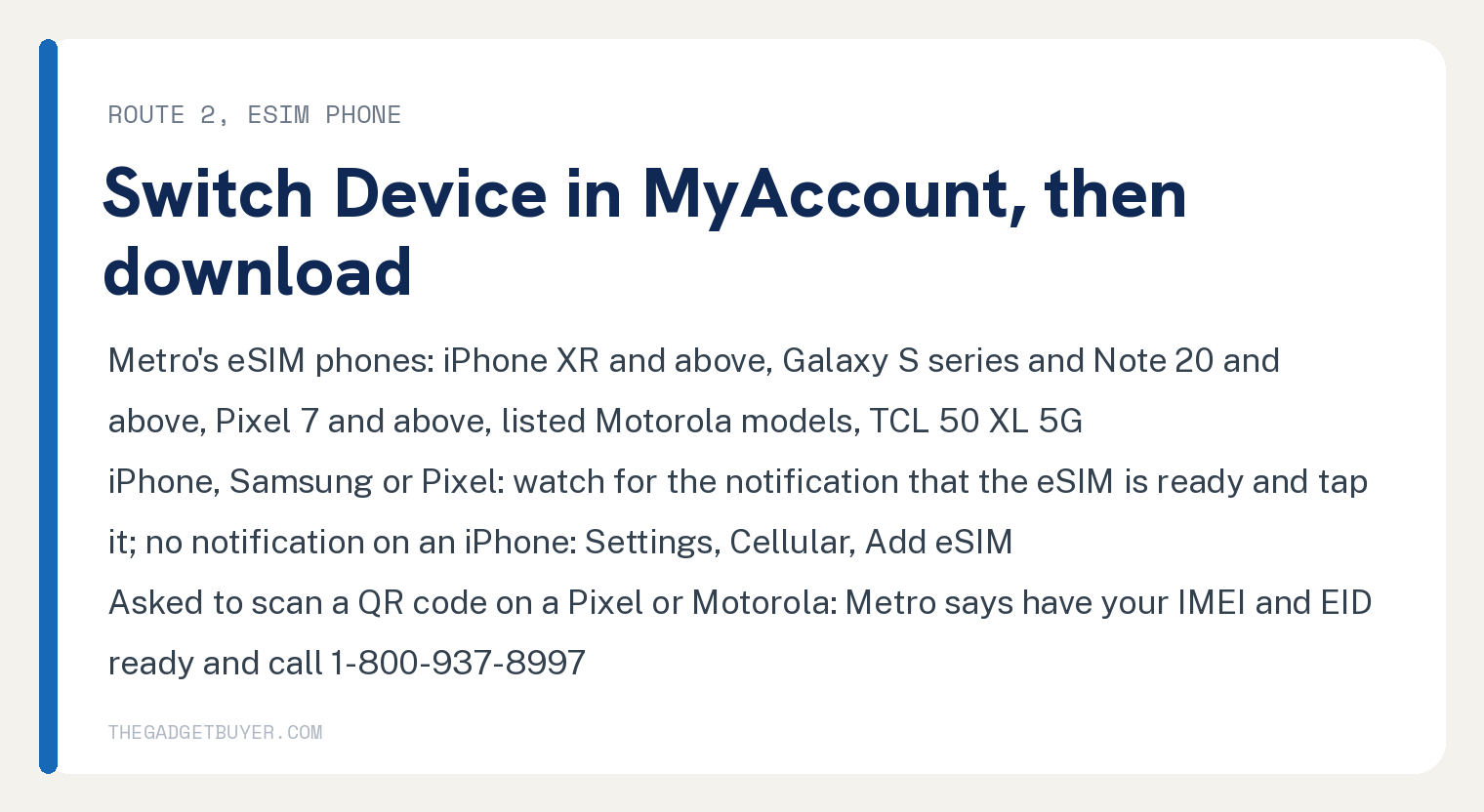
For a phone that supports eSIM, Metro’s line for existing customers is: “Existing customers can switch to an eSIM compatible device by going to Switch Device in MyAccount”. Metro’s page prints that sentence and no menu path beyond it, so this article adds none.
Your plan comes with you. Metro’s FAQ says that if you want to swap your existing Metro line of service to eSIM, “then you will keep the same rate plan.”
Metro’s eSIM device list, as printed on its eSIM page: “Apple – iPhone XR and above”, “Samsung – Galaxy S Series and Note 20 and Above”, “Google – Pixel 7 and above”, one Motorola line listing three models (“Motorola Moto G Stylus 5G 2023 and newer models, Motorola Razr+ 2023 and newer models, Motorola Moto G 5G 2023”), and “TCL- TCL 50 XL 5G”.
After that, on an iPhone, a Samsung or a Pixel you brought yourself, Metro’s download steps start with a notification on the phone that the eSIM is ready, which you tap to download it. Metro’s iPhone wording: “Watch for a Notification on your device that an eSIM from Metro by T-Mobile is ready to be set up on your phone”.
No notification? Metro’s manual path on an iPhone: “From your home screen, tap Settings > Cellular > Add eSIM”.
The same page prints paths for Samsung, Pixel, Motorola and Other under the heading Download your eSIM.
For the Pixel and Motorola steps Metro adds one case: “If you’re prompted to scan a QR code, please have your IMEI and EID ready and give us a call: 1-800-937-8997. To find your IMEI and EID dial *#06# from your phone.”
If the eSIM will not download, Metro’s “Still having issues?” list says to make sure the eSIM was already activated online or with a Metro by T-Mobile support team, to update the phone’s software to the latest version, to connect the phone to Wi-Fi and make sure it can access the internet, and then to follow the steps listed above.
Route 3: let a Metro store or Customer CARE switch it
The same list on Metro’s eSIM page, under “How do I Activate my eSIM compatible device?”, prints two more lines: “Call Metro Customer CARE” and a line sending you to a Metro store. Metro’s Bring Your Own Phone page prints the Customer Care number and a store finder under “Still need help?”.
The fee difference is printed on the Broadband Facts labels on that page, read on October 17, 2026: “Online Device Activation/Change fee” “$0” on all four labels and “In-Store Device Activation/Change fee” “$25/line” on three of them. Those labels are per plan, so check the label for your plan before you go.
What Metro’s two pages do not cover
Neither page prints a step for moving your contacts, photos or other data between phones: the strings contacts and photos count 0 on both, and transfer and backup appear only in marketing lines.
Neither page prints how long a device switch takes to take effect (hours and wait count 0 on both). And Switch Device appears in one sentence on the eSIM page with no menu path, so this article gives none.
Related on this site: switching phones on T-Mobile, switching phones on US Cellular prepaid, switching iPhones on AT&T prepaid, and switching phone carriers without paying fees.
Frequently asked questions
Do I keep my plan when I switch phones on Metro?
Yes, for a line moved to an eSIM phone. Metro’s FAQ says that if you want to swap your existing Metro line of service to eSIM, “then you will keep the same rate plan.”
Can I put two Metro lines on one eSIM phone?
Metro’s answer is no: “No, not at this time. Only one line of service can be activated on a single device.”
What if I deleted the eSIM from my phone?
Metro’s FAQ: “Go to a retail store or call care and we will give you a new eSIM.”
Does Metro charge to switch phones?
On the Broadband Facts labels on Metro’s Bring Your Own Phone page, read on October 17, 2026, the online device change fee is “$0” on all four labels and the in store fee is “$25/line” on three of them. The labels are per plan, so read the one for your plan.
Where is the EID if Metro asks for it?
Metro’s eSIM page: on an iPhone, “Go to Settings > General > About”; on Android, Settings, About Phone, then SIM Status or Status Information. Dialing *#06# shows both the IMEI and the EID, per the same page.
I am having trouble switching my account too my metro PCs by t-moblie /keep my same number 4043225645 is the metro PCs by t- mobile I want it