
Transfer Files From a Laptop to an iPhone, Apple’s Way
To transfer files from a laptop to an iPhone, Apple’s iPhone User Guide gives you AirDrop to a nearby Apple device, a Mail or Messages attachment, a cable with the Finder, Apple Devices or iTunes depending on your computer, a storage device or cloud service, and iCloud. The word Bluetooth does not appear in that article’s body, so the cable route for a Windows laptop running Windows 10 or later is Apple’s Apple Devices app, laid out step by step below.
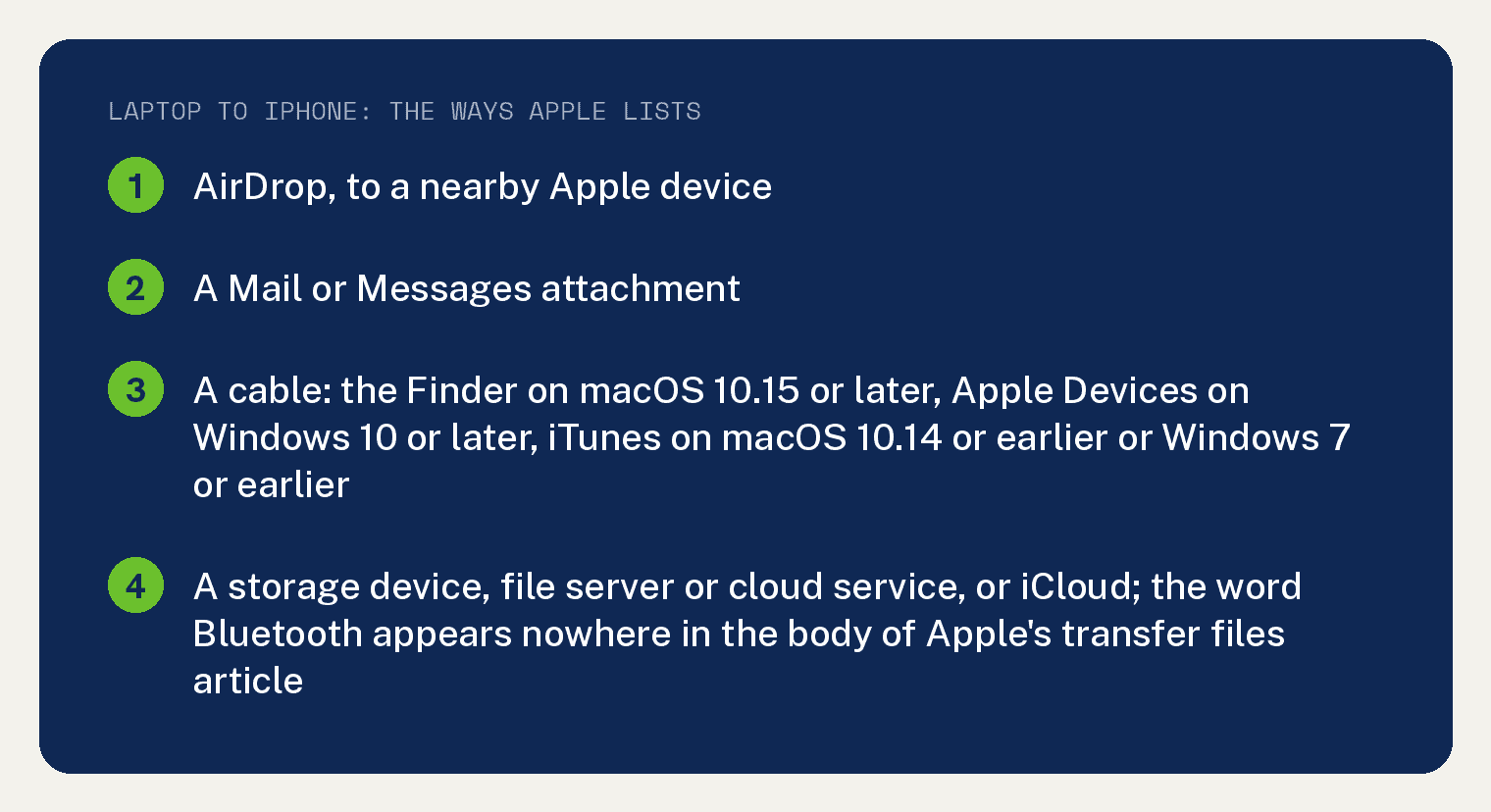
Apple’s first paragraph includes this sentence: “You can transfer files wirelessly with features like AirDrop or apps like Mail and Messages, or you can connect your iPhone to a computer or an external storage device with a cable, and then transfer or sync files.” A second paragraph adds iCloud: “You can also use iCloud to store your files, photos, videos, and more”.
One limit sits above all of those routes, with Apple’s own qualifier. “Transferring, sharing, or syncing may be restricted for some types of data, such as files saved in an app’s proprietary format, files saved in older software versions, and files protected by copyrights.”
Which route fits your laptop
Apple’s cable section splits the tool by operating system in three lines. On a Mac running macOS 10.15 or later, “Use the Finder.”
On a Windows laptop running Windows 10 or later, “Use Apple Devices for Windows.” On a Mac running macOS 10.14 or earlier, or a Windows laptop running Windows 7 or earlier, “Use iTunes.”
Neither page names Windows 8 or 8.1; Apple’s printed split runs from Windows 10 or later down to Windows 7 or earlier.
Apple’s wireless section covers AirDrop and attachments. AirDrop is scoped by Apple to “a nearby Apple device”, and the attachment route is “sending the file as an attachment in the Mail or Messages app.”
Windows laptop to iPhone with Apple Devices, step by step
The Windows article calls this File Sharing: “You can copy files between your computer and apps on your iPhone or iPad using File Sharing.” Its What you need for File Sharing list has four items.
- The latest version of the Apple Devices app.
- “The latest version of Windows 10 or later.”
- An iPhone with the latest version of iOS.
- “An iOS or iPadOS app that works with File Sharing.”
Open Apple Devices on the PC, then “Connect your iPhone or iPad to your computer using the USB cable that came with your device.” Then, in Apple’s words, “Click Files. If you don’t see a Files section, your device has no file-sharing apps.”
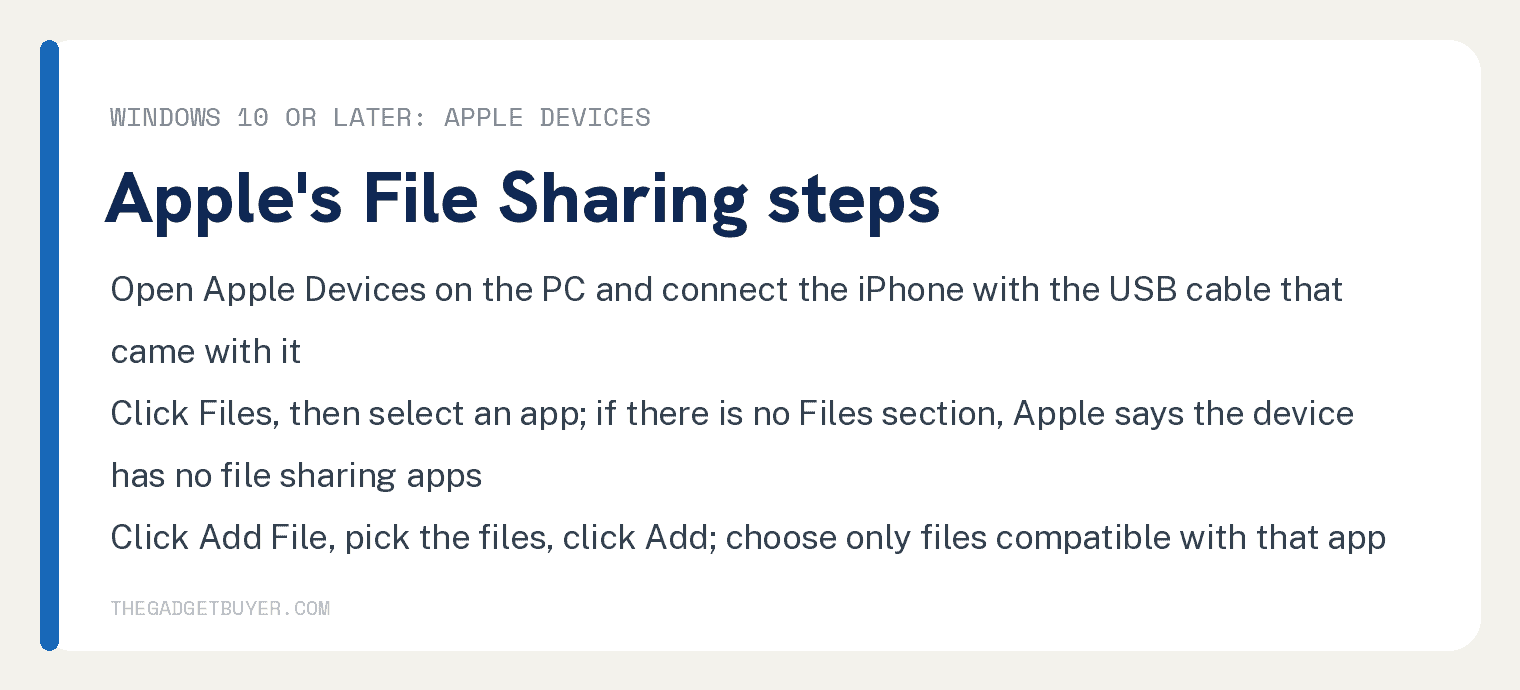
To copy a file onto the iPhone, select the app in the Files section, then follow Apple’s line: “Click Add File, select files you want to copy from your computer, then click Add.” Apple adds that Apple Devices copies the files to that app on the device and to “Choose only files that are compatible with the app.”
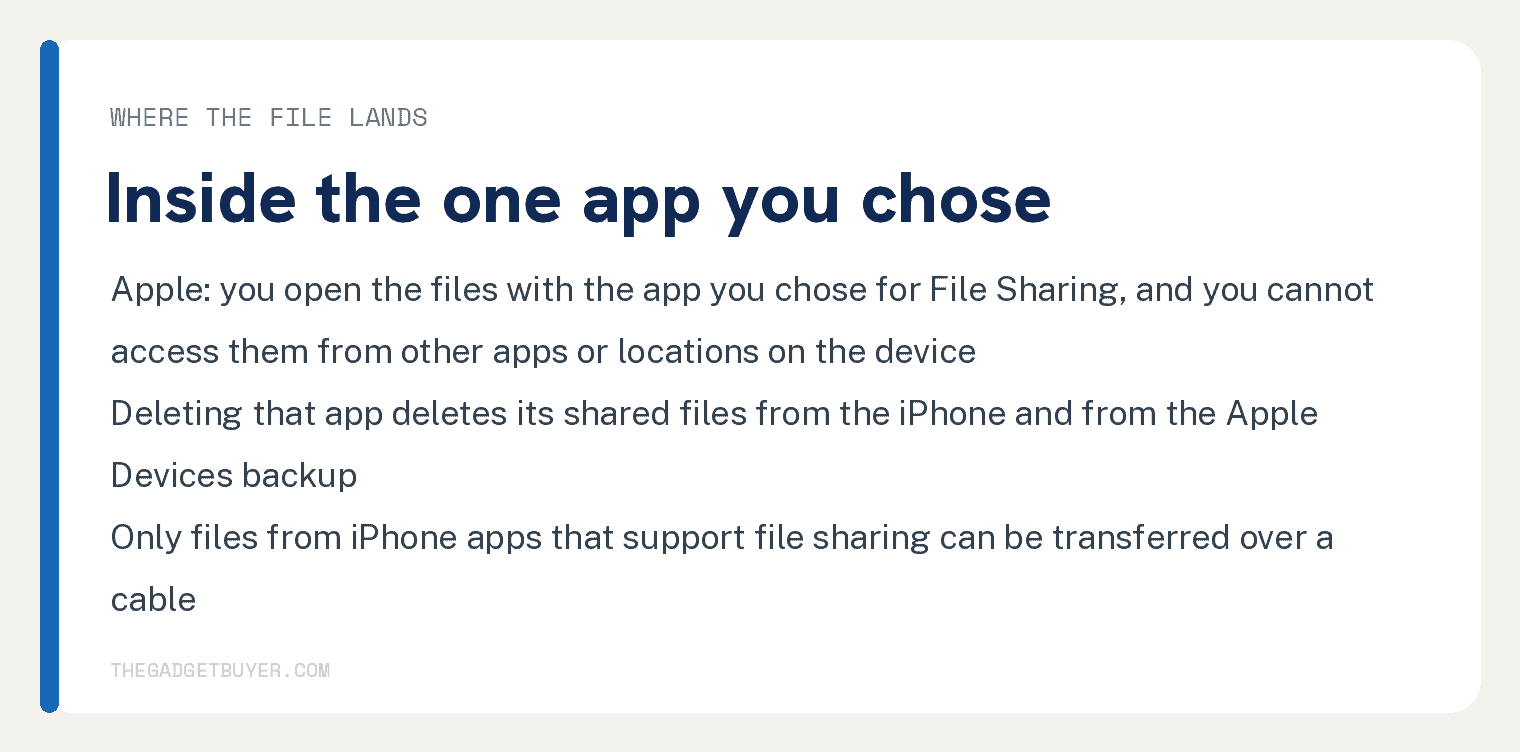
The file lands inside that one app. Apple’s Open shared files section says “On your iPhone or iPad, you can open the files from your computer with the app that you chose for File Sharing.” and adds “You can’t access these files from other apps or locations on your device.”
Going the other way, from the iPhone to the laptop, uses the same screen. Apple’s step: “Select the files that you want to copy to your computer from the Documents list, click Save, select a folder on your computer where you want to copy the files, then click Save.”
One warning before you delete an app
Shared files live and die with their app. Apple’s backup section warns: “If you delete an app with shared files from your iPhone or iPad, you also delete those shared files from your device and your Apple Devices backup.”
The iPhone guide’s cable section says: “Only files from iPhone apps that support file sharing can be transferred.”
Mac laptop to iPhone
On a Mac, Apple’s wireless routes are AirDrop and an attachment. AirDrop is Apple’s way “To quickly share a photo, file, or other item from your iPhone to a nearby Apple device”, and a Mac is one of the devices Apple names at the top of the article, “an iPad, Mac, or Windows device.”
For a cable on a Mac running macOS 10.15 or later, the Finder does the job the Apple Devices app does on Windows. Apple’s cable section says you can use “the Finder, Apple Devices, or iTunes, depending on the model and operating system of your computer.”
If you want photos to appear on the Mac without a transfer at all, our guide to viewing iPhone photos on a Mac without importing covers that, syncing an iPhone and an iPad covers the two device case, and where AirDrop files go on an iPad covers the file you cannot find after an AirDrop.
iCloud, when both ends are signed in
iCloud keeps a file in step on every device signed in to the same account. Apple’s line: “Any change you make to a file on a device that’s signed in to your Apple Account appears on all devices that are signed in to the same Apple Account.”
The requirement note for iCloud says “OS X 10.10 (or later) or Windows 7 (or later) are required.”
What Apple’s two pages do not print
The transfer files article names no Bluetooth way to move a file and no pairing step; the word appears twice on the page, both times in the sidebar table of contents, and zero times in the article body. The Windows File Sharing article does not use the word at all.
Neither page names AirDrop for Windows. Apple scopes AirDrop to a nearby Apple device, and the Windows article does not mention it (zero hits).
Neither page prints a file size or file count limit (zero hits for MB and GB on both; the hits for limit and maximum on both pages are the feedback form’s character limit and, on the guide, a sidebar title).
Frequently asked questions
Can I send a file from a Windows laptop to an iPhone over Bluetooth?
Apple’s transfer files article lists AirDrop, Mail and Messages attachments, a cable, a storage device or cloud service, and iCloud, and the word Bluetooth is absent from its body. For a Windows 10 or later laptop, Apple’s cable route is a USB cable and the Apple Devices app.
Does AirDrop work from a Windows laptop?
Neither Apple page names AirDrop for Windows. Apple scopes AirDrop to sharing with “a nearby Apple device”, and its Windows file sharing article does not mention AirDrop.
Where do the files go on the iPhone after a cable transfer?
Into the one app you selected in the Files section. Apple says you open them “with the app that you chose for File Sharing” and “You can’t access these files from other apps or locations on your device.”
Do I still need iTunes?
Only on older systems, by Apple’s printed split: “Use iTunes.” applies to a Mac on macOS 10.14 or earlier or a Windows device on Windows 7 or earlier. Windows 10 or later uses Apple Devices, and macOS 10.15 or later uses the Finder.