
Sonos Roam Won’t Charge? Sonos Says Check the Adapter First
When a Sonos Roam won’t charge, Sonos’s first suspect is the power adapter: some USB adapters do not have enough power, and a 5V/1A (5W) phone charger, the kind Sonos says was usually included with older phones, is the one it names. Sonos recommends a 5V/2A (10W) USB adapter, and its pages give three checks to run before you contact support.
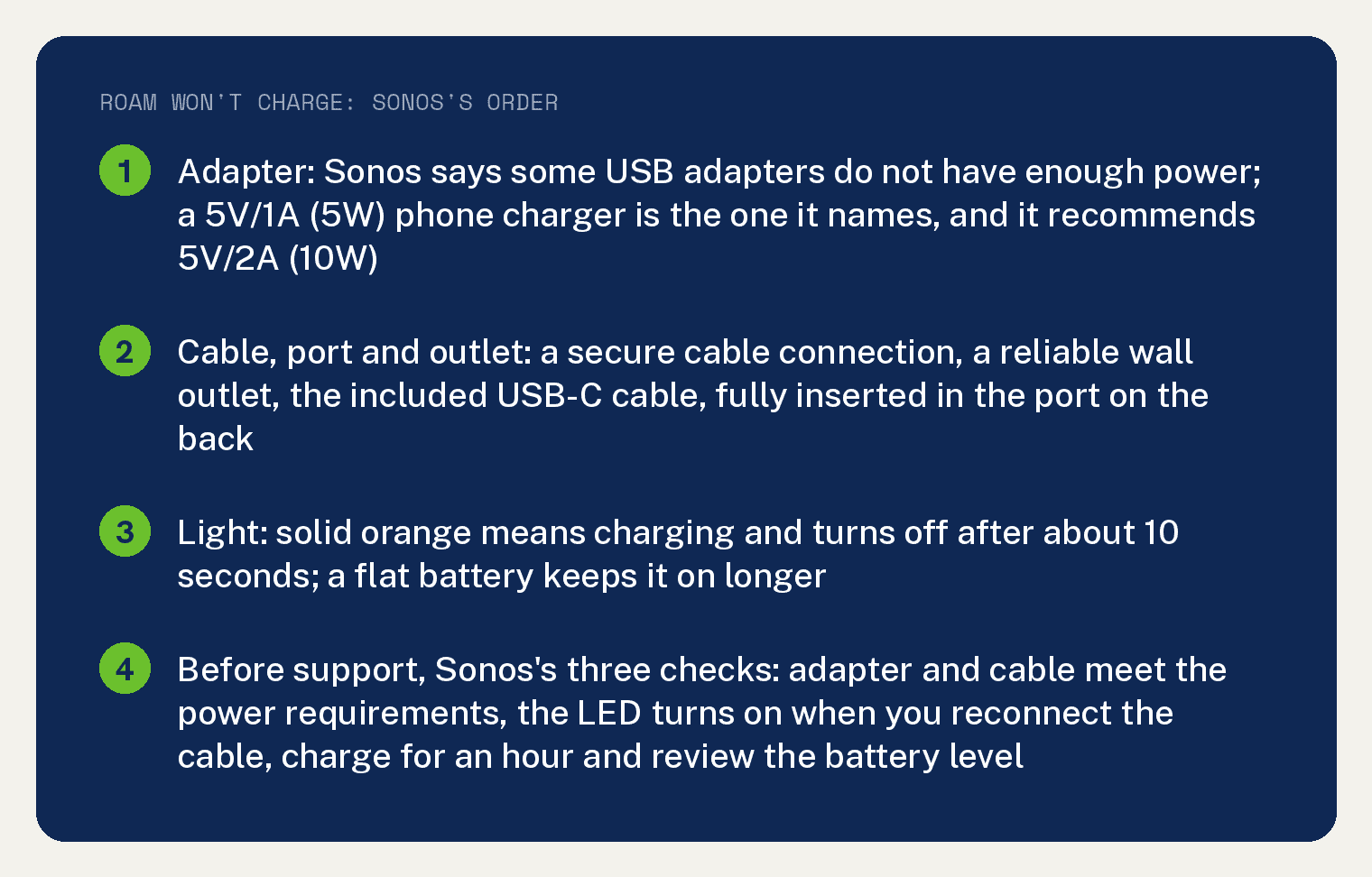
Sonos’s charging troubleshooting page opens on the adapter: “Some USB power adapters don’t have enough power to charge portable Sonos products.” The result it describes goes beyond slow charging: an underpowered adapter “can result in a very slow charging speed or even battery drain when your product is plugged in.”
The adapter, and the 5W trap
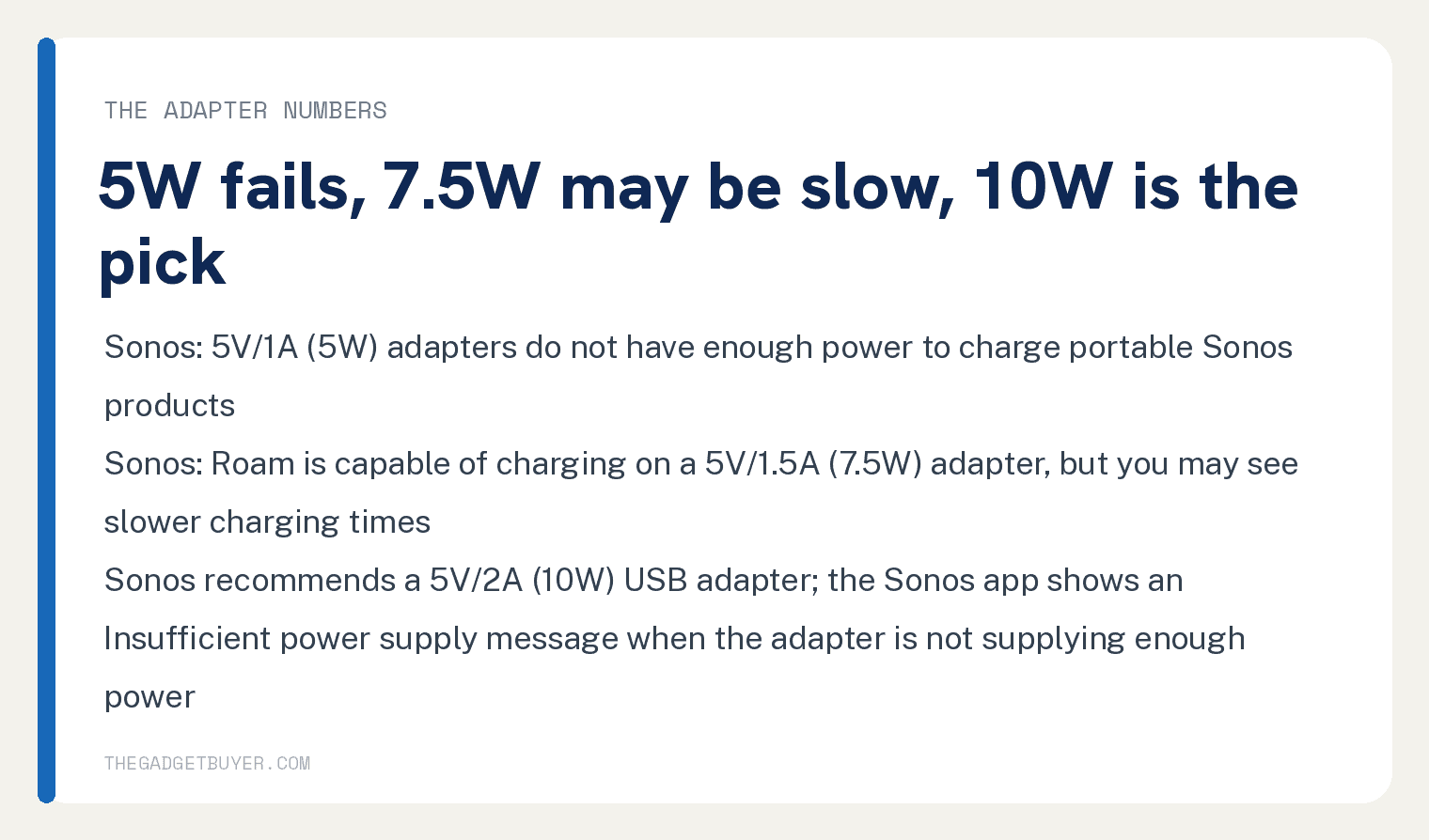
Look at the small print on the charger block. Sonos’s page says 5V/1A (5W) adapters “don’t have enough power to charge portable Sonos products”, that they “were usually included with older smartphone models”, and that most iPhones before the iPhone 11 shipped with one.
The adapter Sonos wants is 10W. Its requirements page says “For the fastest charge, we recommend charging Roam with a 5V/2A (10W) USB power adapter.” and adds that Roam is capable of charging with a 5V/1.5A (7.5W) adapter, with the warning that you may experience slower charging times.
The Sonos app can tell you when the adapter is the problem: Sonos says it shows an Insufficient power supply message in the System settings menu, and “This usually happens if Roam is connected to a common 5V/1A (5W) phone charger.” Sonos’s fix for that message is to connect Roam to a 5V/2A (10W) USB adapter instead.
The cable, the port and the outlet
Sonos sets three conditions for a proper charge: an adapter giving enough power, “a secure cable connection”, and a reliable wall outlet. It also recommends the USB-C cable that came in the box.
Sonos’s Roam charging page covers “your Sonos Roam, Roam SL, or Roam 2” and names the USB-C cable, a “wireless Qi charger, or the Sonos Wireless Charger” as ways to charge it.
The port is on the back, and the cable has to be all the way in. Sonos’s Roam charging page: “When charging, ensure that the USB-C cable is fully inserted into your Roam and power source.”
Read the orange light the right way
A Roam that lights up orange and then goes dark has not stopped charging. Sonos’s words: “Roam will display a solid orange light to indicate that it’s charging. After about 10 seconds, the light will turn off but Roam will continue to charge.”
A flat battery changes that timing. Sonos says that if the battery is depleted or very low, “the orange light will stay on longer than 10 seconds until Roam has enough charge to turn on”, that the time will vary with the adapter and how depleted the battery is, and that once the light turns off Roam “may still require additional charging before it can be used on battery power.”
Orange that flashes means something else. Sonos says the front light “will flash orange when Roam is low on battery (15% charge or less).”
To read the level itself, open the Sonos app’s System tab; Sonos says “The battery level will appear in the listing for your Roam.”
Sonos’s three checks before you contact support
Sonos lists the steps to take first, “to address common charging issues.” All three, in Sonos’s order:
- “Confirm that the charging adapter and cable meet the power requirements of the product.”
- “Confirm that when disconnecting and reconnecting the USB-C cable to the product, the charging LED status light turns on.”
- “Allow the product to charge for an hour, then review the battery level before contacting Sonos Support.”
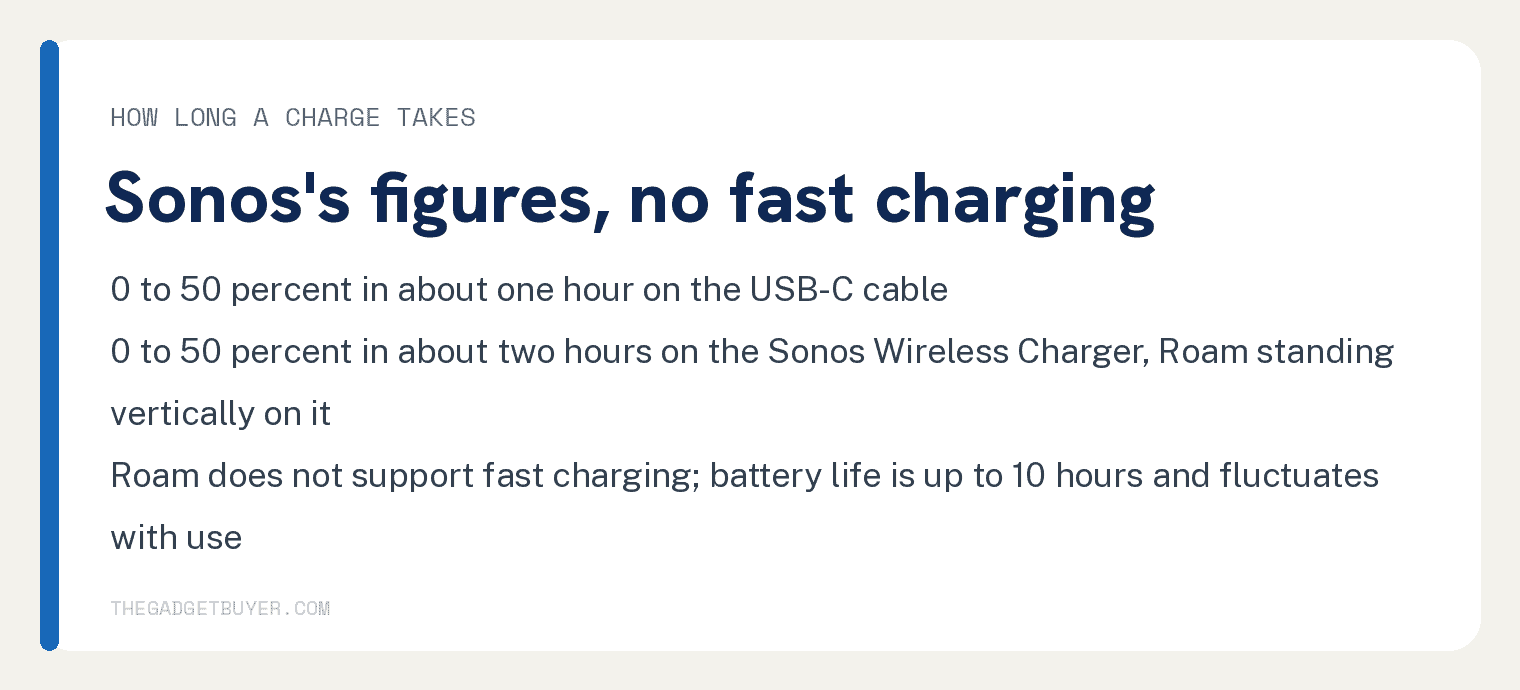
Sonos’s charge times put that hour in context: by its figures Roam charges from 0 to 50 percent “in about one hour when using a USB-C cable” and in about two hours on the Sonos Wireless Charger.
Fast charging and the wireless charger
Fast charging is off the table. Sonos’s Roam charging page says: “Roam does not support fast charging.”
On the Sonos Wireless Charger, position matters: with the charger plugged in, Sonos says to “place Roam so it is standing vertically on top of the charger to begin charging.” Battery life once charged is “up to 10 hours of continuous playback on a single charge” by Sonos’s figure, with pausing, volume, Bluetooth and heat among the things it says make that fluctuate.
Where Sonos’s pages stop
None of the three Sonos pages prints a reset, reboot or restart step for a Roam that will not charge. The words reset, reboot and restart do not appear on them.
None of them prints a battery replacement or service step either; the words replace, replacement, service and repair do not appear. None of them prints a cable swap step; the phrases different cable, another cable and replace the cable do not appear on them.
For other speakers that misbehave on power, we have why a JBL speaker keeps turning off and why a Bose speaker turns on by itself; for the other Sonos light colours, see Sonos blinking orange.
Frequently asked questions
Why is my Sonos Roam not charging with my phone charger?
Sonos says 5V/1A (5W) adapters “don’t have enough power to charge portable Sonos products”, and that most iPhones before the iPhone 11 shipped with one. Use a 5V/2A (10W) adapter, the one Sonos recommends, and check the Sonos app for an Insufficient power supply message.
What does the orange light on a Sonos Roam mean when charging?
Solid orange means it is charging, and Sonos says the light turns off after about 10 seconds while charging continues. On a depleted or very low battery the light stays on longer until the Roam has enough charge to turn on; a flashing orange light means 15 percent charge or less.
How long does a Sonos Roam take to charge?
Sonos gives 0 to 50 percent in about one hour on a USB-C cable and about two hours on the Sonos Wireless Charger, and says Roam does not support fast charging. Its 7.5W adapter note adds that you may see slower charging times on that adapter.