
MSI Laptop Keeps Shutting Off by Itself, So Start With Heat
When an MSI laptop keeps shutting off by itself, MSI’s shutdown page names four kinds of reason that can trigger it, and MSI’s first check is heat: open MSI Center, read the CPU and GPU temperatures, and MSI recommends Cooler Boost if either one passes 95 degrees C. The three checks after that are external and new hardware, a BIOS update and a factory restore, in that order.
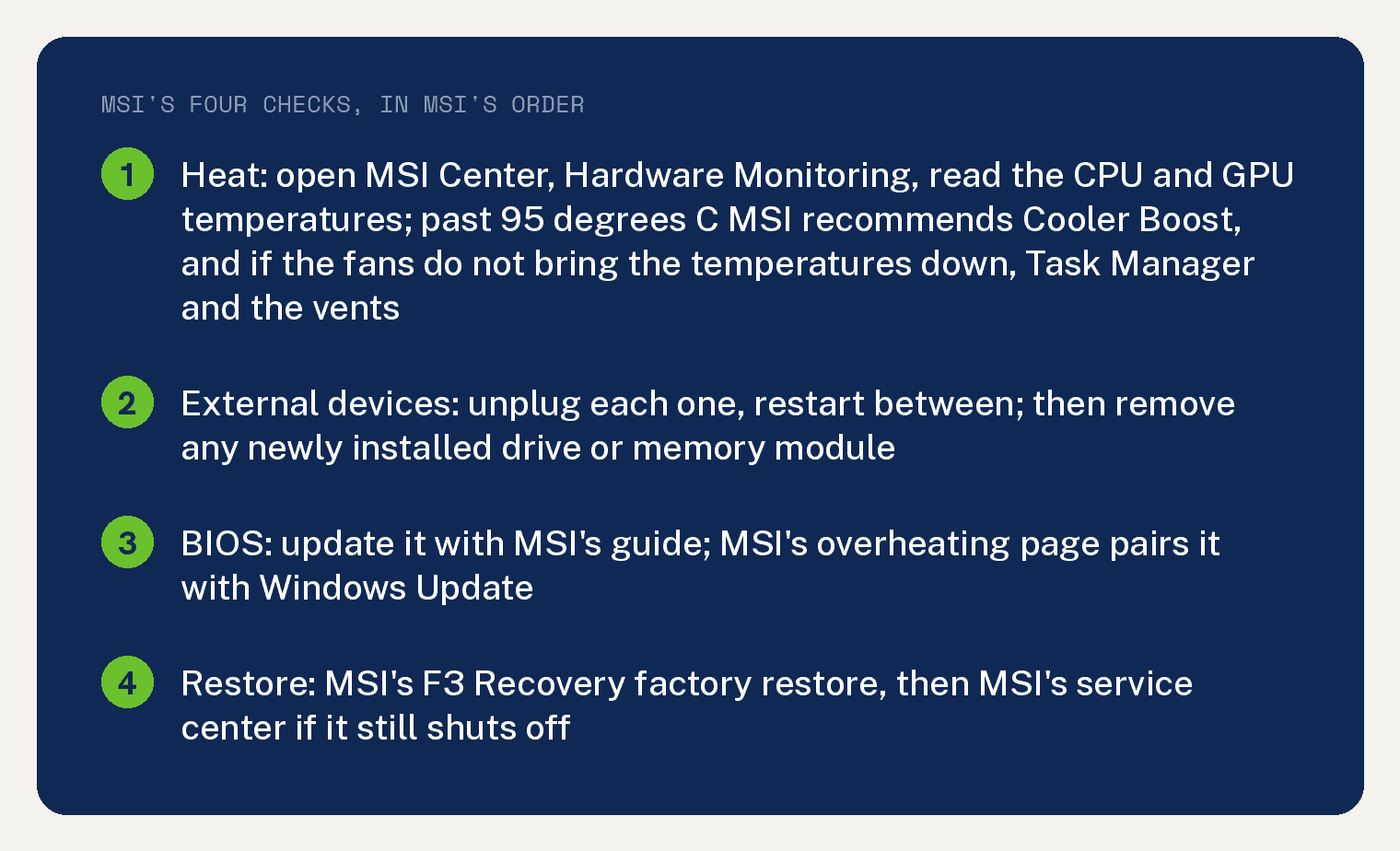
MSI’s shutdown page opens with the causes, qualified with the word can: “Hardware issues, software malfunctions, high temperatures, or an unstable operating system can all trigger automatic shutdowns.” Its four checks are the headings that follow, and this article walks them in MSI’s order with the extra checks from MSI’s overheating page folded in where MSI puts them.
The overheating page belongs here because MSI names shutdowns among its symptoms: “If your notebook experiences overheating during use, intermittent restarts, shutdowns, or performance degradation, please refer to the methods mentioned in this article for troubleshooting.”
Step 1: read the temperatures, then turn on Cooler Boost
Open MSI Center and go to its Hardware Monitoring screen, where MSI says to “check the CPU and GPU temperatures”. The line that decides what you do next is MSI’s: “If either of the temperatures exceeds 95” degrees C, “it is recommended to enable the” Cooler Boost “function to increase the fan speed and keep the CPU and GPU at appropriate operating temperatures.”
On the shutdown page the path to Cooler Boost runs through a gear icon. Select Features, choose User Scenario, then “Click on the small gear icon located at the bottom right of the” Extreme Performance icon, select Fan Speed, then Cooler Boost, then Save.
MSI’s overheating page prints the same destination with its own labels. Type MSI Center into the Windows search bar and open it, click Features, then User Scenario, select Extreme Performance, choose Fan Feed, adjust Fan Speed to Cooler Boost, and click Save.
If you would rather set each fan yourself, the shutdown page adds that you can choose Advanced “to customize the individual fan speed levels.”
If the fans do not bring the heat down
MSI’s shutdown page attaches two more checks to this step, under the condition “If adjusting the fan speed does not effectively reduce the CPU and GPU temperatures”. The first is Task Manager: “Open Task Manager and check if any applications are abnormally using CPU, GPU, or other system resources. If so, try closing them and see if the temperatures improve.”
The second is airflow. MSI’s line is “Ensure that the vents of your computer are not blocked by hair or dust, as this can hinder the cooling efficiency.”
The overheating page gives the cleaning method and a warning that travels with it: “For cleaning, we suggest to use compressed air cans or blowers, maintaining distance from the exhaust vents.” and “Please shut down the laptop before cleaning.”
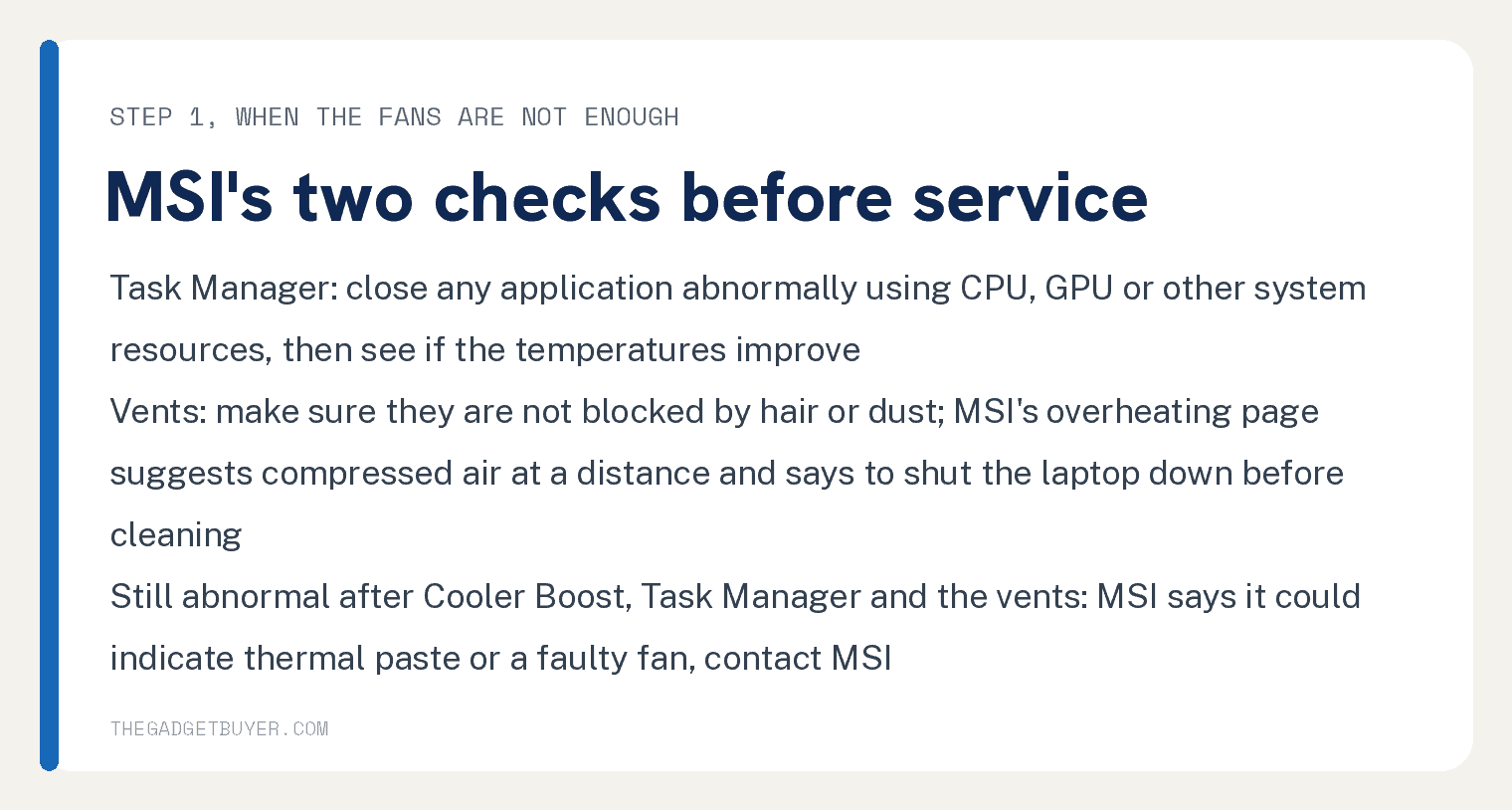
When the temperatures stay high after Cooler Boost, Task Manager and the vents, MSI’s shutdown page says “it could indicate a need to replace the thermal paste or a faulty fan. In such cases, it is recommended to contact MSI’s customer service center for further assistance.”
When they read as normal, keep going down the list. MSI’s instruction: “if the CPU and GPU temperatures are within the normal range, please continue to refer to the following troubleshooting steps.”
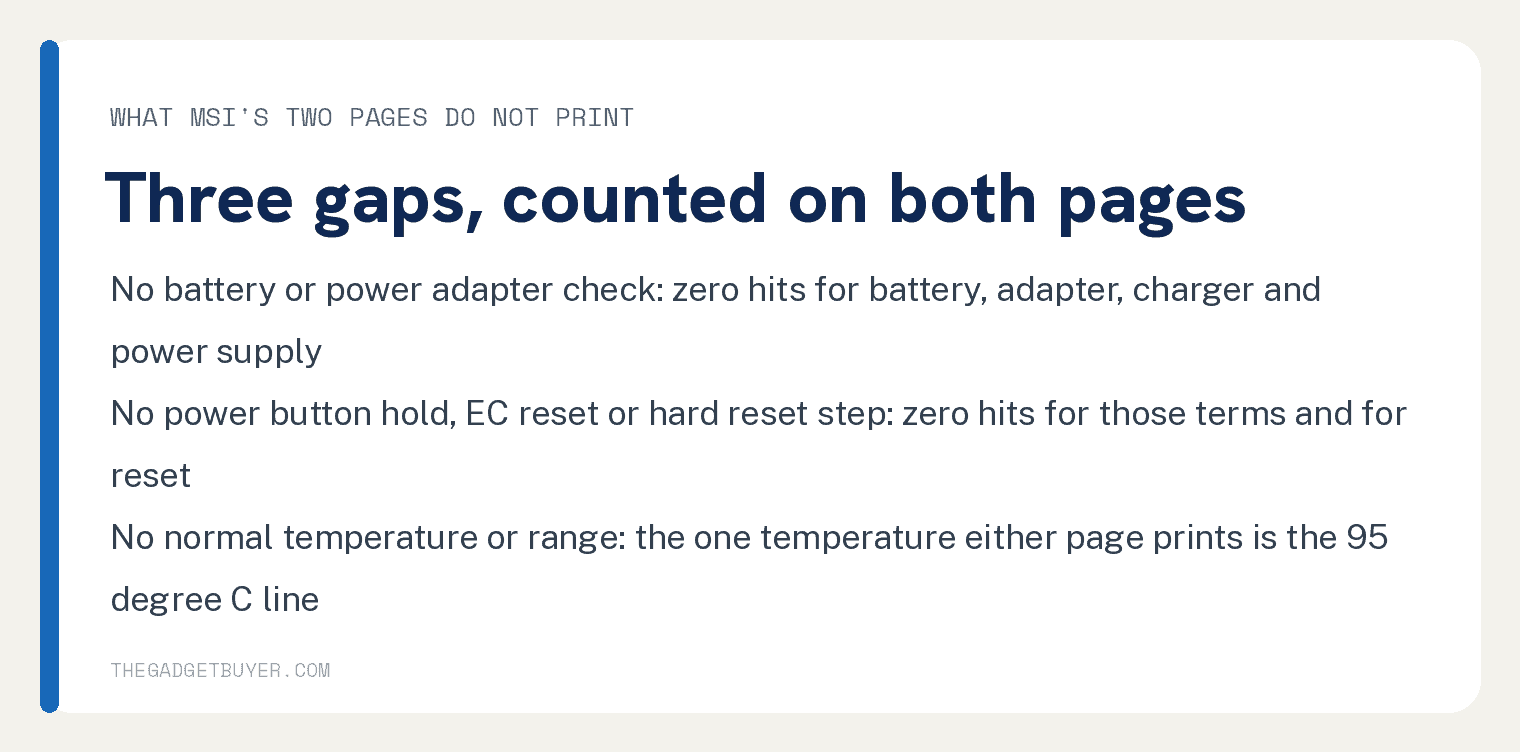
Neither MSI page prints what normal is as a number or a range. The one temperature either page prints is the 95 degree line above (counted on both pages: the degree sign appears once, on the shutdown page).
Step 2: unplug external devices, then remove new hardware
The second check is the things plugged into the laptop, and MSI qualifies it with can sometimes: “External devices connected to your computer, such as external hard drives, memory cards, optical drives, can sometimes cause automatic shutdowns or restarts.”
The method is one at a time, with a restart between. MSI’s words: “Please try disconnecting each external device one by one, and then restart your computer. If the issue does not occur after the restart, it is recommended to contact the manufacturer of the removed device for further assistance.”
If nothing is plugged in, or the shutdowns continue with everything unplugged, MSI turns to parts you added. Its instruction is to “check if you have recently installed any new hardware devices, such as hard drives or memory modules. If so, try removing the newly installed hardware device and check if the issue is resolved.”
Step 3: update the BIOS, and Windows with it
The third check on the shutdown page is the BIOS. MSI points to its own guide, “[Notebook]How to update BIOS?”, and says “to update the BIOS to the latest version, and then confirm whether the problem has been solved.”
The overheating page pairs that update with Windows Update under one heading, “Update BIOS and Run Windows Update”. MSI’s reason there carries its own qualifier: “Updating BIOS and Windows packages often helps resolve known issues and optimize system performance.”
If the laptop freezes rather than shuts off, our guide to an MSI laptop that keeps freezing is the one to read.
Step 4: factory restore with F3 Recovery
The last check before service is a restore to factory settings. The shutdown page points to its guide “How to restore the default factory system through F3 Recovery?” and then says “After restoring the system to its default factory settings, check if the issue is resolved.”
If the laptop still shuts off after all four, the shutdown page closes with service: “If you have followed the steps and the issue persists, please contact the MSI’s customer service center for further assistance.”
The fan scan on MSI’s overheating page
MSI’s overheating page has a check the shutdown page does not print: a fan diagnostic inside MSI Center. Click Features, select Hardware Diagnosis, click Auto Scan “for one-click scan, then click” Start, then “Initiate the test” and click OK when the scan completes.
MSI’s line on the result is “If the hardware test passes, it will display a success message.”
For the laptop that gets hot under games or editing, MSI’s own explanation is that “When running resource-intensive programs like games, video editing, or heavy data processing, the CPU/GPU temperature increases, and the fan speeds up to enhance cooling.”
What MSI’s two pages do not print
Neither page names the battery or the power adapter as a cause or a check (counted on both pages: zero hits for battery, adapter, charger and power supply). If your laptop dies only when unplugged, that case sits outside these two pages.
Neither page gives a power button hold, an EC reset or a hard reset step (zero hits for power button, EC reset, hard reset and reset on both pages).
Our general guide to a laptop power button that is not working and our explainer on what a GPU fan does are the two related reads on this site.
Frequently asked questions
Why does my MSI laptop shut off by itself while gaming?
MSI’s first check is heat, and its overheating page says that under “resource-intensive programs like games” the CPU and GPU temperature increases and the fan speeds up. Read the temperatures in MSI Center’s Hardware Monitoring screen; if either passes 95 degrees C, MSI recommends Cooler Boost, and if the fan speed does not bring the temperatures down, MSI says to consider Task Manager and the vents.
What temperature is normal for an MSI laptop?
Neither MSI page prints a normal temperature or a range. The one temperature either page prints is the 95 degree C line, above which MSI recommends Cooler Boost, and MSI says to continue to the next steps when the readings are “within the normal range” without putting a number on it.
Should I update the BIOS on my MSI laptop to stop the shutdowns?
MSI lists a BIOS update as the third of its four checks, after temperatures and hardware, and points to its own guide for the steps. Its overheating page pairs the BIOS update with Windows Update and says the two “often” help resolve known issues.
Does MSI say to reset the laptop with the power button?
Neither MSI page prints a power button hold, an EC reset or a hard reset step. MSI’s reset of last resort on these pages is the F3 Recovery factory restore in Step 4.