
How to Stop an Apple Watch Battery Dying Fast
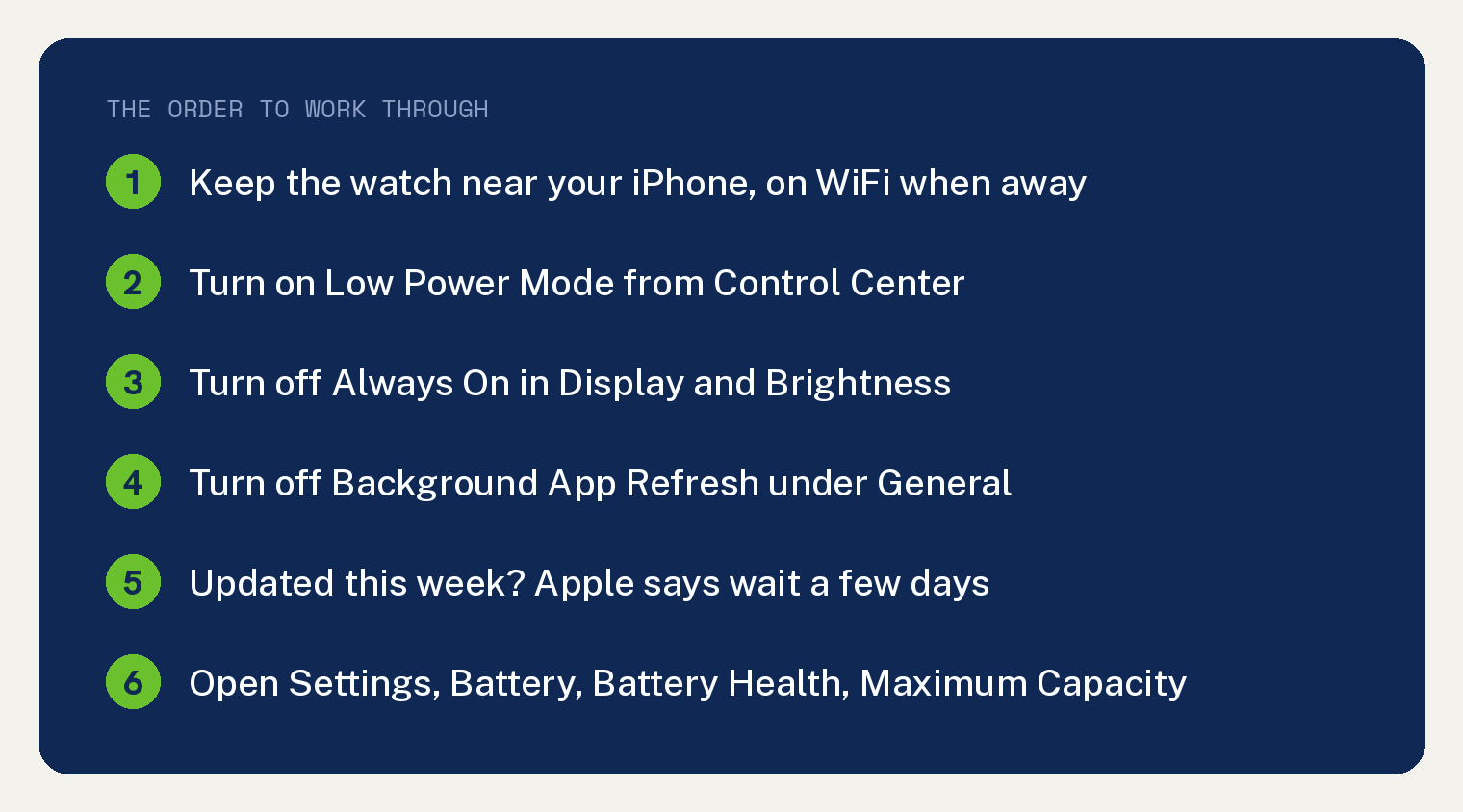
Work an Apple Watch battery dying fast in this order: keep the watch near your iPhone, turn on Low Power Mode, turn off Always On, turn off Background App Refresh, then open Battery Health.
Battery Health is the check for the battery itself. It shows Maximum Capacity, which Apple describes as a measure of your battery’s capacity relative to when it was new.
If that screen shows a Battery Needs Service message, Apple says to contact Apple Support.
Apple says Apple Watch battery life is a combination of many factors, including the age of your watch and how you use it. Apple’s page for a fast draining watch lists its fixes as a set of tips, so the order you see here is ours.
Every menu path below was checked against Apple’s support pages and its watchOS 26 user guide on September 13, 2026.
Find your case first
Match the row that sounds like your watch, then go to that section. If nothing matches, start at Step 1 and work down.
| What you are seeing | Where to go |
|---|---|
| It started right after a watchOS update | Apple says to wait a few days. Read the update section before you change settings. |
| It drains overnight | Apple lists background heart rate and blood oxygen readings, including during sleep, among what Low Power Mode turns off. Read the overnight section. |
| It drains during workouts | Apple has two Workout settings for this. Read the workout section. |
| Cellular model, used away from your phone | Apple says WiFi uses less battery power than cellular. Read Step 1, then the cellular section. |
| A few years old and slowly getting worse | Go to Step 7 and read Maximum Capacity. |
| None of the above | Start at Step 1. |
What Apple says drains an Apple Watch
Each row below pairs what Apple states with the setting that answers it. The last row is the single switch to try first.
| Drain | What Apple says | What to change |
|---|---|---|
| Away from your iPhone | The watch is most efficient with a Bluetooth connection to its paired iPhone. WiFi uses less battery power than cellular. | Keep the phone in range. Use WiFi when you are away from it. |
| Weak signal | WiFi and cellular use less battery power in places with strong signal strength. | Airplane Mode in weak WiFi or no coverage. |
| Always On display | Always On is one of the features Low Power Mode turns off. | Settings, Display & Brightness, Always On. |
| Background readings and refresh | Background heart rate and blood oxygen readings, including during sleep, are on the Low Power Mode list. Refreshing apps in the background can use power. | Low Power Mode, plus Settings, General, Background App Refresh. |
| Watch speaker audio | Speaker playback can drain the battery more quickly. | AirPods or another Bluetooth audio device. |
| A recent watchOS update | Update tasks continue in the background and might affect battery life. | Wait a few days, then check again. |
| A worn battery | Maximum Capacity measures capacity relative to when the battery was new. | Settings, Battery, Battery Health. |
| Start here | Low Power Mode covers the display row and the background readings row in one switch. | Side button, tap the battery percentage, turn on Low Power Mode. |
Step 1: Keep the watch near your iPhone
Apple’s drain page says your Apple Watch is most efficient when it has a Bluetooth connection to the iPhone it is paired with. When battery life is a priority, Apple says to keep the watch and iPhone within range of each other.
Leaving Bluetooth on your iPhone is part of that. Apple’s battery page says disabling Bluetooth on your iPhone increases the battery drain on your Apple Watch.
If you have been switching it off to save your phone, here is what turning Bluetooth off does to an Apple Watch.
When the iPhone is not nearby, the watch can connect to WiFi, or to cellular on models that support it. Apple says WiFi uses less battery power than cellular networks, so use WiFi when you can.
Signal strength counts as well. Apple says WiFi and cellular connections use less battery power in places with strong signal strength.
Apple’s advice for a dead zone is Airplane Mode. If you know you will be in an area with weak WiFi signals or no cellular coverage for some time, Apple says to turn it on to save battery.
Here is how to read your signal on the watch.
- Press the side button on your watch to open Control Center.
- Look at the top of the display for a small blue WiFi icon or a green cellular icon.
- Count the bars in that icon. Apple says they indicate WiFi or cellular signal strength, similar to your iPhone.
Step 2: Turn on Low Power Mode
Low Power Mode is the one switch that covers the display row and the background readings row of the table above. Apple says Low Power Mode arrived in watchOS 9.0.
- Press the side button on your watch to open Control Center.
- Tap the battery percentage button.
- Turn on Low Power Mode.
- Scroll to the bottom of the information screen, then tap Turn On. To set a length instead, tap Turn On For and choose On for 1 Day, On for 2 Days or On for 3 Days.
Success looks like a yellow circle icon at the top of the screen.
The Settings route reaches the same switch. Open the Settings app on your watch, scroll down, tap Battery, then turn on Low Power Mode.
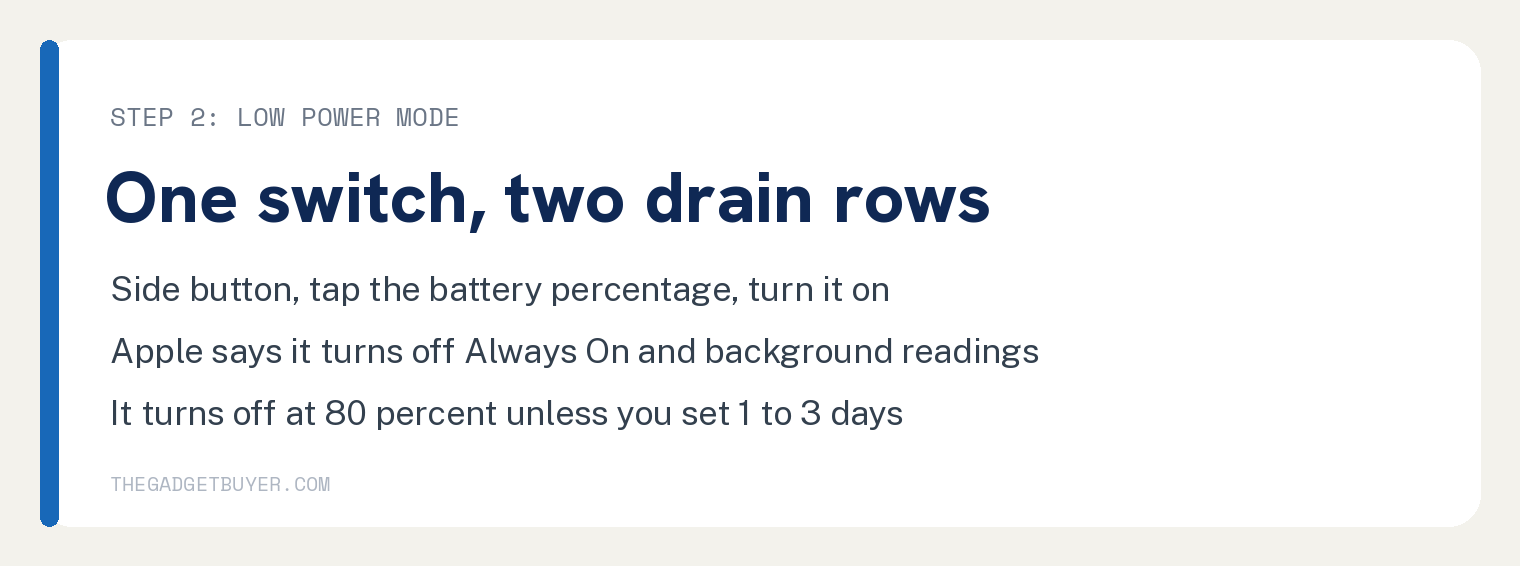
Apple’s list of the features Low Power Mode turns off includes these three:
- Background blood oxygen measurements, including during sleep
- Background heart rate measurements, including during sleep
- Always On display
Apple’s full list is in the FAQ below.
When your iPhone is not nearby, Apple says it also turns off WiFi and cellular connections along with incoming phone calls and notifications. Missed calls and notifications are retrieved once an hour.
Apple names one trap on that page. In Low Power Mode without your iPhone nearby, opening an app that requires a data connection turns WiFi or cellular on so the app can work, and Apple says this can cause significant battery consumption.
Apple also lists what slows down: a phone call can take longer, background app refresh happens less frequently, complications and Live Activities update less frequently, Siri can take longer to process a request, and some animations and scrolling might appear less smooth.
Low Power Mode turns off automatically when your battery is charged to 80 percent, unless you chose a number of days. Apple says your watch also offers it through an alert when the battery goes down to 10 percent.
Step 3: Turn off Always On and stop needless wakes
To keep the sensors running and drop only the screen, turn Always On off on its own. Apple’s drain page gives this path and the watchOS 26 guide matches it.
- Open the Settings app on your watch.
- Tap Display & Brightness.
- Scroll down, then tap Always On.
- Tap Always On to turn off the feature.
Two limits come straight from Apple. Always On is not available while your Apple Watch is in Low Power Mode, and Always On is not supported on Apple Watch SE (2nd Generation).
If you would rather keep Always On, the same screen sets what stays visible with your wrist down through Show Complication Data, Show Notifications and Show Apps.
Wake on Wrist Raise decides whether the screen lights every time you lift your arm. Apple suggests turning it off if you are very active with your hands and your watch display turns on more than you think it should.
With it off, tap the display or press the Digital Crown when you want the screen. Apple’s tip for preventing that wake temporarily is Theater Mode.
Apple prints this switch in two places. Apple’s battery page says Settings, then General, then Wake Screen, and the watchOS 26 user guide puts it under Display & Brightness.
Follow the Display & Brightness path if your watch runs watchOS 26, since that is the version of the guide Apple serves today.
Step 4: Stop apps refreshing in the background
Apple’s watchOS guide says that when you switch to a new app, the app you were using does not remain open or take up system resources. Swiping apps closed by hand is the first thing the old version of this article got wrong.
Apple says those apps may still refresh, meaning they check for updates and new content in the background. Apple says refreshing apps in the background can use power.
- Open the Settings app on your watch.
- Tap General, then tap Background App Refresh.
- Turn off Background App Refresh to prevent all apps from refreshing. To be selective instead, scroll down and turn off refresh for individual apps.
Success looks like every switch you tapped sitting in the off position.
Apple notes one limit. Apps with complications on the current watch face continue to refresh even when their background app refresh setting is off.
If one of those apps sits on your face and you do not need it there, swap that complication or pick another face.
Step 5: Clear the smaller drains
Newer Apple Watch models can play audio through the built in speaker. Apple says this can drain the battery more quickly, and names AirPods or another Bluetooth audio device as the choice for the best battery efficiency.
If you run or walk without your phone, load the music onto the watch itself and listen through headphones.
Temperature is on Apple’s list too, and the wording matters. Apple’s battery performance page, writing about Apple devices in general, says it is especially important to avoid exposing your device to ambient temperatures higher than 95 F (35 C), which can permanently damage battery capacity.
Apple adds on that same page that charging the device in high ambient temperatures can damage it further.
Apple gives the watch its own version of that advice. Apple says to avoid charging or leaving Apple Watch in hot environments, including direct sun exposure, for extended periods of time.
Cold reads differently in Apple’s wording. Apple says that when you use your device in a very cold environment you may notice a decrease in battery life, and that this condition is temporary.
Apple also says performance returns to normal once the battery temperature returns to its normal operating range.
Charging from a computer can work against you. Apple says that if your Apple Watch is connected to a computer that is turned off or is in sleep or standby mode, the Apple Watch battery may drain.
Step 6: Restart the watch and your iPhone
Apple opens its restart page with one line: if something is not working right, try restarting your Apple Watch and its paired iPhone. Take the watch off its charger first, because Apple says you cannot restart it while it is charging.
Both the normal restart and the force restart, step by step, live in our Apple Watch restart walkthrough.
Step 7: Read Maximum Capacity in Battery Health
This step checks the battery itself. Settings cannot put capacity back.
- Open the Settings app on your watch.
- Tap Battery, then tap Battery Health.
- Scroll down to Maximum Capacity.
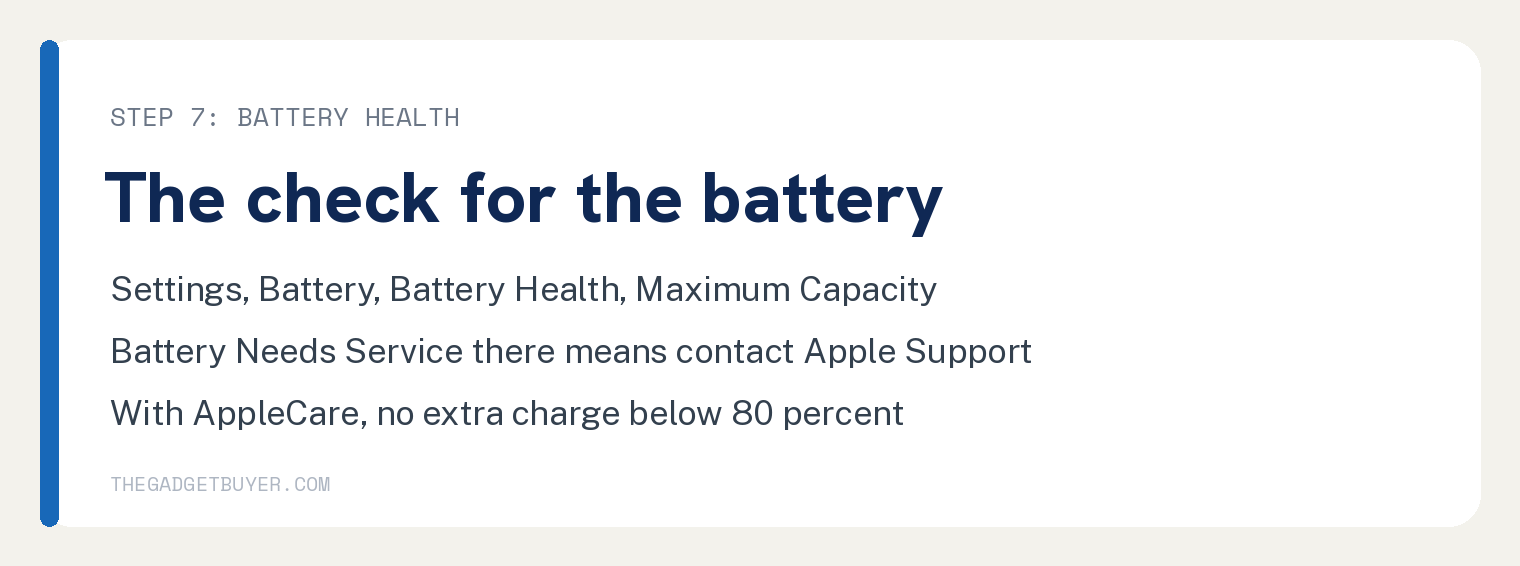
Apple says the percentage shown is a measure of your battery’s capacity relative to when it was new. Apple also says a battery can show slightly less than 100 percent on a new watch, because of the length of time between when the watch was made and when it was activated.
Apple’s design target is a battery that retains up to 80 percent of its original capacity at 1000 complete charge cycles.
Apple’s page for a fast draining Apple Watch prints no capacity number that means replace it now. Checked on September 13, 2026, the words cutoff, threshold, worn and degrade return zero hits on that page, and its only mention of 80 percent is the point where Low Power Mode switches off.
Apple’s instruction there is a message check. If you see a message in Battery Health that says Battery Needs Service, or if you think your battery needs replacement, Apple says to contact Apple Support.
Apple says your watch also alerts you when battery capacity is significantly reduced, so you can check your service options.
If there is no Battery Needs Service message, go back and work through Steps 1 to 5.
Coverage decides what happens after you contact Apple. Apple says the one year warranty for Apple Watch and Apple Watch Sport, and the two year warranty for Apple Watch Edition, include service coverage for a defective battery.
Apple’s Apple Watch service and repair page says the warranty does not cover batteries that wear down from normal use. That same page says AppleCare replaces the battery for no extra charge if the capacity drops below 80 percent.
Out of warranty, Apple says it offers a battery service, and that prices and terms may vary. Apple also says to use Apple or an authorized service provider.
A worn battery can show up in ways beyond short life. Apple’s Apple Watch Battery and Performance page says Series 5 and later, SE and later and Ultra and later manage performance impacts, and that examples of these effects may include longer app launch times, screen dimming, lower speaker volume or missing heart rate data during a workout.
Apple says those impacts may be noticed in certain conditions such as a battery with a low state of charge, a high peak power situation, or a chemically aged battery.
If that sounds like your watch, the choice is service or a newer model. Our guide to choosing an Apple Watch covers the second path.
If the drain started right after a watchOS update
Apple says that even though you can use your Apple Watch immediately after you update watchOS, certain tasks related to the update continue in the background and might affect battery life.
Apple’s instruction is to wait a few days and then check again.
Apple also says some models recalibrate and then estimate maximum battery capacity more accurately after a software update. Series 7 and SE 2 recalibrate after updating to watchOS 26 or later, and Series 8 and Apple Watch Ultra recalibrate after updating to watchOS 26.6 or later.
Apple’s drain page carries no watchOS 26 specific fix beyond that wait. That page was checked for the strings watchOS 26, bug, known issue, reinstall, erase and unpair on September 13, 2026, with zero hits.
If the update itself will not finish, start with the update troubleshooting steps.
If the battery drains overnight
Apple lists background blood oxygen measurements and background heart rate measurements, including during sleep, among the features Low Power Mode turns off.
That tells you those readings keep running through the night while Low Power Mode is off.
Turning Low Power Mode on for 1 day, from Step 2, is the switch that covers them.
Apple says that if your Apple Watch is charged less than 30 percent before you go to bed, you are prompted to charge it.
Charging Reminders goes a step further. Apple says it reminds you to charge your watch before your wind down time and notifies you when your watch is fully charged.
That setting lives on the watch under Settings, then Sleep. On your iPhone, open the Apple Watch app, tap My Watch, then tap Sleep.
Apple builds sleep into its own rating. Apple’s all day figure for Series 11 is based on use that includes 6 hours of sleep tracking over the course of 24 hours.
If the battery drains during workouts
Apple gives you two Workout settings for this, and both live on the same screen.
- Open the Settings app on your watch.
- Scroll down, then tap Workout.
- Tap Low Power Mode. Apple says it then turns on automatically when you begin any workout in the Workout app.
- Tap Fewer GPS and Heart Rate Readings for the second, deeper setting.
Apple says that when you use the Workout app in Low Power Mode, your battery lasts longer while metrics such as heart rate and pace are still measured.
Apple says the second setting turns on automatically when Low Power Mode is active and you begin an outdoor walking, running or hiking workout in the Workout app. Apple adds that your watch needs to be in Low Power Mode for this feature to work.
Apple says reducing the frequency of these readings can extend your battery’s use significantly during long workouts.
Apple names the cost as well. Workout alerts are turned off, splits and segments are not recorded, and metrics such as current pace are not available.
Apple says the feature is available with watchOS 9.1 and later on Apple Watch Series 8 and later, Apple Watch SE 2 and later, and Apple Watch Ultra and later.
If you have a cellular model
Apple’s own rating tells you how much cellular time it counts. For Series 11 with cellular, Apple’s 24 hour figure is based on a total of 4 hours of cellular connection and 20 hours of connection to iPhone via Bluetooth.
A full day on cellular sits outside the use Apple tested.
Apple says WiFi uses less battery power than cellular networks, so use WiFi when you can, and turn on Airplane Mode when you know you will be in weak WiFi or no cellular coverage for some time.
Low Power Mode helps here too. Apple’s guide says cellular is turned off until you require it, such as when you stream music or send a message.
The Step 2 trap applies to you most of all. Opening an app that requires a data connection while you are in Low Power Mode without your iPhone nearby turns the radio on, and Apple says that can cause significant battery consumption.
Why your watch stops charging at 80 percent
Apple says Optimized Battery Charging is on by default when you set up your watch. Apple says the watch delays charging past 80 percent in certain situations, and that in those situations the battery level remains between 75 and 80 percent.
Here is how to fill it the rest of the way right now.
- Keep your Apple Watch connected to its charger.
- Tap your watch to show the charging screen.
- Tap the circle with the green or yellow charging icon.
- Tap Charge to Full Now.
You can also switch the feature off for a day. Open Settings, scroll down and tap Battery, tap Battery Health, turn off Optimized Battery Charging or Optimized Charge Limit, then choose Turn Off Until Tomorrow or Turn Off.
Apple warns that turning off Optimized Charge Limit can increase wear on your battery and reduce its lifespan.
Apple says that if you have Apple Watch Series 9 or later, or any Apple Watch Ultra, Optimized Battery Charging is always on.
A yellow charging symbol is a separate signal. Apple says that if the charging symbol is yellow, your Apple Watch is in Low Power Mode, which turns off when the battery is charged to 80 percent.
FAQ
How long should an Apple Watch battery last on one charge?
Apple rates them by model, so the old answer of 18 hours for every watch is out of date. Series 12 and Series 11 are rated up to 24 hours, Ultra 4 up to 50 hours, and Ultra 3 up to 42 hours.
Ultra 2 and the first Apple Watch Ultra are rated up to 36 hours. SE 3, SE 2, the first SE, Series 10, Series 9 and every model from Series 8 back to Series 1 are rated up to 18 hours.
Apple adds that battery life varies by use, configuration, cellular network, signal strength and many other factors, and that actual results will vary.
Should I close apps on my Apple Watch to save battery?
No. Apple’s watchOS guide says that when you switch to a new app, the app you were using does not remain open or take up system resources.
Background App Refresh is the setting that changes power use, and Step 4 walks through turning it off for all apps or for one app at a time.
What do I give up in Low Power Mode?
Apple’s list is background blood oxygen and heart rate measurements including during sleep, heart data for hypertension notifications, heart rate notifications, the Always On display, double tap and wrist flick gestures, the start workout reminder and Time in Daylight.
Away from your iPhone it also turns off WiFi and cellular connections, incoming calls and notifications, and Apple says missed calls and notifications are retrieved once an hour.
Apple says workouts in Low Power Mode still measure metrics such as heart rate and pace.
What Maximum Capacity number means the battery is worn out?
Apple’s page for a fast draining Apple Watch prints no number for that. Checked on September 13, 2026, the words cutoff, threshold, worn and degrade return zero hits on that page.
Apple says to contact Apple Support if Battery Health shows a Battery Needs Service message, and Apple’s service and repair page says AppleCare replaces the battery for no extra charge if the capacity drops below 80 percent.
Apple’s design target is a battery that retains up to 80 percent of its original capacity at 1000 complete charge cycles.
Does Low Power Mode damage the battery over time?
Apple’s Low Power Mode page describes the feature as a way to reduce the power your Apple Watch uses, and it prints no long term cost. That page was checked on September 13, 2026 for the words wear, lifespan, damage, degrade and capacity, with zero hits.
The wear warning Apple does print is about a different switch. Apple says turning off Optimized Charge Limit can increase wear on your battery and reduce its lifespan.
Why did my Maximum Capacity number change after a watchOS update?
Apple says some Apple Watch models recalibrate and then estimate maximum battery capacity more accurately after receiving a software update.
Apple names Series 7 and SE 2 after watchOS 26 or later, and Series 8 and Apple Watch Ultra after watchOS 26.6 or later.