
When Your iPad Keeps Freezing, Match the Fix to the Freeze
If your whole iPad is frozen, force restart it. On an iPad without a Home button, press and quickly release the volume button closest to the top button, do the same with the volume button farthest from it, then hold the top button until you see the Apple logo.
On an iPad with a Home button, press and hold the Home button and the top button together until the Apple logo appears. If your iPad keeps freezing in one app, or freezes again after it restarts, the steps below match each case to its fix.
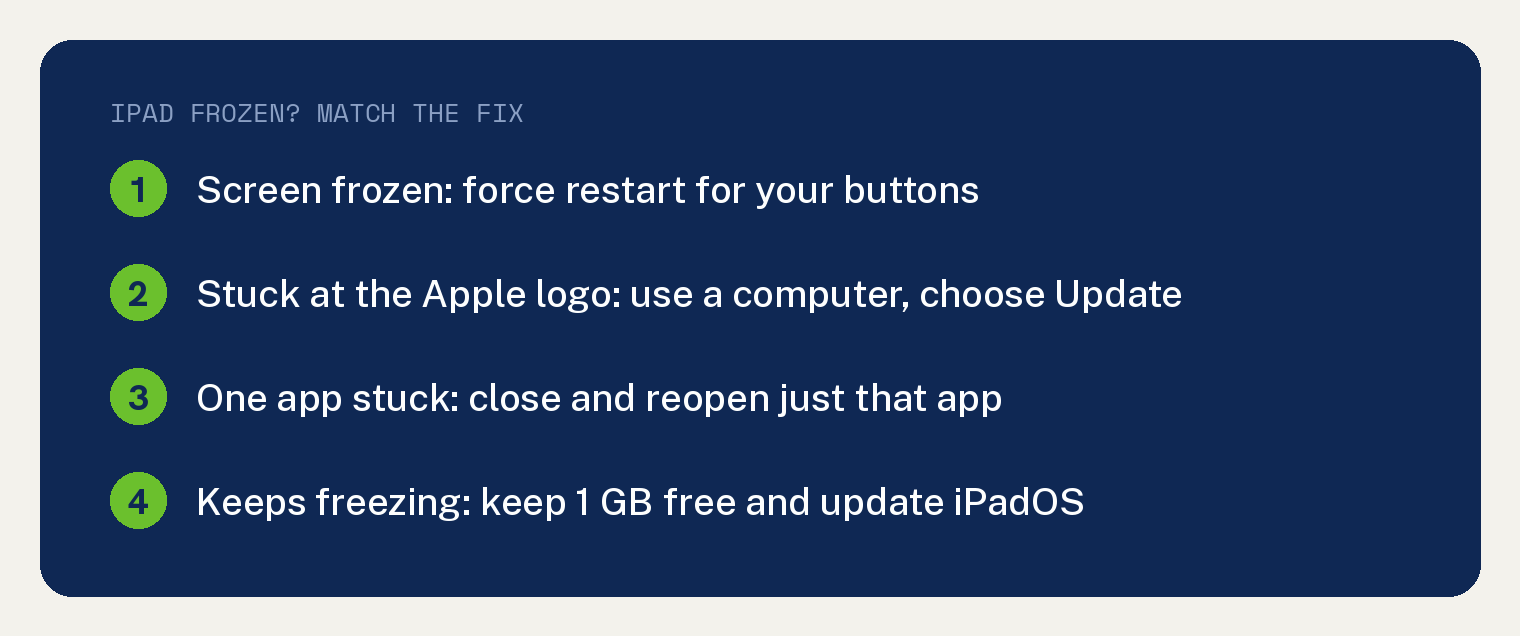
The restart steps come from Apple’s support page for an iPad that won’t turn on or is frozen.
What does your iPad freeze look like?
Apple covers these freezes on separate support pages. This table is our own map of which steps fit what you see on your screen.
| What you see | Start here | Apple’s page |
|---|---|---|
| Screen frozen or black, no response to touch | Force restart for your buttons | iPad won’t turn on or is frozen |
| Apple logo, or a red or blue screen, at startup | Connect to a computer, choose Update | iPad won’t turn on or is frozen |
| One app stops responding | Close and reopen that app | App stops responding |
| Freezes or slows down again and again | Storage, power and battery checks | iPhone or iPad running slow |
How do you force restart a frozen iPad?
Use the steps for your iPad’s buttons. Apple’s page labels them “On your iPad without a Home button” and “On your iPad with a Home button”.
iPad without a Home button
- Press and quickly release the volume button closest to the top button.
- Press and quickly release the volume button farthest from the top button.
- Press and hold the top button until you see the Apple logo.
iPad with a Home button
Apple’s step is one line: “Press and hold both the Home button and the top button until you see the Apple logo.”
If the screen stays black
If your iPad doesn’t turn on after this, Apple’s next step is to check the hardware and charge it. Apple adds: “You might need to charge for up to an hour.”
If it still won’t turn on, see our guide to an iPad that won’t turn on.
What if your iPad is stuck on the Apple logo?
An iPad that shows the Apple logo, or a red or blue screen, during startup and goes no further is a different problem. Apple’s fix uses a computer: the steps put the iPad in recovery mode, then have you choose Update.
- Connect your iPad to a computer. On a Mac with macOS Catalina 10.15 or later, open the Finder; on a Mac with macOS Mojave or earlier, open iTunes; on a PC, use the latest version of the Apple Devices app or iTunes.
- Find your iPad on the computer.
- With the iPad still connected, press the buttons for your model (below).
- Keep holding until you see the recovery mode screen.
- When you get the option to restore or update, choose Update.
No Home button: press and quickly release the volume button closest to the top button, then the volume button farthest from it. Then press and hold the top button, and keep holding it after the Apple logo appears.
Home button: press and hold both the Home button and the top button, and keep holding.
Your computer then downloads the software for your iPad. Watch the clock: “If it takes more than 15 minutes, your iPad will exit recovery mode, and you’ll need to repeat steps 2–4.”
If your iPad gets past startup but then restarts by itself over and over, see our guide on why your iPad keeps restarting.
What if only one app keeps freezing?
Close that one app and open it again. Apple’s page for an app that stops responding gives these steps in this order:
- Close the app, then open it again.
- Restart your iPad, then open the app again.
- Check for an app update. Open the App Store, tap your profile icon, then tap App Updates.
- If the app has no update, update iPadOS (steps below, under Update iPadOS).
- Delete the app, then download it again.
To close an app, Apple’s page for an iPad that runs slow says to swipe up from the bottom of the screen (or double click the Home button on older device models), find the app, and swipe up on its preview.
Know the risk before step 5. Apple warns: “When you do this, you might lose data that was stored in the app.”
If the app still freezes, Apple’s page says: “If you found the app on the App Store, contact the app developer.”
Should you close all your apps to stop freezing?
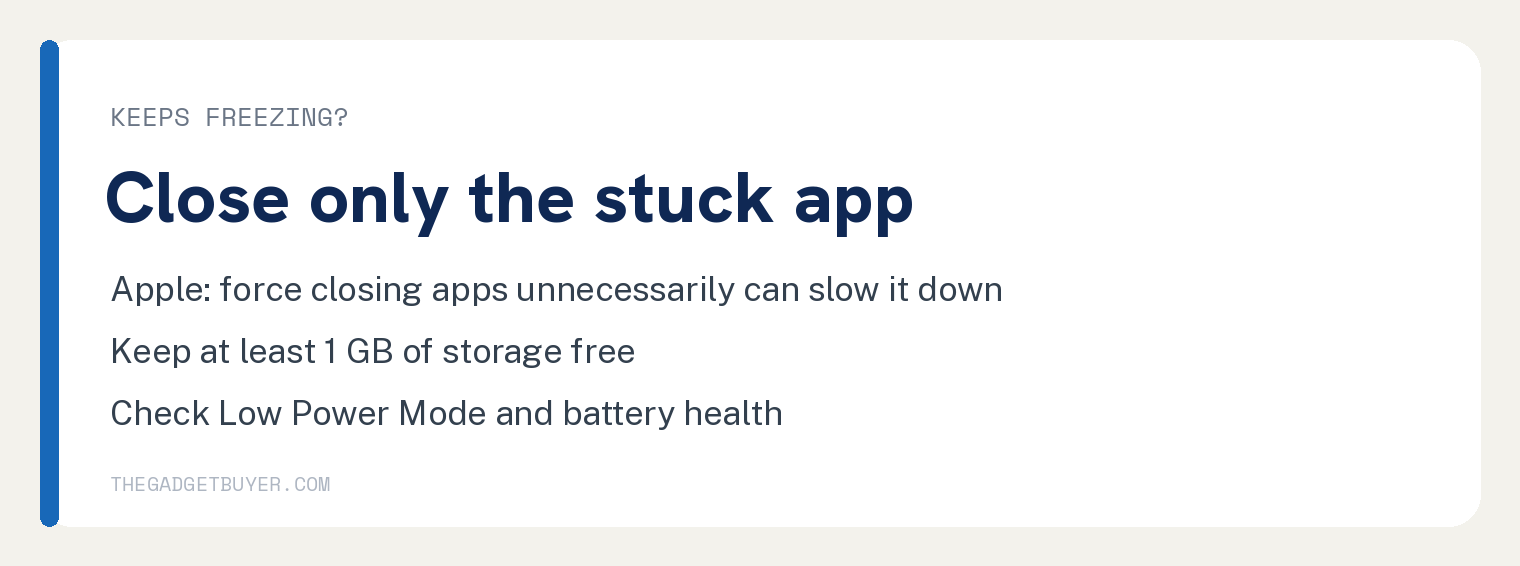
No. Close just the app that has stopped responding. Apple says: “Force closing apps unnecessarily can slow down your device.”
Apple gives the reason on the same page: “Reopening a closed app takes longer because it has to reload all its data.”
Why does my iPad keep freezing?
Apple’s page for an iPhone or iPad that freezes or runs slow says: “If your iPhone or iPad freezes or has performance issues, try these tips.” Our order starts with storage and software.
Keep at least 1 GB of storage free
A nearly full iPad can slow down. Apple says: “To avoid slowdowns, maintain at least 1 GB of free space.”
To check, open Settings, tap General, then tap the Storage line for your device. Tap an app in the list to free space.
Offloading an app “frees up storage used by the app, but keeps its documents and data.” Deleting an app “removes the app and its related data.”
Update iPadOS
Apple’s app page sends you to a software update when an app has none of its own. To update over Wi-Fi:
- Back up your iPad using iCloud or your computer.
- Plug it into power and connect to the internet with Wi-Fi.
- Open Settings, tap General, then tap Software Update.
- If an update is available, tap Download and Install, then follow the onscreen instructions.
If the update won’t install, see our guide to an iPad that won’t update to iPadOS 26.
Check your internet connection
A busy or changing network can slow apps down. Apple says: “Apps often need an internet connection, and slow performance can occur due to network congestion or when a device reconnects to cell towers while moving.”
Apple adds: “Even with a strong signal, you might need to wait, try a different location, or use Wi-Fi.”
Turn off Low Power Mode
Low Power Mode saves battery by cutting how much power the iPad uses. When it is on, Apple says it “disables certain features or makes them work slower, and the battery icon turns yellow.”
Apple says: “Low Power Mode can be turned on by going to Settings and tapping Battery.” Apple adds: “If you need your iPhone or iPad to function without low-power restrictions, consider leaving Low Power Mode off.”
Keep it out of the heat and cold
An iPad that is too hot or too cold “might run slower,” Apple says. Move it somewhere with a more moderate temperature.
Check battery health
Batteries wear out over time, and Apple says an aging battery “loses capacity and peak performance.” To check yours, open Settings, tap Battery, then tap Battery Health.
When does a freezing iPad need service?
Apple’s frozen iPad page says: “If your iPad still isn’t working, you might need service.”
Check the screen too. Apple notes that “A touch screen that responds to taps incorrectly can make your device seem slow.” If yours misreads taps, see our fixes for an iPad touchscreen not working.
Sources
- If your iPad won’t turn on or is frozen (Apple Support)
- If an app on your iPhone or iPad stops responding (Apple Support)
- If your iPhone or iPad is running slow (Apple Support)
- Update your iPhone or iPad (Apple Support)
None of the buttons on the main screen will push. I can’t troubleshoot because it won’t let me use ANY BUTTON.