
iPhone Unlocking Without Passcode? That Is Face ID at Work
An iPhone unlocking without passcode entry is Face ID doing its job: once your face is enrolled, a look at the screen opens the phone and the passcode stays in reserve. Apple’s line: “With a simple glance, Face ID securely unlocks your iPhone or iPad Pro.”
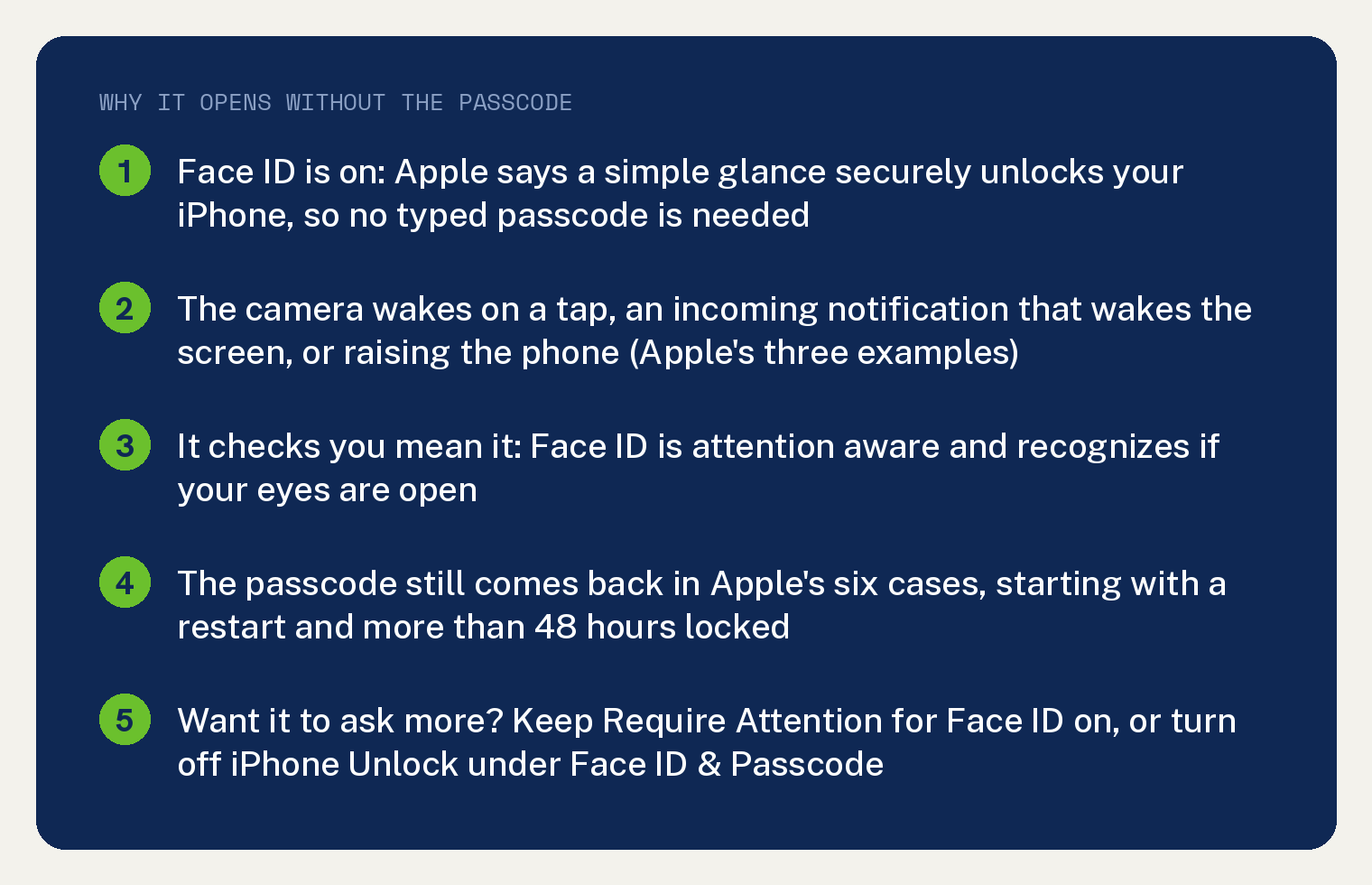
The phone wakes its camera on its own. Apple gives three examples: the camera “is intelligently activated; for example, by tapping to wake your screen, from an incoming notification that wakes the screen, or by raising to wake your iPhone.”
So a tap, a notification that wakes the screen or a lift, with the camera seeing your face or your eyes, is the whole unlock when your eyes are open and looking at the screen. The passcode is still set underneath, and Apple lists the moments it comes back, below.
Why does my iPhone unlock without the passcode?
Because Face ID is on and it saw you. Apple’s requirement is that the TrueDepth camera sees your face or your eyes, and it says that holds whether the phone is lying on a surface or held in a natural position.
It also checks that you mean it. Apple’s page calls Face ID attention aware, says it “recognizes if your eyes are open”, and adds: “This makes it more difficult for someone to unlock your device without your knowledge (such as when you are sleeping).”
If your phone opens while you are looking at it from arm’s length or less, that is the feature working as designed. Apple puts the odds of a stranger’s face opening it at “less than 1 in 1,000,000 with a single enrolled appearance whether or not you’re wearing a mask.”
When does the iPhone still ask for the passcode?
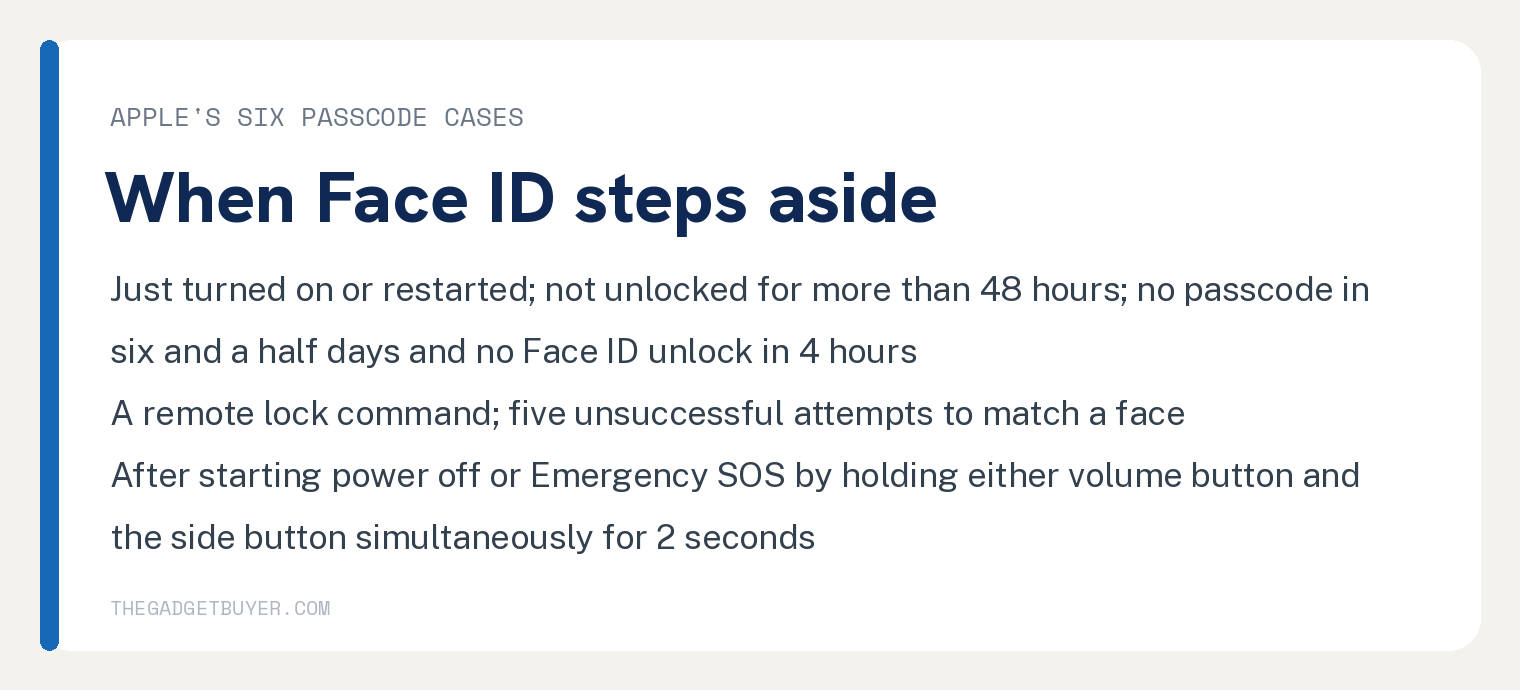
Apple ties Face ID to a passcode and lists six moments the passcode is required instead. Its lead in: “To use Face ID, you must set up a passcode on your device. You must enter your passcode for additional security validation when:”
- “The device has just been turned on or restarted.”
- “The device hasn’t been unlocked for more than 48 hours.”
- “The passcode hasn’t been used to unlock the device in the last six and a half days and Face ID hasn’t unlocked the device in the last 4 hours.”
- “The device has received a remote lock command.”
- “After five unsuccessful attempts to match a face.”
- “After initiating power off or Emergency SOS by pressing and holding either volume button and the side button simultaneously for 2 seconds.”
A separate sentence on the same page covers a big change in your look. Apple’s example is shaving a full beard: Face ID “confirms your identity by using your passcode before it updates your face data.”
How do I make my iPhone ask for the passcode more?
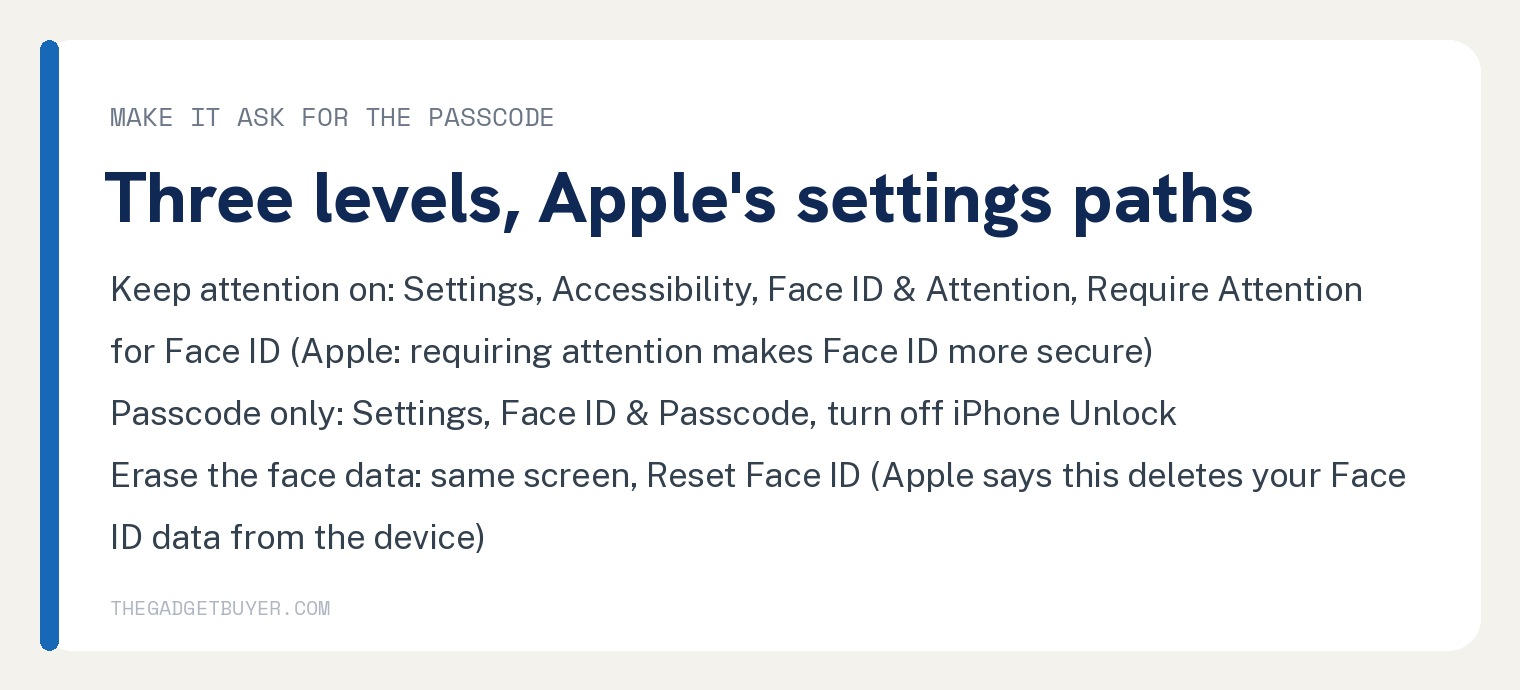
You have three levels, and this site’s recommendation is the first one. It is to make sure Require Attention for Face ID is turned on, so the phone opens only when you are looking at it.
Apple’s guide describes that setting as “an additional level of security”, and its note reads: “Requiring attention makes Face ID more secure.”
The path, from Apple’s guide: “Go to Settings > Accessibility > Face ID & Attention.” Apple’s page on the technology adds one case where this setting is off without you touching it: it is turned off automatically if you enable VoiceOver during initial setup.
The second level is to stop Face ID unlocking the phone at all, so only the passcode opens it. Apple’s path: open Settings, then Face ID & Passcode, and turn off iPhone Unlock.
The third level erases your face data. On the same Settings screen, Apple says to tap Reset Face ID, and that doing so “will delete Face ID data, including mathematical representations of your face, from your device.”
Could someone else be unlocking it?
Apple names the people whose faces have higher odds of matching yours, and says the odds rise further with Face ID with a mask: twins and siblings who look like you, and children under 13, “because their distinct facial features might not have fully developed.” Its advice for that case: “If you’re concerned about this, we recommend using a passcode to authenticate.”
For a lost or stolen phone, Apple’s page says you “can prevent Face ID from being used to unlock your device by marking your device as lost in Find My.”
What Apple’s two pages do not cover
Both pages cited below are Face ID pages. An iPhone with a Home button and Touch ID is outside them: the string Touch ID appears on the technology page only in two comparison lines, and on the guide page only as links to Set up Touch ID, so this article gives no Touch ID steps.
Neither page prints a Raise to Wake or Tap to Wake setting path (those strings count 0 on both), and neither names a pocket or bag unlock case (pocket and bag count 0). Apple’s sleeping example above is the only example printed on these two pages of someone unlocking the phone without your knowledge.
Related on this site: an iPhone that says Unavailable, resetting an Apple ID password, and an Apple ID disabled for security reasons.
Frequently asked questions
Is it a problem if an iPhone unlocks without the passcode?
No, with Face ID set up. Apple: “To unlock your device using Face ID, simply glance at it.” The passcode is still required in the six cases Apple lists, starting with a restart.
Why did my iPhone unlock while it was lying on the table?
Face ID works from that position when it can see you: Apple says the camera must see your face or your eyes whether the phone is lying on a surface or held in a natural position. A notification that wakes the screen is one of Apple’s three examples.
How do I make my iPhone only unlock with the passcode?
Turn off iPhone Unlock under Face ID. Apple’s path is Settings, then Face ID & Passcode, then disable iPhone Unlock. To erase the face data too, Apple’s step on the same screen is Reset Face ID.
Can my iPhone unlock while I am asleep?
Apple’s attention check covers that case: Face ID “recognizes if your eyes are open”, which Apple says makes it harder for someone to unlock the phone without your knowledge, sleeping being its example. Keep Require Attention for Face ID on; Apple’s note is that “Requiring attention makes Face ID more secure.”