
Do You Need Mesh WiFi or Just a Better Router?
This article contains Amazon affiliate links. The Gadget Buyer may earn a commission when you buy through them, at no extra cost to you.
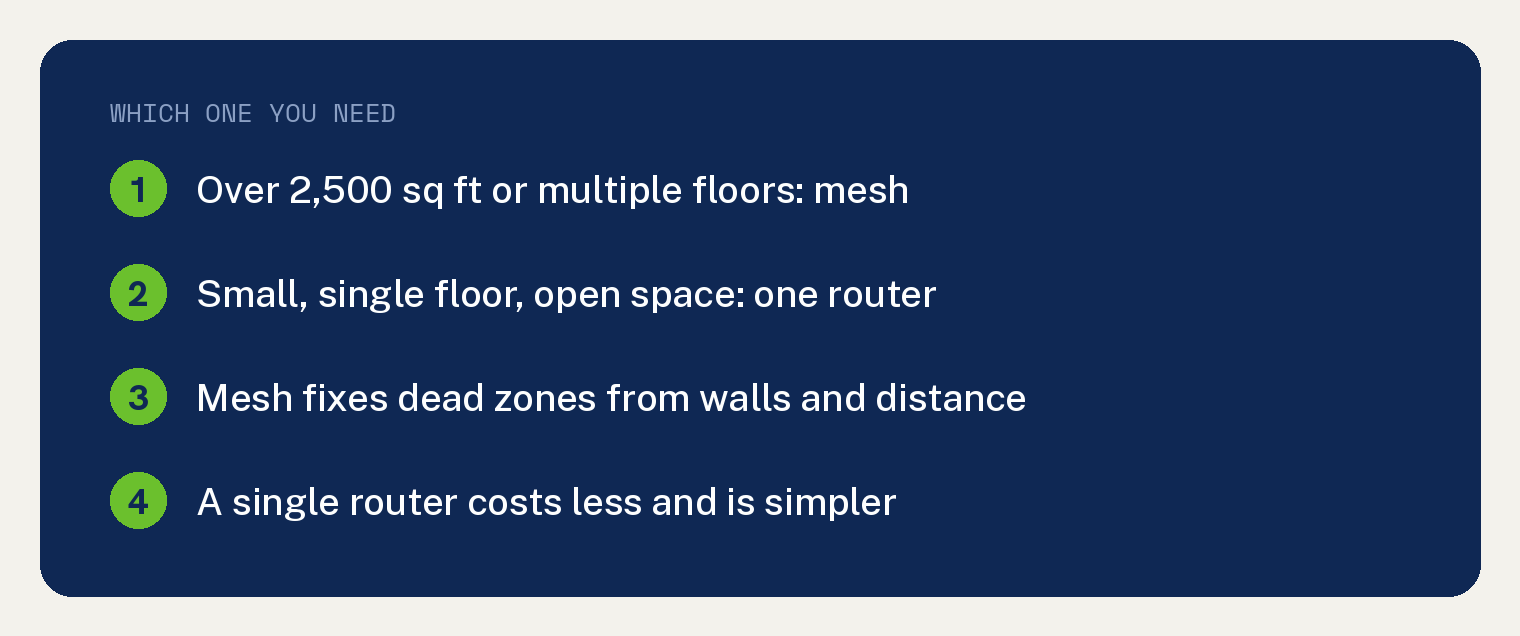
Do you need mesh WiFi, or just a better router? If your home is over about 2,500 square feet, has multiple floors, or has rooms a single router cannot reach, get a mesh system. If it is a smaller, single floor, open space, one good router is cheaper and simpler.
Mesh solves one specific problem: dead zones caused by distance, walls, and floors. A single router solves everything else for less money.
The Real Question: Is It Your Layout or Your Router?
People blame their router when the real problem is the shape of their home. Sorting that out first saves you money.
A single router sends WiFi from one spot. The farther a room sits from that spot, and the more walls and floors in between, the weaker the signal gets.
Mesh WiFi uses two or three units placed around the house. They pass the signal along, so a far bedroom gets a strong connection from a nearby unit instead of a weak one from across the house.
| Feature | Single router | Mesh system |
|---|---|---|
| Best home size | Under 1,500 sq ft | 2,500 sq ft and up |
| Floors and layout | One floor, open | Multiple floors, odd shapes |
| Dead zones | Can leave a few | Removes most of them |
| Devices at once | Around 50 to 75 | 150 or more |
| Cost and setup | Cheaper, simpler | Costs more, still easy |
| Best for | Small open homes | Large or multi floor homes |
When a Single Router Is Enough
You do not need mesh if a single router already reaches every room you care about.
A single router is the smarter buy when your home is under about 1,500 square feet, on one level, with an open layout. In that space, one strong router placed in the center covers everything.
It is also the better pick if you can put the router within about 30 feet of your one problem room. A good router beats a mesh kit there, for less money.
Apartments and small condos almost always fall in this group. Save the extra cash and buy one solid router.
When Mesh WiFi Is Worth It
Mesh earns its price once your home is big enough or broken up enough that one router cannot cover it.
Reach for mesh when your home is over 2,500 square feet, has two or more floors, or has a basement or a far wing that always drops. Mesh also helps a busy smart home, since it handles far more devices at once than a single router.
One rule keeps you honest: your internet plan should be at least 300 Mbps to feel the benefit. Below that, a good single router often performs the same for less. Not sure what you have? See our guide on how home internet plans work.
What I Run at Home
I learned this the hard way. I ran a Netgear Nighthawk router and started having problems with it.
I switched to an eero mesh network, and it has worked great for several years.
One unit covers the 1,200 square foot place at the coast, and the same system now runs in two more houses in the family: a 3,300 square foot single story ranch and a 3,600 square foot two story, both on three packs.
I also run a TP Link mesh system in a 3,000 square foot house, and it covers the whole place with no complaints. Both are proof that once a house gets big, mesh is the move.
For the specific units I would buy, see our best mesh WiFi systems guide.
Should You Get WiFi 6 or WiFi 7?
If you are buying new gear in 2026, WiFi 7 is generally worth it. The price gap over WiFi 6 has shrunk, and WiFi 7 gives you more years before you upgrade again.
You feel WiFi 7 most in a busy home with 40 or more devices, several 4K streams, and video calls going at once. A quieter home with a handful of devices will be happy on WiFi 6 for a while yet.
Two Systems I Trust
If you decide on mesh, two names have earned it in my house.
eero is the pick when you want the simplest life. Its app is known for easy setup, and mine just runs.
The relatives running the other two would never call themselves tech people, and both setups went in without trouble.
Match the pack to the house. A single eero 6+ unit is rated to 1,500 square feet, and the eero 6+ three pack is rated to 4,500.
TP Link Deco is TP Link’s mesh line and the value pick when you want strong coverage for the money. My own TP Link mesh covers a 3,000 square foot house without a fuss.
Either one beats stringing along an old router that keeps dropping. If your current router is the real problem, our guide on fixing a router that keeps dropping WiFi can help you decide if it is worth saving.
See today’s eero 6+ price on Amazon →
See today’s TP Link Deco price on Amazon →
Frequently Asked Questions
Do I need mesh WiFi for a small apartment?
Usually no. A small, single floor apartment is well covered by one good router placed near the center. Mesh is built for larger or multi floor homes with dead zones.
Is mesh WiFi faster than a single router?
Not by itself. Mesh does not raise your top speed; it spreads a strong signal into rooms a single router cannot reach. In a small home, a single router can be just as fast.
How many mesh units do I need?
Most homes do well with a two or three unit kit. A 2,000 to 3,000 square foot home usually needs three, while a smaller home may only need two.
Will mesh WiFi help if my internet plan is slow?
Only a little. Mesh spreads the signal you have, but it cannot add speed you are not paying for. Below about 300 Mbps, a good single router often performs the same.