
How Verizon Home Internet Works: Fios, 5G, Lite
Verizon Home Internet works in three different ways, and which one you get depends on your address. Verizon splits its home service into Fios, 5G Home, and a slower fixed wireless option for homes fiber and 5G do not reach.
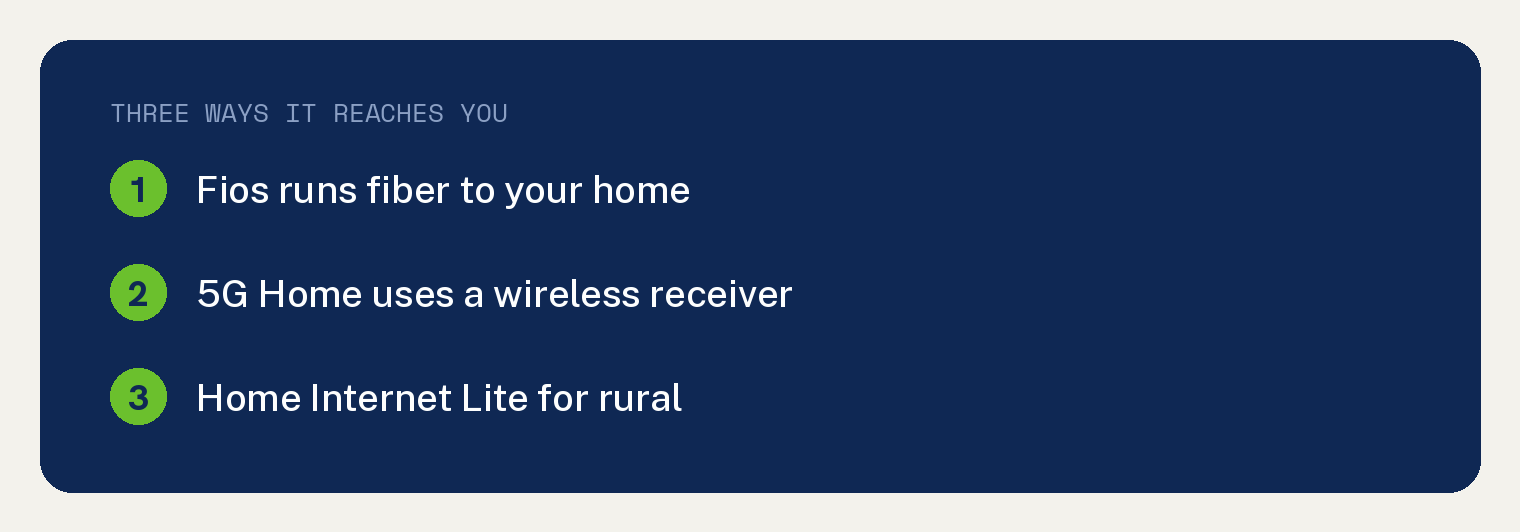
Fios runs internet through fiber optic lines buried to your home. 5G Home is wireless: a small receiver in your house pulls a 5G signal from a nearby Verizon tower, no cable needed.
Fios is the fastest and steadiest option. 5G Home is the wireless pick when Fios does not reach you. For rural spots beyond both, Verizon now offers Home Internet Lite, a lower speed fixed wireless plan.
The Three Ways Verizon Delivers Home Internet
Every Verizon home plan lands in one of three buckets. Here is the short version of each before we dig in.
| Feature | Fios | 5G Home | Home Internet Lite |
|---|---|---|---|
| How it reaches you | Fiber cable | 5G wireless | Fixed wireless |
| Top speed | Up to 5 Gbps | 300 to 1,000 Mbps | Up to 25 Mbps |
| Data limits | None | None | Slows after 150 GB |
| Annual contract | None | None | None |
| Best for | Fastest, steadiest home use | Homes with no fiber | Rural homes with no fiber or 5G |
How Verizon Fios Works
Fios is Verizon’s fiber optic service. Thin glass strands carry your data as pulses of light, which is why fiber is so fast and so steady.
Verizon runs that fiber line to your home and installs a small box called an Optical Network Terminal. Your router then plugs into that box.
Fios plans run from about 300 Mbps up to 5 Gbps on the top Fios 5 Gig plan. The popular 2 Gig plan lands around 2.3 Gbps.
Most Fios plans give you matching download and upload speeds, which helps with video calls, gaming, and sending big files. There are no data caps and no annual contract.
Verizon lists Fios starting as low as 35 dollars a month with Auto Pay, and the faster tiers cost more. Adding a Verizon mobile plan can lower the bill further.
How Verizon 5G Home Internet Works
5G Home Internet is wireless. There is no cable to your house.
Verizon ships you a receiver, sometimes called a gateway. You place it near a window, and it grabs the 5G signal from the closest Verizon tower and turns it into WiFi for your home.
Speeds usually land between 300 Mbps and 1,000 Mbps, depending on how strong the 5G signal is at your address. Homes inside a Verizon Ultra Wideband area see the fastest numbers.
There are no data caps and no annual contract. Verizon lists 5G Home starting at 50 dollars a month, or as low as 35 dollars a month if you also have a qualifying Verizon mobile plan.
Verizon also advertises a multi year price lock, so the monthly rate does not jump on you. Setup is meant to be self install: plug it in, open the app, and follow the prompts.
How Verizon’s Fixed Wireless Option Works
For homes that fiber and 5G Home do not reach, Verizon sells Home Internet Lite. It is a fixed wireless plan that pulls a signal from a Verizon tower, the same idea as 5G Home but slower.
Home Internet Lite delivers download speeds up to 25 Mbps. That is enough for HD streaming, email, and browsing, but not for a busy house full of 4K TVs and gamers.
It slows down after you use 150 GB in a month, then keeps going with unlimited data at a lower speed. Verizon lists it starting at 35 dollars a month with a qualifying mobile plan, with a 3 year price lock.
Verizon’s older LTE Home Internet worked the same way on the 4G LTE network. New LTE Home sign ups are closed now, so existing LTE Home customers keep their plans while new rural customers get Home Internet Lite instead.
How Much Speed Do You Actually Need?
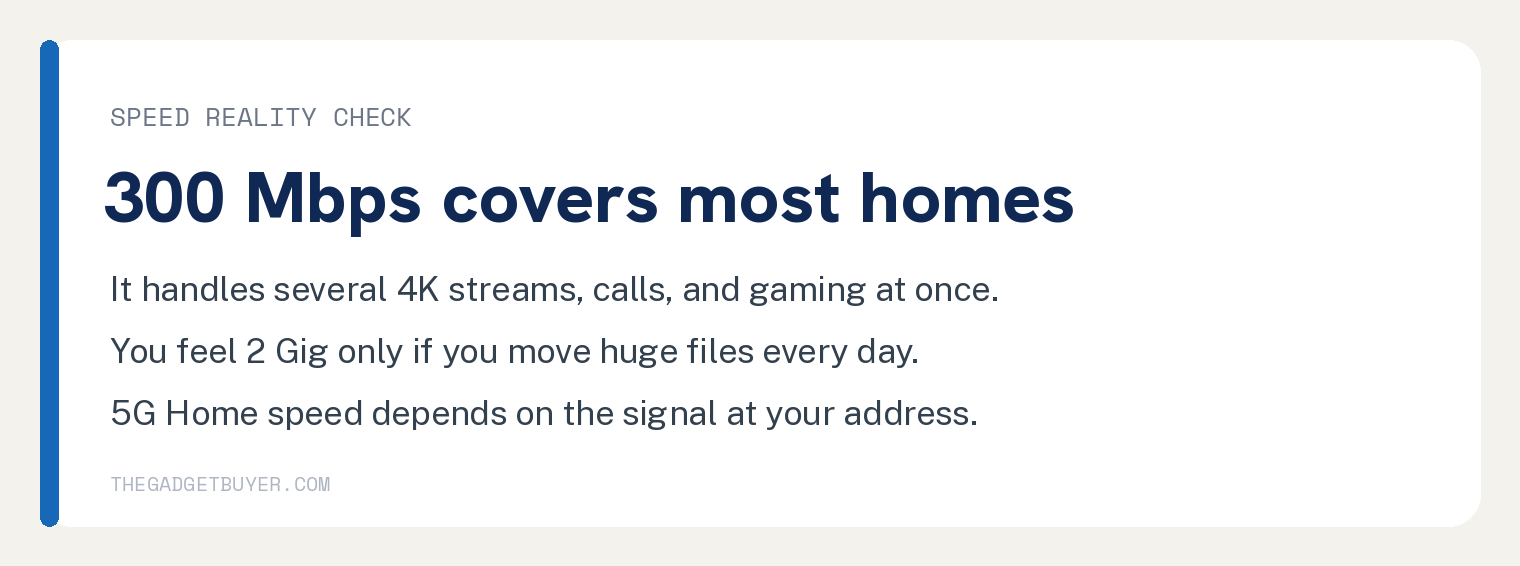
The big Fios numbers look exciting, but most homes never use them. Here is the honest reality check before you pay for the top tier.
A 300 Mbps plan already handles several 4K streams, video calls, and gaming at once. That covers the average family with room to spare.
You only feel 2 Gig or 5 Gig if you routinely move huge files, run a home server, or have a houseful of heavy users hammering the line at the same time. For most people, paying for 5 Gbps buys a bigger number on the bill rather than a better Netflix night.
5G Home is a different case. Its speed depends on your signal, so two neighbors can get different results. Run the Verizon app during setup and try a few spots near the window before you settle on one.
Home Internet Lite has one catch worth knowing. After 150 GB in a month it slows down, and 150 GB goes fast in a house that streams a lot of TV. It is best for light users, a second home, or a place where nothing faster exists.
Which Verizon Home Internet Should You Get?
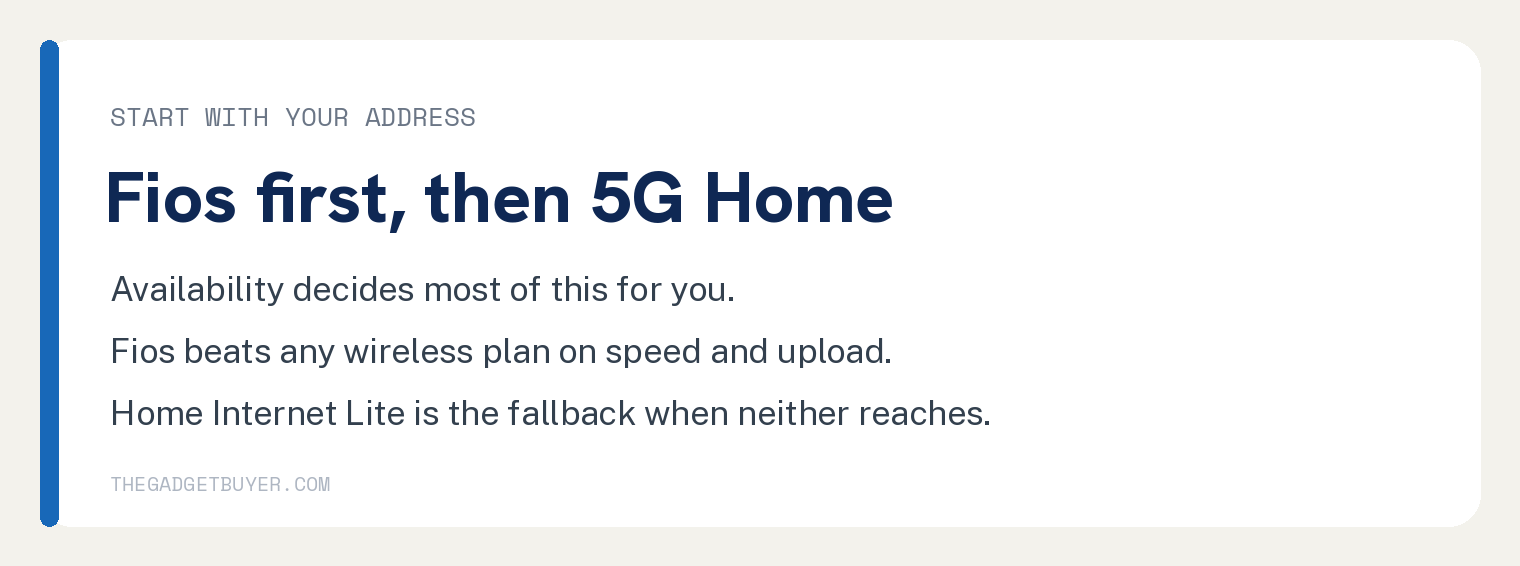
Start with your address, because availability decides most of this for you. You can check what reaches your home on the Verizon 5G availability page and our guide to checking it.
If Fios is available, get Fios. Fiber beats any wireless plan on speed, upload, and steadiness, and the price is competitive.
If Fios is not offered at your address, 5G Home is the strong second choice. It is fast, simple to set up, and has no cap or contract.
If neither reaches you, Home Internet Lite is the honest fallback. It keeps a rural home connected even if the speeds are modest.
For a deeper look at what each tier runs, see our breakdown of Verizon internet costs and Verizon internet speeds.
What You Need to Get Started
For Fios, Verizon sends a technician to run or activate the fiber line and set up the box. Online orders often waive the install fee.
For 5G Home or Home Internet Lite, you set it up yourself. Verizon mails the receiver, and you place it where the signal is strongest, usually near a window facing the tower.
All three plans include the equipment you need in the plan. If your wireless signal is weak in far rooms, a mesh system can help, and you can learn more in our guide to the best mesh WiFi systems. If your 5G Home signal is weak, our tips on boosting Verizon 5G Home Internet can help.
Frequently Asked Questions
Does Verizon Home Internet have data caps?
Fios and 5G Home have no data caps and no annual contract. Home Internet Lite does not cut you off either, but it slows your speed after 150 GB of use in a month.
Is Verizon 5G Home Internet as good as Fios?
Fios is faster and steadier because fiber is a wired connection. 5G Home is very good and often plenty for a normal household, but it depends on your 5G signal strength, which fiber never has to worry about.
Can I get Verizon Home Internet without a Verizon phone plan?
Yes. You can sign up for a Verizon home plan on its own. Adding a qualifying Verizon mobile plan lowers the monthly price on all three home internet options.
Do I need to install Verizon 5G Home Internet myself?
Usually yes, and it is simple. Verizon mails the receiver, you plug it in near a window, and the Verizon app walks you through finding the best spot for signal.