
What T Mobile Home Internet Plans Really Cost You
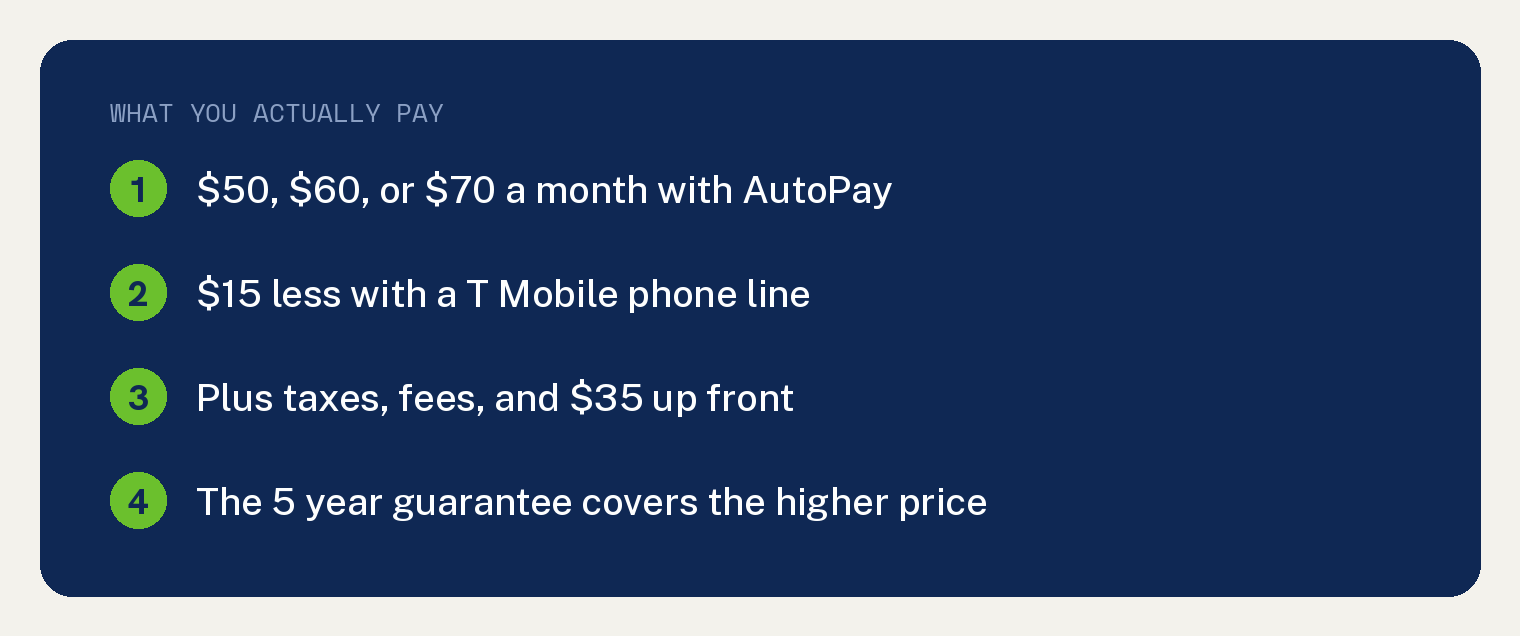
T Mobile Home Internet costs $50, $60, or $70 a month with AutoPay, and drops to $35, $45, or $55 when you also have a T Mobile phone line. All three tiers run on the same 5G network, so the tier you pick changes your equipment and your extras more than it changes your speed.
The $15 discount is a monthly bill credit that T Mobile labels limited time, so treat the higher number as the price you are signing up for.
Prices, speeds, and terms below were read off T Mobile’s own pages on August 19, 2026.
The three tiers, side by side
T Mobile sells three fixed wireless plans that arrive over its 5G network. Its fiber service is a separate product with separate pricing.
| Feature | Rely | Amplified | All In |
|---|---|---|---|
| With AutoPay | $50 | $60 | $70 |
| With a phone line | $35 | $45 | $55 |
| Typical download | 170 to 354 Mbps | 170 to 498 Mbps | 170 to 498 Mbps |
| Typical upload | 12 to 55 Mbps | 12 to 55 Mbps | 12 to 55 Mbps |
| Gateway | 5G gateway | WiFi 7 | WiFi 7 |
| Mesh extender | No | No | Included on request |
| Streaming included | No | No | Hulu and Paramount Plus |
| Best for | Most households | Heavy houses with WiFi 7 gear | Streaming subscribers |
Look at the two speed rows together. The floor is identical across all three plans, and the upload range never moves at all.
What the top two tiers buy is a higher ceiling on a good day, which is the part of a wireless connection nobody can promise you.
The advertised price is not the guaranteed price
T Mobile advertises a 5 Year Price Guarantee on these plans, and the wording of it matters more than the headline.
The guarantee says T Mobile “won’t change the price of fixed wireless 5G internet data for at least 5 years while you are on an eligible plan.”
Then it lists what sits outside that promise, including “taxes & fees, voluntary equipment or speed upgrades, future wireless generations, select limited time promotions, per use charges, third party services, and network management practices.”
Now read the fine print on the bundle discount. T Mobile calls the $15 a month a bill credit and describes it as “Limited time; subject to change.”
So the number the guarantee protects is $50, $60, or $70, and the $35 headline price rests on a credit T Mobile itself labels limited time and subject to change. T Mobile never puts those two clauses in the same sentence, and they sit on the same page.
The credit also has conditions worth knowing before you count on it. It requires a qualifying postpaid voice line, it is limited to two per account, and T Mobile says credits stop if you cancel any lines or change plans.
What else lands on the bill
Three charges sit outside the monthly plan price.
- A $35 device connection charge due at the time of sale. T Mobile lists it on every plan.
- Taxes and fees. The plan comparison row is labeled “Monthly price w/ AutoPay, plus taxes and fees,” and T Mobile names Regulatory Programs and Telco Recovery Fees totaling up to $2.10 per line.
- Up to $370 if you cancel and do not return the gateway undamaged.
One more condition catches people. The AutoPay discount requires a bank account or a debit card, and paying by credit card costs $10 more per line each month.
There is no annual contract and no monthly equipment fee, which are both real advantages over most cable plans.
Size the tier to your household load
Two mistakes cost people money here, and they pull in opposite directions.
The first is buying speed a house cannot use. If every device in your home is on WiFi with nothing plugged in by cable, the top of a speed range rarely reaches you.
I ran into that when Brightspeed Fiber arrived at the house at the coast and I took the 1 Gig plan, when 500 Mbps or even 200 would have carried us.
The second mistake is going so cheap that the connection maxes out every evening, and then blaming the provider for service that was sized wrong at signup.
The way to size this is to count what happens at 8pm on a Tuesday. My own house runs heavy: two adults on work video calls all day, two teenagers who bring friends over, and every TV streaming at once.
Here is the sizing question that actually decides it. How many people are doing something live at the same time, and how many of those things are video calls or 4K streams?
One or two people, a few phones, and evening streaming sits well inside Rely’s published range. A full house of simultaneous video calls is where a higher ceiling starts to earn its keep.
Coverage inside the house matters as much as the plan number, and whether you need mesh WiFi or just a better router is the question to settle before you upgrade a tier.
T Mobile publishes two different speed ranges
On its plans page, T Mobile says Amplified and All In customers see “typical download speeds between 170 mbps to 498 mbps,” with Rely at “170 mbps to 354 mbps.”
On its own Open Internet disclosure, the same fixed wireless product is listed at “typically between 72 to 245 Mbps” down and “15 to 31 Mbps” up.
Both numbers are T Mobile’s, published on the same day. The disclosure page describes its figures as roughly the 25th and 75th percentiles of network tests.
T Mobile does describe the top two tiers as having no speed caps, while Rely is written as speeds up to 354 Mbps. That ceiling still sits well above the 245 Mbps that the same company’s disclosure puts at roughly the 75th percentile.
Plan for the lower set either way. A wireless connection depends on your distance from the tower, the walls in between, and how busy the local cell is at 8pm.
The disclosure also publishes latency at 19 to 37 milliseconds on 5G, which is the number gamers ask about and the one T Mobile leaves off its marketing pages.
If your speeds swing wildly after install, the reasons WiFi cuts in and out covers the causes that live inside your house rather than at the tower.
What the top tier actually includes
All In is the only tier with extras, and T Mobile values them at over $480 a year on its plan comparison and over $490 a year a few paragraphs away on the same page.
The list covers Advanced Cyber Security, Hulu with ads, Paramount Plus Essential, a mesh WiFi extender you request after activation, around the clock tech support through Assurant, and a gateway upgrade after year three.
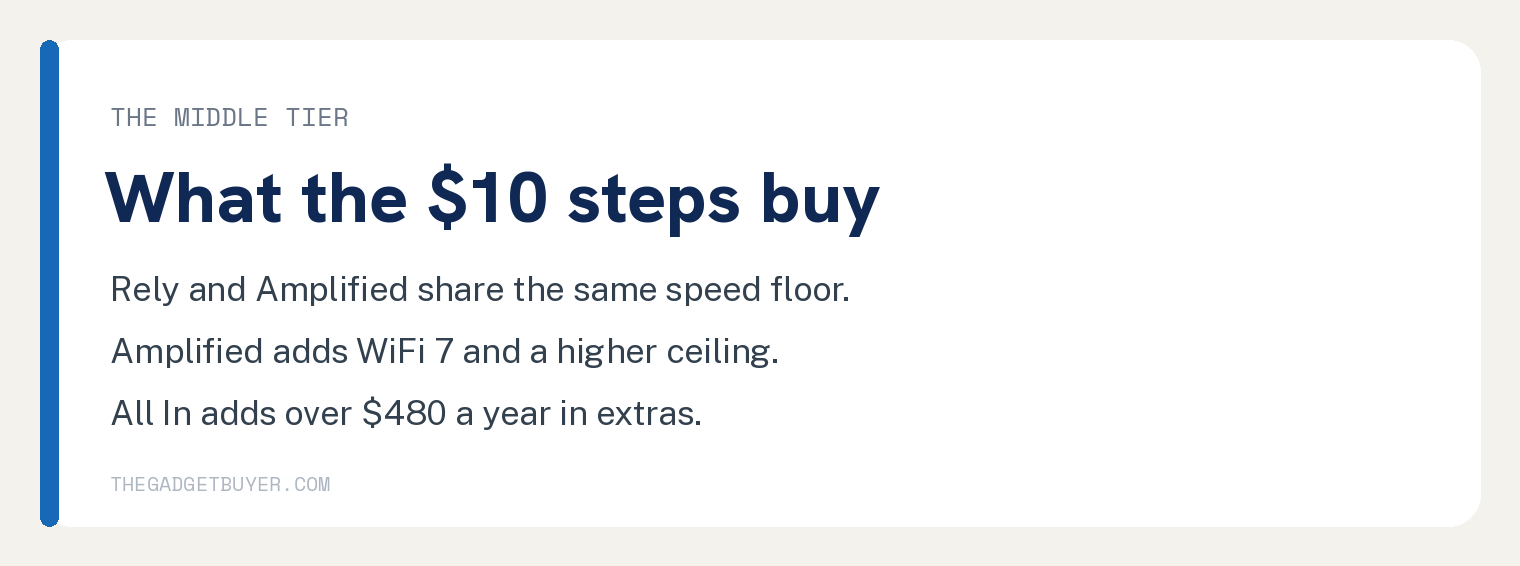
That changes the math for a specific household. Those two services together list at more per month than the $20 gap between Rely and All In.
If you subscribe to neither, the same $20 buys a WiFi 7 gateway and a security add on, and the speed floor does not move.
Those two subscriptions come with strings. T Mobile limits the Hulu offer to new and returning Hulu subscribers, and the same restriction applies to Paramount Plus.
Before you order
Run these four checks first.
- Check availability at your exact address. T Mobile sells this only where it decides the network can carry it, and coverage varies street by street.
- Confirm the phone line requirement if you are budgeting on the $35 price, because that number needs a qualifying postpaid voice line.
- Check whether fiber is available to you. T Mobile Fiber is a separate product, listed at $70 a month for 1 Gig and $80 for 2 Gig, with symmetrical speeds and a WiFi 6 router.
- Note both windows. T Mobile gives you 15 days to cancel, and the refund arrives as a bill credit you have to request within 30 days of cancelling.
T Mobile puts self install at about 15 minutes and includes the gateway at no extra cost, so trying it costs you the $35 connection charge and some patience.
Readers weighing this against the other 5G option should compare it with which Verizon Home Internet plan to get, and cable shoppers can size the same household against Spectrum internet plans and how much speed you need.
Common questions
Is T Mobile Home Internet unlimited?
Yes, there is no hard data cap. T Mobile does say that customers who pass 1.2TB in a billing cycle are prioritized last on the network during congestion, so heavy months can feel slower at busy hours.
Does T Mobile Home Internet need a contract?
No. T Mobile lists no annual contract on all three tiers, and there is no monthly equipment fee. Returning the gateway undamaged after you cancel avoids a charge of up to $370.
Can I use T Mobile Home Internet at a second address?
No. T Mobile states the service is for in home use at the address provided at activation and that service is restricted away from that approved address.
Is the gateway good enough on its own?
In a small or open home, usually. Larger or multi story houses often need the mesh extender, which is included only on All In and has to be requested after activation.
Which T Mobile Home Internet plan is the best value?
Rely for most households, since the published speed floor and upload range match the higher tiers. All In wins for anyone who wants Hulu and Paramount Plus and is eligible to start or restart them.
Is 5G home internet fast enough for working from home?
For most jobs, yes. Upload sits at 12 to 55 Mbps by T Mobile’s own figures, which carries video calls, and latency runs 19 to 37 milliseconds on its disclosure page.