
Turn Off Text Messages on an iPhone With the Right Switch
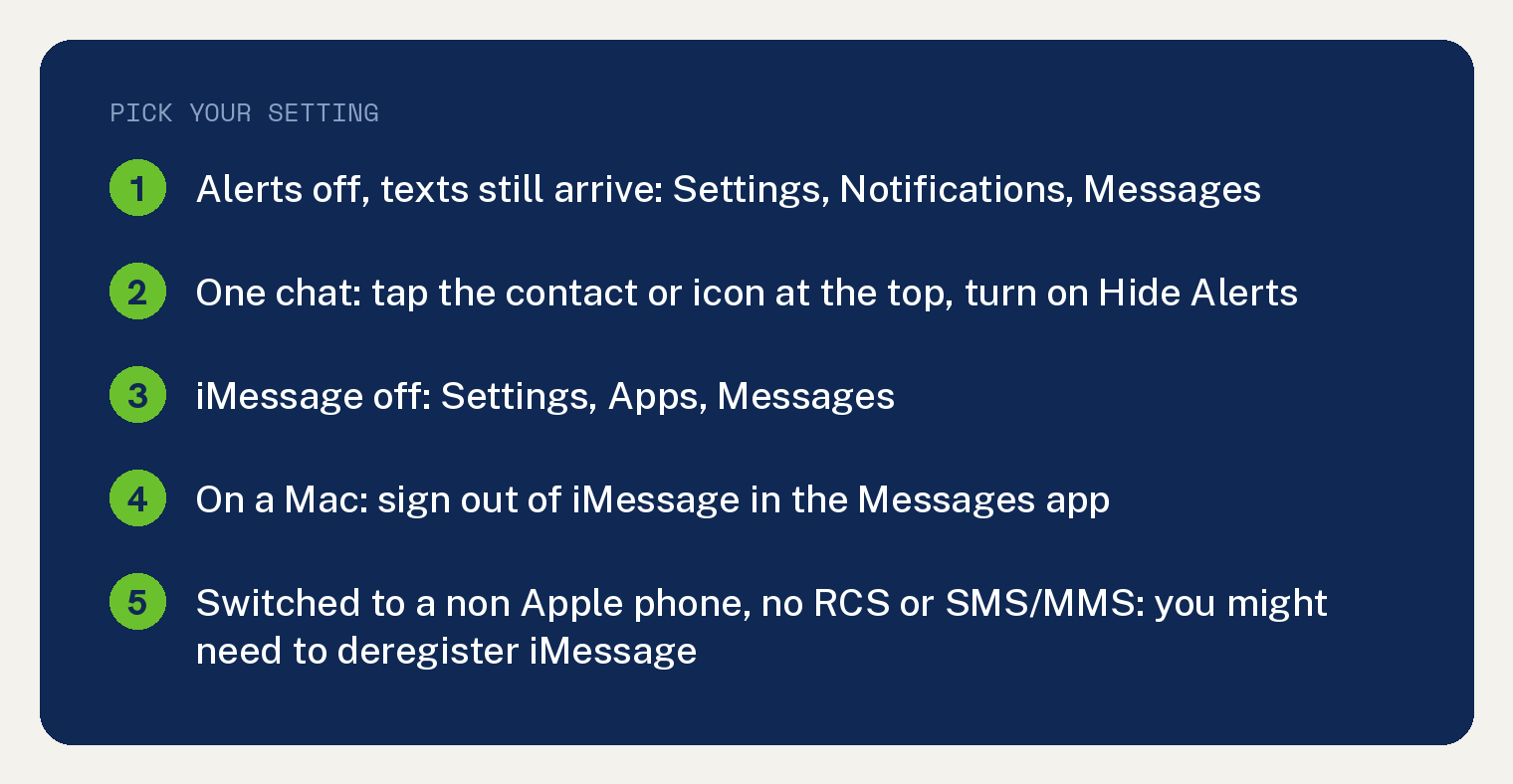
To turn off text messages on an iPhone so they stop interrupting you, turn off their alerts: open Settings, tap Notifications, tap Messages, then turn off Allow Notifications. Your texts keep landing in the Messages app, ready when you open it.
Apple’s notifications page backs this up: “You can stop getting notified about activity in the Messages app while continuing to receive messages.”
Pick the setting for what you want stopped
| What you want | Where to go |
|---|---|
| No text alerts at all | Settings, Notifications, Messages, Allow Notifications off |
| Quiet one chat | Open the chat, tap the contact or icon at the top, turn on Hide Alerts |
| No more texts from one person | Block that person or number |
| iMessage off on the iPhone | Settings, Apps, Messages, iMessage off |
| No messages on your Mac | Messages on the Mac, Settings, iMessage, Sign Out |
| Switched to a non Apple phone and not getting RCS or SMS/MMS texts | You might need to deregister iMessage |
Silence text alerts and keep every message
- Open the Settings app.
- Tap Notifications, then tap Messages.
- Turn off Allow Notifications.
The people who text you will know. Apple’s note on that step reads: “Senders receive a note indicating that you have notifications silenced.”
To get alerts back, turn Allow Notifications on again. Apple adds: “If you also want to hear them, make sure the Ring/Silent switch isn’t in Silent mode and your volume is audible.”
If calls have gone quiet as well, our guide to an iPhone not ringing on incoming calls starts with Silent mode.
Mute sounds
Go to the same Messages screen under Notifications, tap Sounds, then tap None. Apple says None “turns off the swoosh sound for sent messages and the tone for messages you receive.”
The None setting mutes sent and received sounds together, so one cannot be muted alone.
Quiet one conversation or one person
To mute a single chat, open it, tap the contact or icon at the top, then turn on Hide Alerts. Apple says you “continue to receive its messages,” and the same note about silenced notifications goes to the sender.
To stop a person’s messages completely, Apple points to blocking: “To completely stop getting messages for one conversation, you can block a specific person or number or leave a group conversation.”
Turn off iMessage on the iPhone
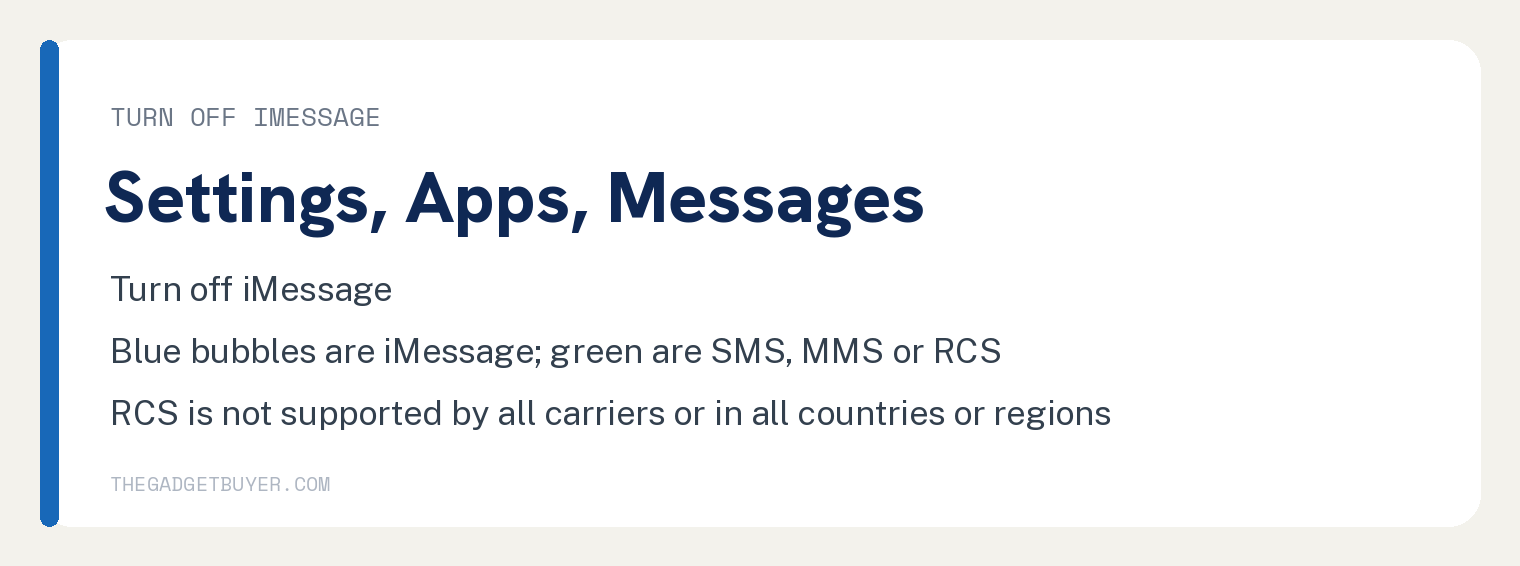
iMessage texts are the blue bubbles you trade with other iMessage users. Apple’s setup page describes them this way: “Your iMessage texts appear in blue bubbles.”
- Open Settings and tap Apps.
- Tap Messages.
- Turn off iMessage.
Green bubbles are SMS, MMS or RCS messages sent over cellular service. Apple notes: “(RCS messages aren’t supported by all carriers or in all countries or regions.)”
If a chat flipped from one color to the other, our explainer on why texts turn from blue to green on an iPhone goes through the reasons.
Turn iMessage back on
Go back to Settings, tap Apps, tap Messages, then turn on iMessage. On that screen, Send & Receive is where you pick which of your phone numbers and email addresses iMessage uses.
Stop texts from showing up on your Mac
Sign out of iMessage in the Messages app on the Mac. In Apple’s words: “If you don’t want to see messages on your Mac, you can sign out of iMessage.”
- Open the Messages app on your Mac.
- Choose Messages, then Settings, then click iMessage.
- Click Sign Out, then confirm.
Green texts on a Mac depend on iMessage too. Apple’s Mac guide says: “To receive and send SMS, MMS, or RCS messages on your Mac, you must be signed in to the same Apple Account and be using iMessage on your iPhone and Mac.”
To keep iMessage on the Mac and stop messages sent to your phone number, stay in that iMessage pane and deselect the phone number below “You can be reached for messages at.”
Back on the iPhone, Apple’s setup page sends you to Settings, Apps, Messages, then Text Message Forwarding to confirm which devices receive the SMS, MMS and RCS texts you get. Apple’s forwarding page adds: “(Text Message Forwarding is always on for each of your devices that is using Messages in iCloud.)”
Forwarding itself carries Apple’s note: “Availability varies by region and carrier.” For a tablet, see how to turn off text messaging on an iPad, and for a second phone on your account, how to unsync two iPhones.
Switched to a non Apple phone? You might need to deregister iMessage
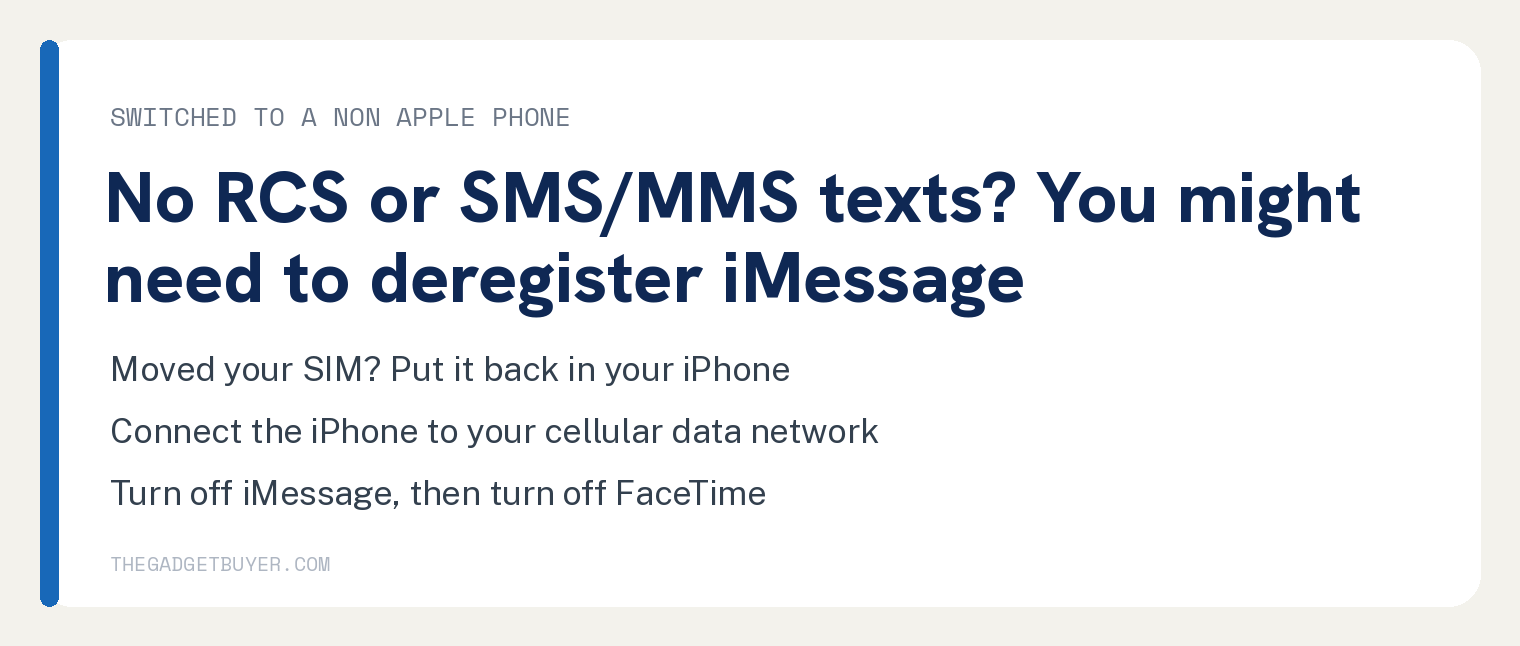
Deregistering removes your phone number from iMessage services. Apple’s deregistration page sets the condition: “If you switched to a non-Apple phone and aren’t getting RCS or SMS/MMS messages, you might need to deregister iMessage.”
If you still have the iPhone, follow these steps:
- If you transferred your SIM card from your iPhone to the non Apple phone, put it back in your iPhone.
- Make sure the iPhone is connected to your cellular data network.
- In Settings, tap Apps, tap Messages, then turn off iMessage.
- Go back to Settings, tap Apps, tap FaceTime, then turn off FaceTime.
Without the iPhone, you can deregister iMessage online.
Apple says you should be able to receive texts right away, though it “might take a few hours for some Apple devices to recognize that you’re not using iMessage when they send you a message.”
On where texts land afterward, Apple’s online deregistration section says: “If someone sends a text to your phone number, you’ll get the message as an RCS message or SMS/MMS only on your phone.”