
JBL Charge 6 vs Charge 5: Is the Upgrade Worth It?
This article contains Amazon affiliate links. The Gadget Buyer may earn a commission when you buy through them, at no extra cost to you.
The JBL Charge 6 costs $20 more than the JBL Charge 5, and that extra money buys 8 more hours of battery, Auracast pairing, and a deeper water rating.
The Charge 6 runs $159.95 as of July 2026, down from a $199.95 list price.
The Charge 5 runs $139.95, down from $179.95.
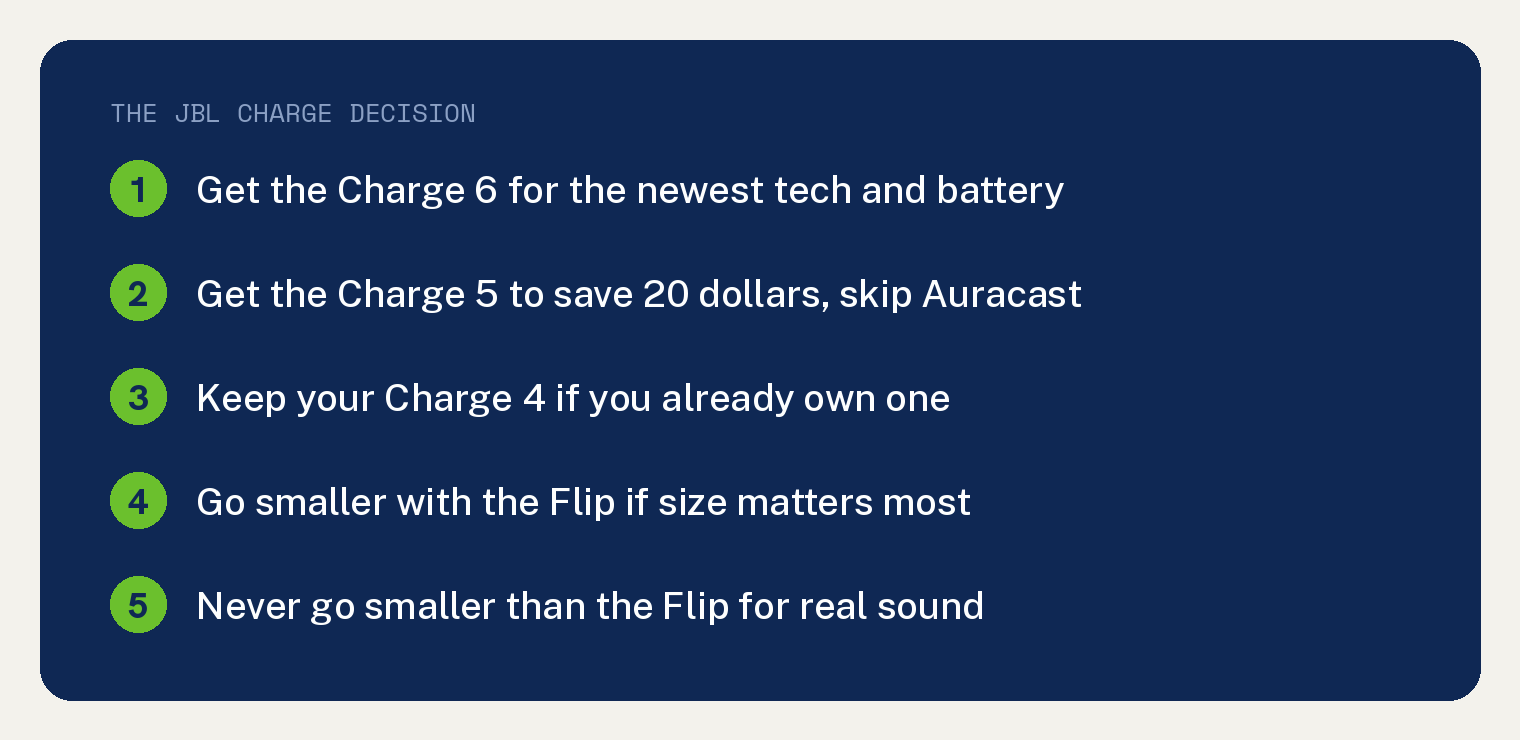
Get the Charge 6 for the newest tech and the longest playtime. Get the Charge 5 to save money on nearly the same speaker.
If you already own a JBL Charge 4, the model Kern still uses, you do not need to rush out and replace it.

How the JBL Charge lineup compares
Every generation carries the built in powerbank the Charge name refers to, so any of them will top up your phone at the beach.
Here is how all three JBL Charge speakers stack up on paper, as of July 2026.
| Feature | JBL Charge 4 | JBL Charge 5 | JBL Charge 6 |
|---|---|---|---|
| Price (July 2026) | Discontinued | $139.95, list $179.95 | $159.95, list $199.95 |
| Battery life | Up to 20 hours | Up to 20 hours | Up to 28 hours |
| Water and dust | IPX7 | IP67 | IP68, plus a 1 m drop rating |
| Output power | 30W | 40W | 45W combined |
| Bluetooth version | 4.2 | 5.1 | 5.4 |
| Multi speaker pairing | JBL Connect Plus | PartyBoost | Auracast |
| Weight | About 2.1 lbs | 2.11 lbs | 2.18 lbs with strap |
| Best for | Owners who already have one | Saving money without losing much | The longest battery and toughest build |
What the JBL Charge 6 adds
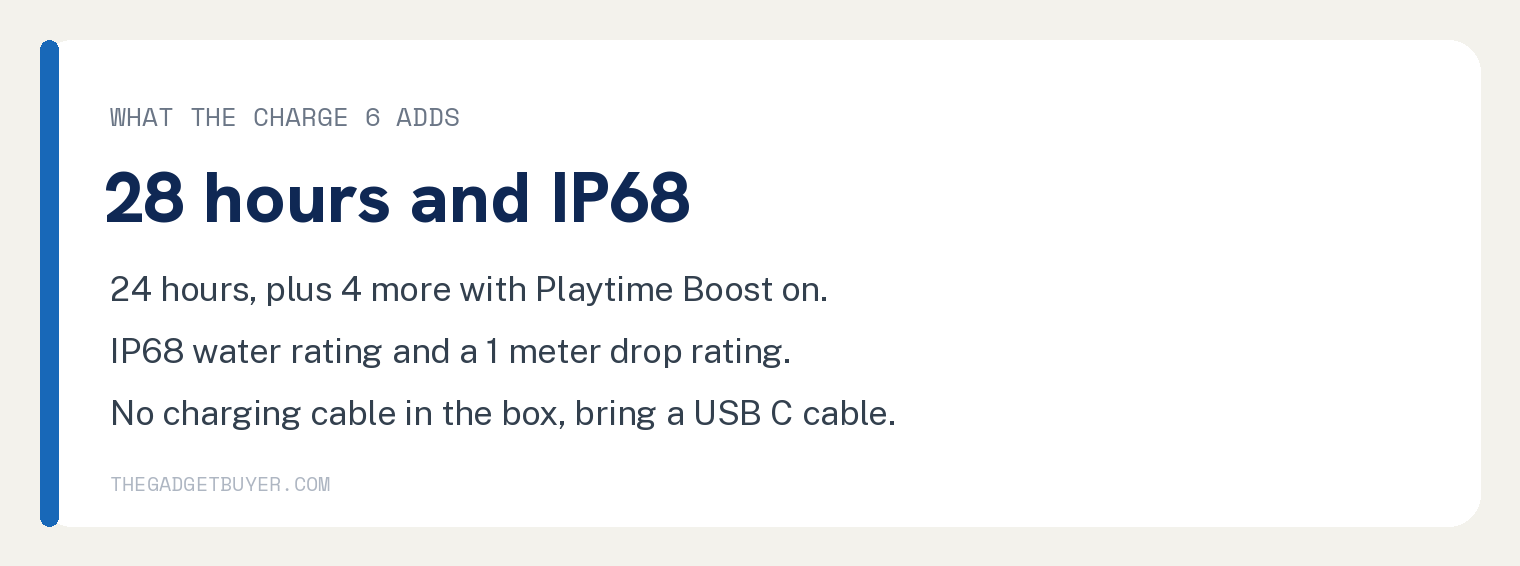
The JBL Charge 6 plays up to 28 hours on a single charge.
That is 24 hours standard, plus 4 more hours once you turn on Playtime Boost.
It moves from IP67 to IP68. Only the water digit changes, since the Charge 5 is already fully dust tight at IP67.
JBL rates the Charge 6 as drop proof separately from its IP rating, saying it keeps playing after a 1 meter drop onto concrete.
AI Sound Boost analyzes your music in real time for maximum output with less distortion, according to JBL.
Auracast replaces PartyBoost as the way to link speakers, and it is an industry standard that reaches beyond JBL.
Ten minutes on the charger gives you up to 150 minutes of playtime, JBL says.
The Charge 6 can also play lossless audio over its USB C port, which no earlier Charge could do. JBL delivers that through a software update in the JBL Portable app, so it is not there the moment you open the box.
One tradeoff: JBL no longer includes a charging cable in the box. Bring your own USB C cable.
The JBL Charge 5: the money saver
The JBL Charge 5 costs $139.95 as of July 2026, down from a $179.95 list price.
It still plays up to 20 hours and carries an IP67 waterproof and dustproof rating.
It skips AI Sound Boost and Auracast, using JBL’s older PartyBoost system to link speakers instead.
Kern has not tested the Charge 5 himself. Every spec here comes straight from JBL’s official product listing.
The JBL Charge 4: why Kern still uses his
Kern has used a JBL Charge 4 for years and still reaches for it today.
His verdict on the Charge he owns: small enough to carry, big enough to sound good, and not so heavy that your arm wants to fall off.
He also owns the JBL Flip 5, the JBL Go 2, and the JBL Boombox 2, all bought during a $3,000 run at every well reviewed portable speaker he could find in 2021.
Near water, on the boat, or at the pool, he reaches for a JBL almost every time.
Range has never been the problem either. A JBL on his back deck keeps playing while he walks his roughly quarter acre back yard, and one left on shore keeps playing while he wades out to a boat anchored in a foot or two of water.
He has never had a JBL speaker beep or fail from getting wet, across years of pool days, beach days, and rain.
His hands on testing covers the Charge 4. Every Charge 5 and Charge 6 number in this article comes from JBL’s own published listings.

Which JBL Charge should you buy
Get the JBL Charge 6 if you want the newest tech and the longest battery.
Get the JBL Charge 5 if you want to save $20 and do not need Auracast.
Keep your JBL Charge 4 if you already own one. It still works great.
Already own a Charge 5? Skip the Charge 6. You would be paying full price for 8 hours of battery and a pairing standard that only matters when you own several speakers.
Go smaller with the JBL Flip if size matters more than sound to you.
Never go smaller than the Flip. The sound from anything smaller does not compare, in Kern’s experience.
Other JBL speakers worth a look
Two other JBL speakers come up constantly alongside the Charge.
Need the smallest and cheapest JBL option? See our JBL Go 2 writeup, though bass and volume suffer at that size.
Having trouble with a JBL speaker you already own? Start with what to do if your JBL speaker will not charge.
JBL Charge buying questions
Is the JBL Charge 6 worth $20 more than the Charge 5?
Yes, if battery life and toughness matter to you. The Charge 6 adds 8 more hours of playtime and jumps to IP68 protection.
No, if you just want solid JBL sound for less. The Charge 5 covers that job for $139.95.
Is the JBL Charge 4 still good in 2026?
Yes. Kern still uses his Charge 4 today and calls the Charge line the best all around JBL speaker.
It plays up to 20 hours and carries an IPX7 waterproof rating, though it lacks the newer Auracast pairing.
Are JBL Charge speakers waterproof?
Yes. Every generation covered here carries a rating for full submersion.
See our full breakdown of whether JBL speakers work underwater for the exact depth and time limits.
What is the difference between IP67 and IP68?
IP67 means the speaker survives 30 minutes submerged in up to 1 meter of water.
IP68 covers deeper or longer submersion. Both ratings start with a 6, which means both speakers are already fully dust tight, so dust protection is not what changes.
JBL publishes no depth or time figure for the Charge 6 IP68 rating. Treat it as extra water headroom with no stated new limit.