
What User Busy Really Means on Your iPhone
User Busy means the phone network could not deliver your call because the other end could not take another one. That is the whole official meaning.
It is not an Apple message. Apple does not use those words anywhere in iOS or on its support site.
It comes from the phone network. “User busy” is a standard telephone cause code, defined by the ITU as the called party being unable to accept another call.
Which means the most repeated explanations for it are wrong, and this guide starts by clearing those out.
What User Busy does not mean
Four popular explanations circulate for this message. Three of them are contradicted by Apple’s own documentation.
| Common claim | Reality |
|---|---|
| They declined your call | No. Apple sends a declined call to voicemail, and the network has a separate code for rejection that is not User Busy. In some countries declined calls are disconnected instead. |
| They have Do Not Disturb or a Focus on | No. Focus silences the alert on their phone. It does not send a busy signal back to you. |
| They blocked you | No. Apple states that a blocked caller can still leave a voicemail, and the person you called gets no notification at all. |
| They are on another call | Possible, and the only one that fits the official definition. |
Being blocked is the one people worry about most, so it is worth being direct. Apple’s documentation says a blocked caller can still leave a voicemail and the person you called gets no notification. It says nothing about a busy signal, and no Apple source connects blocking to this message.
If you are hearing User Busy and wondering whether someone blocked you, this message is not your evidence.
Where does the User Busy message come from?
Your phone is relaying something the network told it.
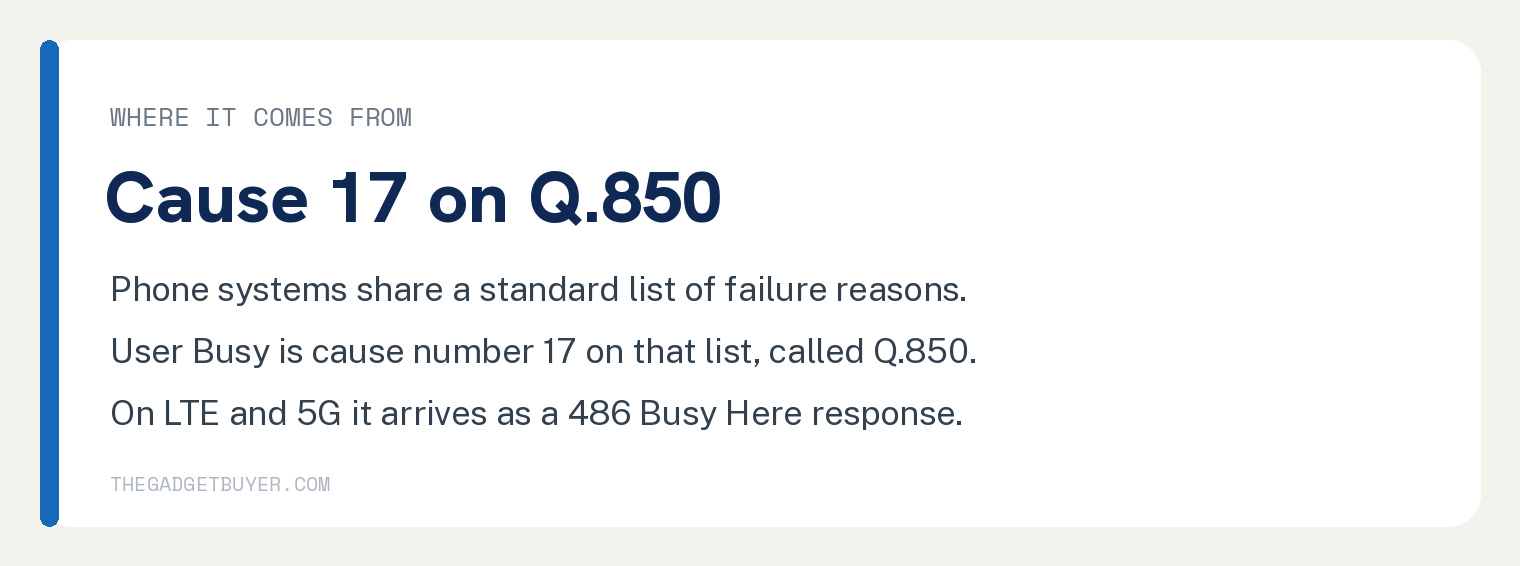
Telephone systems worldwide use a shared list of reasons a call failed. The list is a standard called Q.850, and User Busy is cause number 17 on it.
The definition is dry and precise: the called party is unable to accept another call because the user busy condition has been encountered.
On modern calling over LTE and 5G, the same thing shows up as a “486 Busy Here” response, which the ITU maps to that cause code, though not exclusively. Same meaning, different plumbing.
One honest nuance. The standard says this cause may be generated by the network or by the called user. So it is not purely a carrier thing, though it is not something iOS invents on its own.
Why do you keep getting User Busy from one person?
If it happens with one contact over and over, and their line rings fine for other people, the likely reasons narrow down fast.
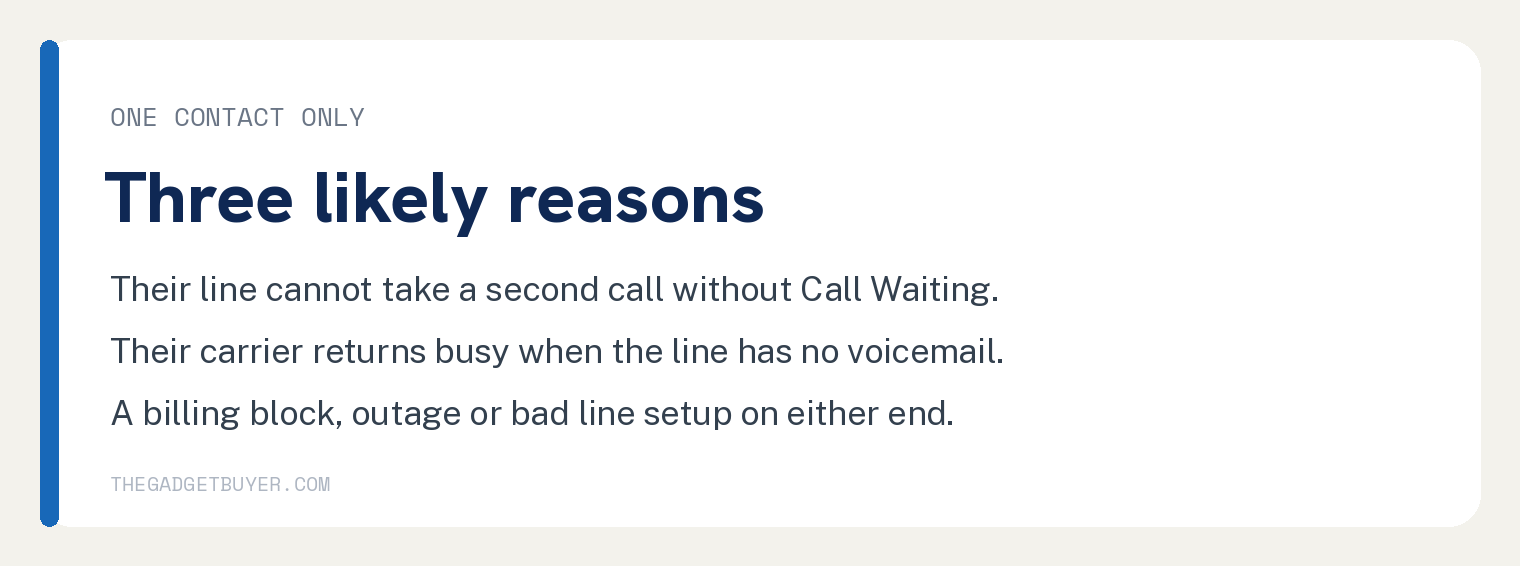
Their line really cannot take a second call. Without Call Waiting turned on, a second call has nowhere to go. Apple notes that with Call Waiting off, incoming calls go straight to voicemail, so this only produces a busy result on setups without voicemail.
Their carrier has a busy on failure setting. Some carriers offer conditional call forwarding or a do not disturb feature that returns a busy signal when a line has no voicemail. This is a carrier feature on their end, not the iPhone Focus setting people assume.
A carrier or provisioning problem on either end. Billing blocks, outages, and misconfigured lines all show up as strange call failures.
Here is the uncomfortable part. Almost none of this is on your side, and almost none of it is something you can fix from your phone.
What can you actually do about it?
Apple’s own troubleshooting for failed calls is mostly written for the person receiving calls, not the person making them. That tells you something.
Still, a few steps are worth running before you conclude it is them.
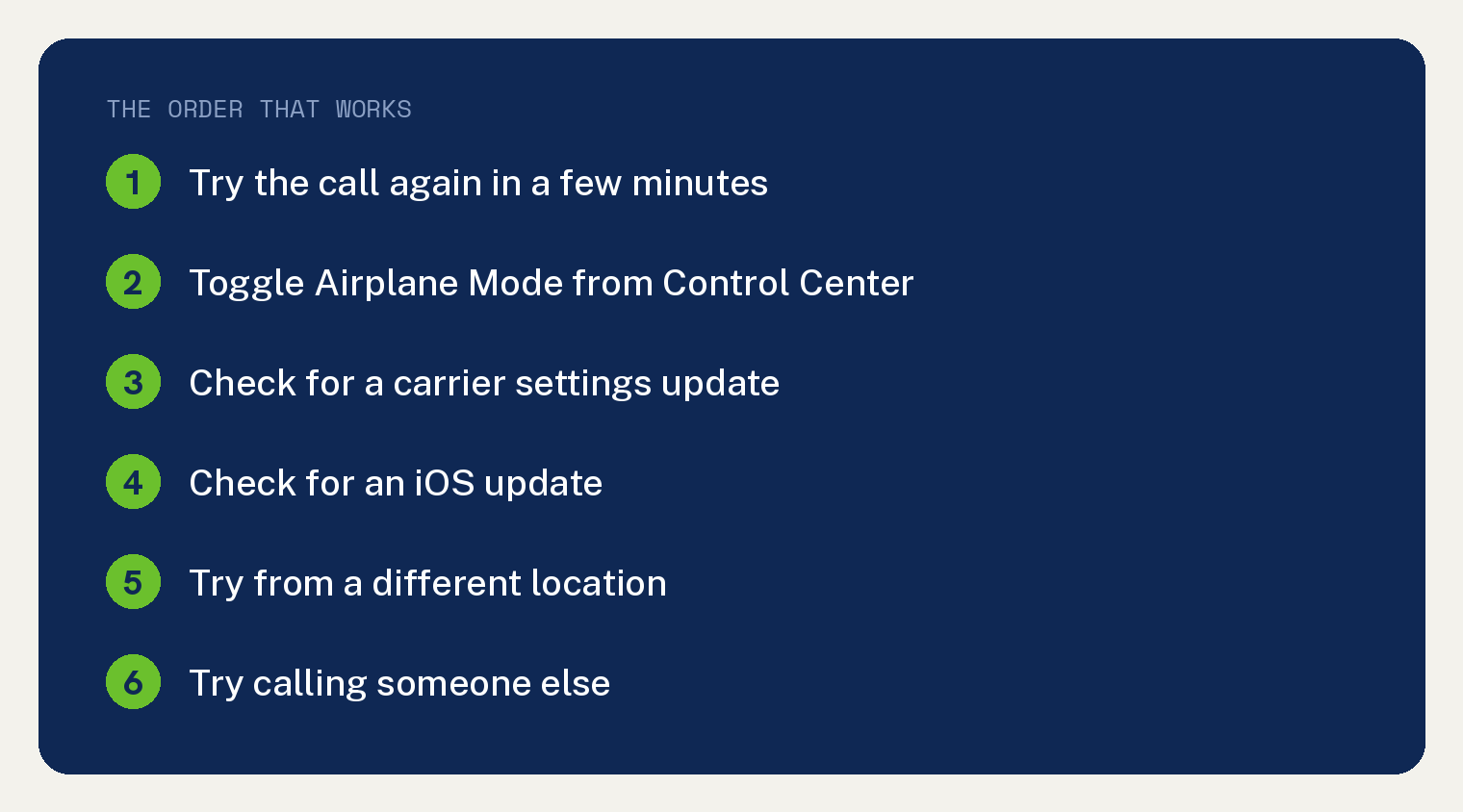
- Try the call again in a few minutes. If they were on another call, this is the entire fix.
- Toggle Airplane Mode. Open Control Center, tap the airplane icon, wait five seconds, then tap it again.
- Check for a carrier settings update. Open Settings, tap General, then About. If an update is waiting, a prompt appears. The version is listed next to Carrier on that screen.
- Check for an iOS update. Settings, then General, then Software Update.
- Try from a different location. A weak signal produces odd call failures that look like the other person’s problem.
- Try calling someone else. If every call fails, it is you. If only one number fails, it is them or their carrier.
- Reset Network Settings, as a last resort. Settings, General, Transfer or Reset iPhone, Reset, then Reset Network Settings. Know what this costs you first: it resets your saved WiFi networks and passwords, your cellular settings, and your VPN and APN settings.
- Call your carrier. Ask about outages and whether anything is blocking outbound calls on your line.
If step 6 shows every call failing, our guide on telling whether your iPhone is GSM or CDMA can help you work out whether the handset matches the network you are on.
Does User Busy happen on FaceTime?
You will find articles saying it does, and that it means the other person has not set up FaceTime.
We could not verify that against any Apple source, and it does not hold together technically. FaceTime runs over the internet, and a carrier cause code has no path into it.
What Apple does document is simpler: a FaceTime call can be declined, and a missed FaceTime audio call can go to voicemail when Live Voicemail is on.
So we are not going to repeat the FaceTime explanation. If a FaceTime call is not going through, that is a different problem with different causes.
What should the other person check?
If it is someone you can text, this is the useful list to send them.
- Are they on another call right now?
- Is Call Forwarding on? Settings, then Apps, then Phone, then Call Forwarding.
- Is Call Waiting off on their carrier plan? Call Waiting and Call Forwarding are GSM features, so they may not apply on every network.
- Is your number in their Blocked Contacts? Settings, then Apps, then Phone, then Blocked Contacts. In current iOS it also lives at Settings, then Privacy & Security, then Blocked Contacts.
- Is call screening on, which sends unsaved numbers straight to voicemail?
That call screening one is worth a note. Current iOS handles unknown callers through a Screen Unknown Callers control under Settings, then Apps, then Phone, with choices for how unsaved numbers are handled. Silence Unknown Callers still exists too, but for FaceTime, which is why you may see both names.
Frequently asked questions
Does User Busy mean I have been blocked?
No. Apple documents that a blocked caller can still leave a voicemail and that the person you called gets no notification. Nothing in Apple’s documentation connects blocking to this message, so it is not proof of anything.
Does User Busy mean they hit decline?
No. Declining sends the call to voicemail, and the phone network uses a different code for a rejected call than it does for a busy one. Apple does note that in some countries or regions declined calls are disconnected without going to voicemail.
Why does it say User Busy instead of just ringing?
Because the network got an answer back saying the call could not be completed, so it never rang. A busy result is a definite answer, which is why it comes back fast instead of ringing out.
Can I do anything to force the call through?
No. If the far end cannot take another call, no setting on your phone changes that. Wait a few minutes and try again, or send a text.
Why do I get User Busy on every call I make?
That points at your line rather than theirs. Toggle Airplane Mode, check for a carrier settings update, and if it persists, call your carrier about outages or a block on your account.
If calls are getting through but texts are not, our fixes for an iPhone not getting verification texts cover that separately. If you are trying to stop someone from reaching you rather than reach them, here is how to block a number on iPhone and exactly what the other person sees.
And if your notifications are arriving silently rather than not at all, our guide on what Deliver Quietly means and where it went explains that setting.