
How to Add More Storage to an iPad: Space, iCloud, a Drive
None of the three Apple storage pages this article draws on prints a slot or an upgrade for the storage inside an iPad, so the way to add more storage to an iPad is one of three things: free up the space it has, move photos and files to iCloud, or plug in an external drive. The words internal, expand and microSD do not appear on any of them.
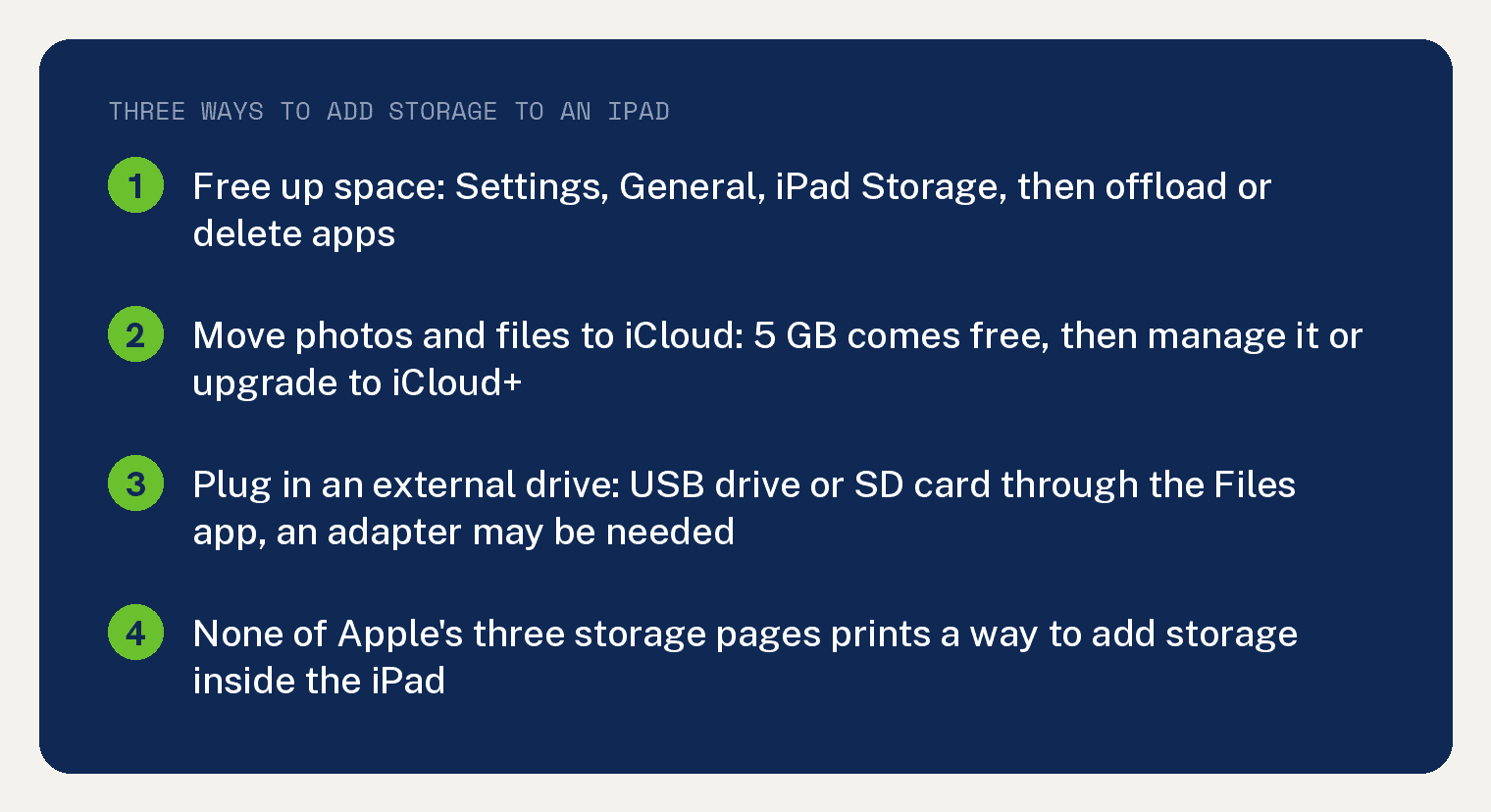
Here are the three routes in order, from the bare minimum to the fully built out setup. The middle one, iCloud, is our pick for a full iPad, because Apple names iCloud backups, iCloud Photos and iCloud Drive as what that storage holds.
Option 1: free up the storage the iPad already has
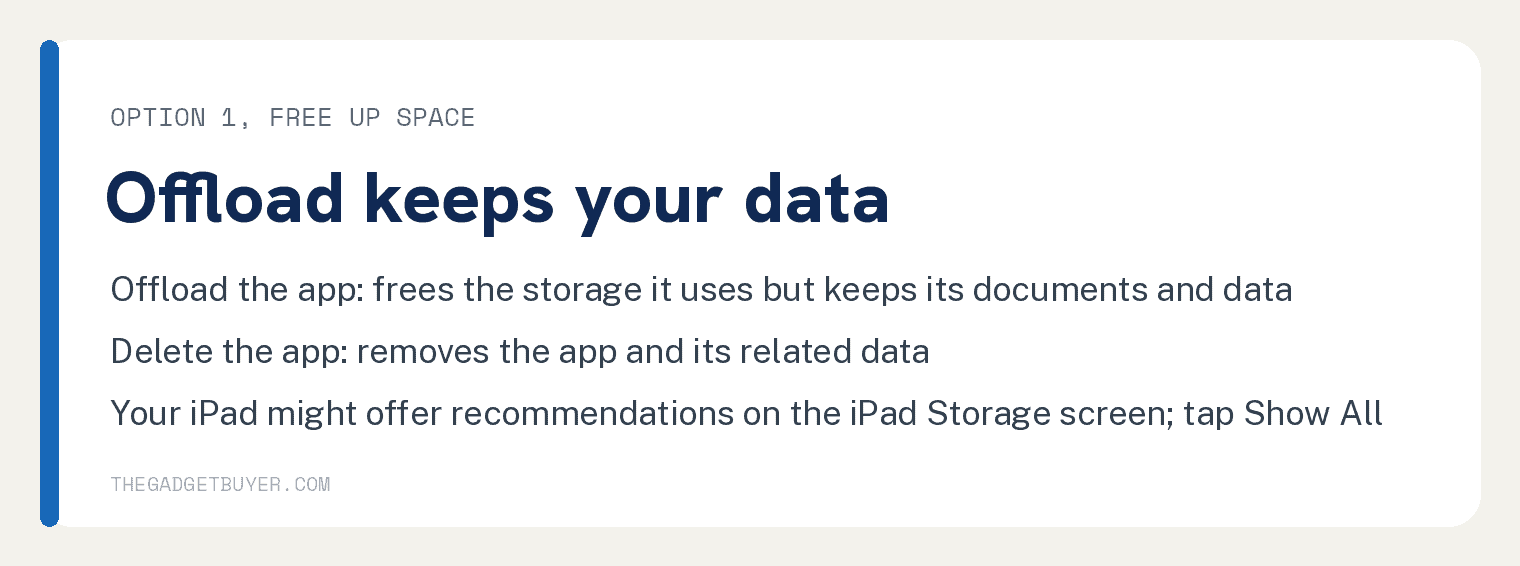
Open Settings, tap General, then tap iPad Storage, and you get Apple’s recommendations plus a list of apps with how much storage each one uses. Apple’s steps on its check storage page read “Open Settings.” then “Tap General.” then “Tap [device] Storage to see recommendations and a list of apps with their storage usage.”
Tap an app to see its detail, and from there you can offload it or delete it. Offloading keeps the app’s documents and data, in Apple’s words “Offload the app. This frees up storage used by the app, but keeps its documents and data.”
Deleting removes the app and its data, and depending on the app you might be able to delete some of its documents and data instead. Apple’s line: “Delete the app, which removes the app and its related data. Depending on the app, you might be able to delete some of its documents and data.”
Your iPad might offer its own cleanup suggestions on that screen. Tap Show All to see them, read each one, then tap Enable to turn it on or tap the suggestion to review the contents you can delete, which is the order Apple’s page gives.
Cached files are handled for you. Apple’s page says “To free up space, your device removes cached and temporary files, so you don’t have to.” and that a device low on storage removes items you can download again or do not need, such as unused apps and temporary files.
Option 2: move photos and files to iCloud, our pick for a full iPad
iCloud storage is separate from the storage built into the iPad, and Apple’s page on managing it asks: “Not sure about the difference between the storage capacity that comes with your device and iCloud storage?” You start with 5 GB free, and when that runs low you either clear space in iCloud or move up to iCloud+.
Apple’s page says the 5 GB comes automatically when you set up iCloud, and names iCloud backups, iCloud Photos and iCloud Drive among the things it holds. Its line on running low: “And if you’re running low on iCloud storage, you can manage your storage to make more space or upgrade to iCloud+.” If two devices share one Apple Account, see can I back up two iPhones to the same iCloud account.
Letting iCloud fill up has a cost. Apple lists it: “If you run out of iCloud storage, your device won’t back up to iCloud, new photos and videos won’t upload to iCloud Photos, and iCloud Drive and other iCloud apps won’t stay up to date across your devices. And you won’t be able to send or receive emails with your iCloud email address.”
On iPadOS 17 or later, iCloud settings carry a Recommended for You screen that points at things you might not need anymore, like photos, large files or old backups. Open Settings, tap your name, tap iCloud, then tap Recommended for You, which is the path Apple’s page prints for an iPad with iOS 17 or iPadOS 17 or later.
If you do not use iCloud Photos, your Photos Library sits inside your iCloud Backup. Apple’s page lists one step first: “Save your photos and videos to your computer, then manually back up your device.”
Then it gives the choice in one sentence: “If you want to keep your photos and videos on your device, you can turn off Photos in Backup or upgrade to iCloud+ for more storage.” Apple’s manage storage page prints no iCloud+ price; it carries the link “Learn how to upgrade to iCloud+”.
Option 3: plug in an external drive, the fully built out setup
An iPad reads USB drives and SD cards through the Files app and other supported apps. Apple’s external storage page opens with “You can use the Files app and other supported apps to access files stored on external devices, such as USB drives and SD cards, connected to your iPad.”
Attach the drive or card reader to the charging port using a compatible connector or adapter. Depending on the iPad model and the device, Apple says you may need one of four adapters, all sold separately: the Lightning to USB Camera Adapter, the Lightning to USB 3 Camera Adapter, the USB-C to SD Card Camera Reader or the Lightning to SD Card Camera Reader.
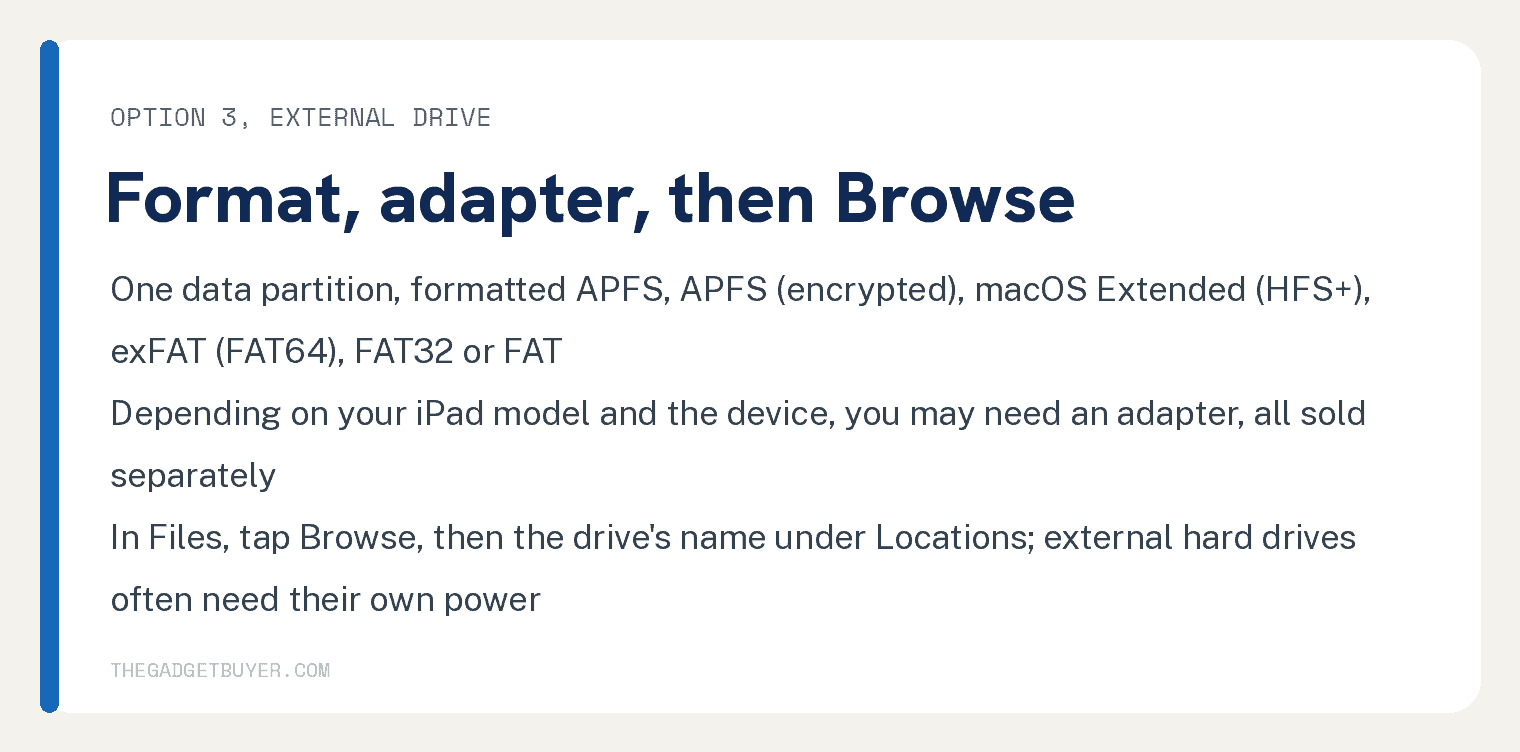
The drive needs a single data partition and a format the iPad reads. Apple’s note lists them: “it must be formatted as APFS, APFS (encrypted), macOS Extended (HFS+), exFAT (FAT64), FAT32, or FAT.” and adds that you change a drive’s formatting with the Files app on iPad or on a Mac or PC.
To find the drive, open Files, tap Browse at the bottom of the screen, then tap the device’s name under Locations. Apple adds “If you don’t see Locations, tap Browse again at the bottom of the screen.”
External hard drives are the catch. Apple’s page says “External hard drives often require an external power source when used with iPad.” and gives two answers: a powered USB hub on models that support Thunderbolt or USB 4, and on an iPad with a Lightning connector the Lightning to USB 3 Camera Adapter connected to a USB power adapter.
An external drive is a place for files, and Apple’s page prints nothing about installing apps on one. When you are done, disconnecting is removing it from the charging port.
Which option is right for you?
If the iPad is a little full, start with Option 1, because offloading an app keeps its documents and data. If photos and videos are what fill the iPad, Option 2 is our pick, since iCloud Photos is one of the things Apple names for that storage.
Option 3 fits people who carry big files and do not mind a drive and, depending on the iPad model and the drive, an adapter. Which iPad model you have is part of whether you need an adapter, so see iPad generations to check yours, and see can you transfer apps to iCloud storage for the app side of iCloud.
Where Apple’s pages stop
None of the three pages prints a way to add storage inside the iPad. The words internal, expand, expandable and microSD do not appear on any of them.
Apple’s external storage page prints no size limit for a drive. The one use of the word maximum on that page is the feedback form’s character limit, and the words TB, GB, capacity and size do not appear in its text.
Frequently asked questions
Can you add a memory card to an iPad?
Only as an external device. Apple’s external storage page covers SD cards through a card reader attached to the charging port, and the only slot it names is the one on the reader.
What happens when you offload an app?
It removes the app but keeps its documents and data, so the space comes back without losing your files. Apple’s words: “Offload the app. This frees up storage used by the app, but keeps its documents and data.”
Does an external drive need its own power?
Apple says external hard drives “often require an external power source when used with iPad.” Its two answers are a powered USB hub on models that support Thunderbolt or USB 4, and the Lightning to USB 3 Camera Adapter connected to a USB power adapter on a Lightning iPad.