
Ways To Tell How Much Memory Your iPhone Has Without Digging Through Settings
Ever wonder how much space you actually have left on your iPhone? Maybe you’re trying to download a new app and suddenly hit a wall, or your phone keeps nagging you with “Storage Almost Full” notifications. It’s frustrating when you don’t know what’s eating up all your space or how to even check what’s going on.
The good news is that checking your iPhone’s memory is easier than you think, and there are multiple ways to do it right from your device. You don’t need to be a tech expert or dig through complicated settings. Whether you want to see your total storage, figure out which apps are hogging space, or understand how much RAM your phone has, there are simple methods that work for everyone.
This guide will walk you through all the ways you can check your iPhone’s memory, from the built-in Settings app to helpful third-party tools. You’ll also learn the difference between storage and RAM so you know exactly what you’re looking at. By the end, you’ll feel confident managing your iPhone’s space like a pro.
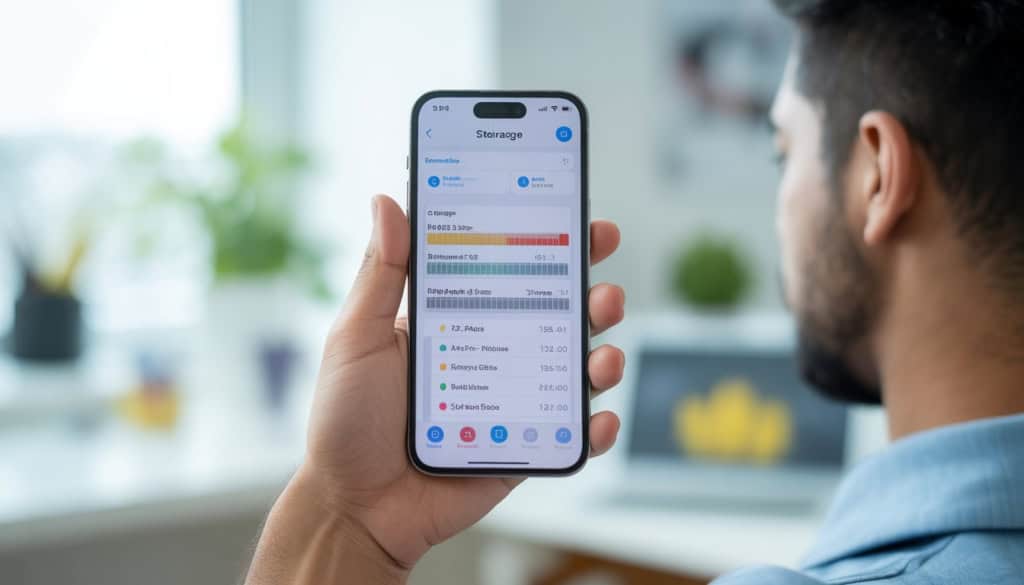
1) Check iPhone Storage in Settings > General > iPhone Storage
You know that moment when your phone tells you it’s out of space right as you’re trying to take a photo? Yeah, we’ve all been there. The good news is that checking how much memory you have left is actually super easy.
Just open your Settings app. It’s the gray icon with gears that you probably tap into more often than you’d like to admit.
Once you’re in Settings, scroll down a bit and tap on General. From there, you’ll see an option called iPhone Storage. Go ahead and tap that.
Now here’s where you need a tiny bit of patience. Your iPhone needs a moment to calculate everything. You’ll see a colorful bar at the top that shows what’s eating up your space. Below that, there’s a detailed breakdown of your storage usage showing exactly which apps and files are taking up room.
Think of it like opening your closet and actually seeing how much space each pile of clothes takes up. Suddenly it makes sense why you can’t fit anything new in there.
The list shows your apps in order from biggest to smallest. You might be surprised to see which ones are the storage hogs. That game you haven’t played in months? It could be sitting there taking up several gigabytes.
This screen also shows you how much total storage capacity your iPhone has and how much is still available. It’s like checking your bank account, but for phone space instead of money.
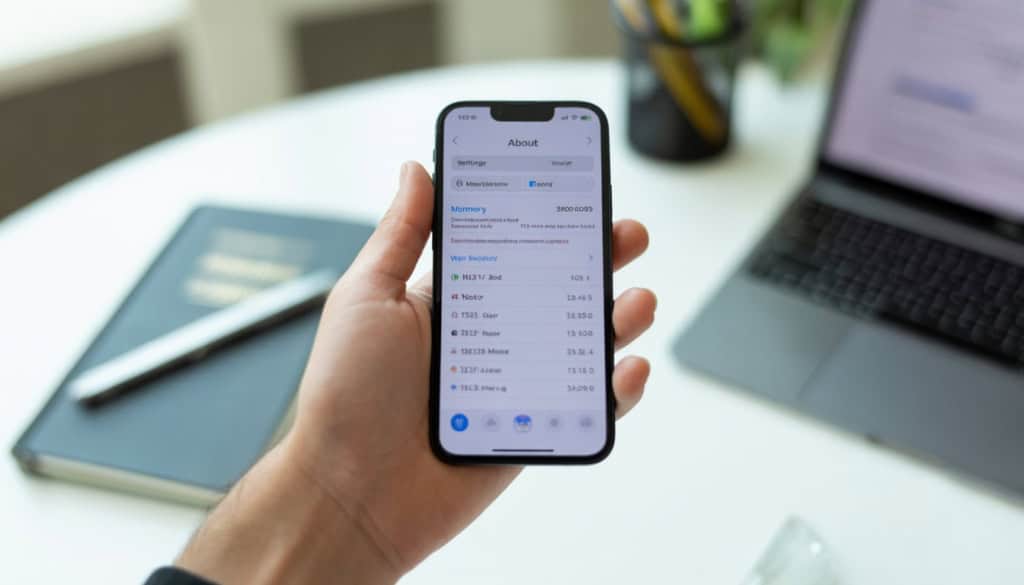
2) Look up RAM size in Settings > General > About > Memory
Okay, I need to be straight with you here. This path doesn’t actually exist on your iPhone.
If you go to Settings > General > About, you’ll see tons of useful info about your phone. You’ll find your model name, storage capacity, and software version. But here’s the thing: Apple doesn’t show RAM details in the Settings app at all.
It’s like Apple decided to keep that information behind the curtain. They don’t make it easy to check how much memory your iPhone has because they don’t think you need to worry about it. They want the phone to just work without you having to think about the technical stuff.
You can see how much storage space you have using Task Manager-style tools, but RAM is different. Storage is where your apps and photos live. RAM is like your phone’s short-term memory that helps everything run smoothly in the moment.
So if you were hoping to find a Memory section in your About menu, it’s not going to be there. Apple keeps RAM specs off the main menu entirely.
Don’t feel bad if you went looking for it. A lot of people assume it should be there since storage info is right there in Settings. It makes sense that RAM info would be nearby too.
The good news? There are other ways to find out how much RAM your iPhone has. You just need to look outside the Settings app or check Apple’s official specs for your specific model online.
3) Use the Files app to see how much space your documents take
You know that Files app on your iPhone? The one that looks like a little blue folder? It’s not just for opening PDFs or finding that recipe you downloaded last week.
It can actually help you figure out how much space your documents and downloads are hogging. Think of it like opening your closet to see which boxes are taking up the most room.
The Files app is where you can access files stored in iCloud Drive and other cloud services. But it also shows you what’s living on your actual phone. When you open it up and browse through your folders, you can tap and hold on any file or folder to see details about it, including its size.
This is super helpful if you’ve been downloading tons of work documents, school papers, or memes. Those files add up faster than you’d think.
The Files app lets you manage and organize all your documents from one place, whether they’re stored locally on your phone or up in the cloud. You can even delete stuff right from the app if you find something you don’t need anymore.
It won’t show you every single thing taking up space on your phone. Apps, photos, and system files live elsewhere. But for documents specifically, it’s a quick way to peek at what’s piling up without diving into your full storage settings.
4) Connect your iPhone to a Mac and check storage via Finder
If you’ve got a Mac lying around, this method feels a little more official. It’s like getting a behind-the-scenes tour of your iPhone’s storage situation.
First, grab a USB cable and plug your iPhone into your Mac. Once it’s connected, open Finder. You’ll see your iPhone pop up in the sidebar on the left, usually under “Locations.”
Click on your iPhone’s name. The main window will show you a colorful storage bar at the bottom that breaks down what’s hogging your space—apps, photos, system files, and more. It’s pretty detailed and way easier to read than scrolling through Settings on your phone.
You can also use Finder to sync your iPhone and manage backups while you’re at it. Think of Finder as Mission Control for your iPhone when it’s connected to your Mac.
This method is great if you want a bigger screen view of what’s going on. Plus, if you’re already sitting at your computer, it saves you from squinting at your phone screen. The visual breakdown is super helpful when you’re trying to figure out which app is secretly eating up 20GB of storage.
Once you’re done checking, just unplug your iPhone. No syncing required unless you actually want to move files around. It’s a quick peek under the hood without any commitment.
5) Open iTunes on Windows and view device storage details
If you’re on a Windows computer, you’re probably stuck using iTunes. Yes, it’s still around in 2026, and yes, it still feels like a relic from another era. But the good news is checking your iPhone storage through iTunes is actually pretty simple once you know where to look.
First, grab your charging cable and plug your iPhone into your computer. Make sure your phone is unlocked or it won’t show up properly. Then open iTunes and wait for it to recognize your device.
Once your iPhone appears in iTunes, click on the little phone icon near the top left. You’ll land on a summary page that shows basic info about your device. Scroll down a bit and you’ll see a colored bar graph near the bottom of the screen.
That bar is your storage breakdown. It shows how much space your apps, photos, music, and other stuff are taking up. Each category gets its own color, so you can see at a glance what’s hogging all your memory.
It’s not the prettiest interface, and it’s definitely not as smooth as what Mac users get. But it does the job. You can hover over each section of the bar to see exact numbers for each category.
This method works great if you want a detailed look at your storage without digging through your phone’s settings. Plus, if you’re already using iTunes to back up your device, you’re already halfway there.
6) Use third-party apps like Device Monitor to check RAM info
Sometimes the built-in iPhone settings just don’t cut it when you want the full picture of what’s going on inside your phone. That’s where third-party apps come in handy.
Apps like Device Monitor Z give you a quick look at your iPhone’s RAM usage in real time. Think of it like getting a backstage pass to your phone’s performance. You can see how much memory you’re actually using right now, not just what you started with.
These apps are pretty simple to use. You download them from the App Store, open them up, and boom—there’s your RAM info right on the screen. Device Monitor Z shows you detailed RAM stats along with other useful stuff like CPU usage and storage space.
The cool part? You don’t need to dig through settings or remember secret codes. Everything’s laid out in one place, usually with charts or graphs that make sense at a glance.
Some of these monitoring apps even let you track your memory usage over time. So if your phone’s been acting sluggish lately, you can see if RAM might be the culprit.
Just a heads up though—most of these apps show you how much RAM you’re currently using, not necessarily the total amount your iPhone has installed. That’s still useful info, but it’s a slightly different number than what we talked about in earlier sections.
The best part? Most of these apps are free to download. You might see some in-app purchases for extra features, but the basic RAM monitoring usually doesn’t cost a thing.
7) Review storage breakdown by app in Settings > iPhone Storage
Want to see exactly which apps are hogging all your space? This is where the magic happens.
Open your Settings app and tap General. Then tap iPhone Storage. You’ll land on a page that shows you everything.
At the top, there’s a colorful bar that breaks down your storage by category. Think of it like a pie chart for your phone’s closet. You’ll see how much space goes to apps, photos, messages, and other stuff.
Scroll down a bit and you’ll find a list of every single app on your phone. Each one shows how much space it’s using right next to its name. The biggest space hogs sit at the top of the list.
This breakdown is super helpful because it shows you two things. First, there’s the app itself. Second, there’s all the data that app has stored over time.
For example, your messaging apps might be taking up way more space than you thought because of all those photos and videos you’ve sent and received. Your social media apps might be packed with cached images.
Tap on any app in the list to see even more details. You’ll find out when you last used it and get options to delete the app or clear out some of its data. This is where you can really start making smart decisions about what stays and what goes.

8) Check storage usage for photos via the Photos app settings
Your photos might be the biggest space hog on your iPhone, but figuring out exactly how much room they’re taking up isn’t always obvious. The good news? There’s a spot in your settings where you can see the real numbers.
Head to your Settings app and tap on General, then iPhone Storage. Scroll down until you see the Photos app listed. This shows you how much space your photos and videos are actually using on your device right now.
Here’s where it gets interesting. If you have iCloud Photos turned on, you might see two different numbers. One tells you how much space the photos take up on your phone. The other shows how much they’re using in iCloud.
The magic happens when you enable a feature called Optimize iPhone Storage. This keeps smaller versions of your photos on your phone while storing the full-quality versions in iCloud. Think of it like keeping a photo album of thumbnails in your pocket while the big prints stay safe at home.
To turn this on, go to Settings, tap Photos, and toggle on Optimize iPhone Storage. You’ll need iCloud Photos enabled first for this to work.
This method gives you specific information about your photo storage, which helps you decide if you need to delete some old screenshots or back things up somewhere else. No guessing required.
9) Look at available space shown during app downloads or updates
Ever been about to download a new app and gotten hit with that dreaded “Cannot Download App” message? That’s actually your iPhone trying to do you a solid by letting you know you’re running low on space.
When you tap to download or update an app from the App Store, your iPhone does a quick storage check behind the scenes. If there’s not enough room, you’ll see a pop-up that tells you exactly how much space you need and how much you have left. It’s like your phone gently tapping you on the shoulder and saying, “Hey, we might have a problem here.”
This is one of the easiest ways to get a quick snapshot of your storage situation without digging through settings. You don’t have to do anything special. Just try to grab an app, and your iPhone will show you the math.
The message usually appears right when you tap “Get” or “Update.” It’ll say something like “This app requires 2.5 GB, but only 1.8 GB is available.” That’s your cue that it’s time to do some digital spring cleaning.
You can also see a simplified version of this info right on the app’s page in the App Store. Look under the app name and you’ll spot how big it is. Compare that to what you think you have left, and you’ll know if you’re cutting it close.
It’s not the most scientific method, but it works in a pinch. And honestly, sometimes the best tech tips are the ones that just happen while you’re trying to do something else.
10) Use Apple’s Support app for a quick device summary
Apple actually makes a free app that can tell you about your iPhone without digging through a bunch of menus. It’s called the Apple Support app, and it’s designed to help you troubleshoot problems and manage your devices.
When you open the app and sign in with your Apple ID, it automatically detects your iPhone and shows you a summary of your device. You’ll see your model name, serial number, and warranty status right away.
The cool part is that you can tap on your device to see more details. The app gives you access to solutions for all of your Apple products in one place. While it won’t show your storage in giant letters on the main screen, it helps you understand what device you have.
This is especially helpful if you’re trying to figure out which iPhone model you own. The app pulls that info directly from Apple’s servers, so you know it’s accurate.
You can also use the app to chat with Apple support if you need more help. They can walk you through checking your storage or answer questions about your specific model.
Think of it as having an Apple Store employee in your pocket. It’s free, easy to use, and connects directly to your device’s information. If you’re someone who likes having all your Apple stuff in one spot, this app is worth downloading.
Why iPhone Memory Matters
Your iPhone’s memory controls how many apps you can download, how many photos you can take, and whether your phone will keep running smoothly or start acting weird on you.
What iPhone Storage Does for You
Think of your iPhone’s storage like a closet. Everything you own has to fit inside it—your apps, photos, videos, text messages, even the operating system itself.
When you take a photo, it goes in the closet. When you download TikTok, it takes up space. When you record a video of your dog doing something adorable, that needs room too.
Your iPhone storage holds:
- All your photos and videos
- Every app you’ve downloaded
- Text messages and attachments
- Music and podcasts
- System files that make your phone work
The problem is that closet doesn’t get bigger. If you bought an iPhone with 64GB of storage, that’s all you get forever. You can’t add more like you would on a computer.
How Memory Impacts What You Can Do
When your storage gets full, your iPhone starts acting like a cranky toddler. You’ll see that dreaded “Storage Almost Full” message pop up at the worst times.
You won’t be able to take new photos. Apps might crash or refuse to update. Your phone could slow down because it needs some breathing room to work properly.
Checking your iPhone’s storage helps you avoid these problems before they start. You can see which apps are hogging space and delete the ones you don’t use. You can back up old photos to the cloud and remove them from your phone.
Running out of memory means missing moments you wanted to capture. It means apps that won’t download or updates that won’t install. Understanding how much memory your iPhone has gives you control over what stays and what goes.
Understanding iPhone Storage vs. RAM
Your iPhone actually has two different types of memory working behind the scenes, and mixing them up is one of the easiest ways to get confused when shopping for a new phone or trying to figure out why yours feels sluggish.
Storage and RAM: What’s the Difference?
Think of your iPhone like a desk where you do your work. Storage is like the filing cabinet next to your desk. It holds all your stuff—photos, apps, videos, messages, everything. When you buy a 128 GB or 256 GB iPhone, that number tells you how big your filing cabinet is.
RAM is completely different. It’s the actual desk surface where you’re working right now. RAM holds the apps and tasks you’re currently using. When you switch between Instagram, Messages, and Safari, RAM keeps those apps ready so you don’t have to reload them from scratch every time.
Here’s where it gets confusing: you can check your iPhone’s storage anytime in Settings, but Apple doesn’t show you how much RAM your phone has. They build in what they think you need based on your model. Newer iPhones have more RAM to handle fancy features like multiple apps running at once.
Why Both Kinds of Memory Matter
Storage affects how much you can keep on your phone. Run out of storage, and you can’t take new photos or download apps. It’s frustrating when you’re trying to capture a moment and your phone says “Storage Full.”
RAM affects how fast your phone feels. RAM impacts your iPhone’s performance when switching between apps or using demanding features. Low RAM means apps reload more often, your phone feels slow, and multitasking becomes annoying.
You can always delete photos or apps to free up storage. But you can’t upgrade RAM—it’s built into your phone permanently. That’s why understanding both storage and RAM helps you pick the right iPhone from the start.
Memory and storage are different terms, so the use of the term memory referring to storage was a bit confusing while reading this article. Memory is another form of rapid storage in an iPhone which is usually a lot smaller than the SSD (solid state disk) on most iPhones today (2024). Modern high-end desktop computers have 32 GB of memory on average today.
You are confusing memory with storage
Thanks for pointing out our error. It was sent back for a rewrite.